



AI Automation Market (By Automation Type: Intelligent Process Automation, Conversational AI Automation, Cognitive Decision Automation, Autonomous Systems Automation, and Generative AI-based Automation; By Deployment: Cloud, Hybrid, and On-premises; By Enterprise Size: Large Enterprises and SMEs; By Integration Mode; By Vertical; By Region: North America, Europe, Asia-Pacific, and LAMEA) Industry Size, Share, Growth, Trends 2026 to 2035.

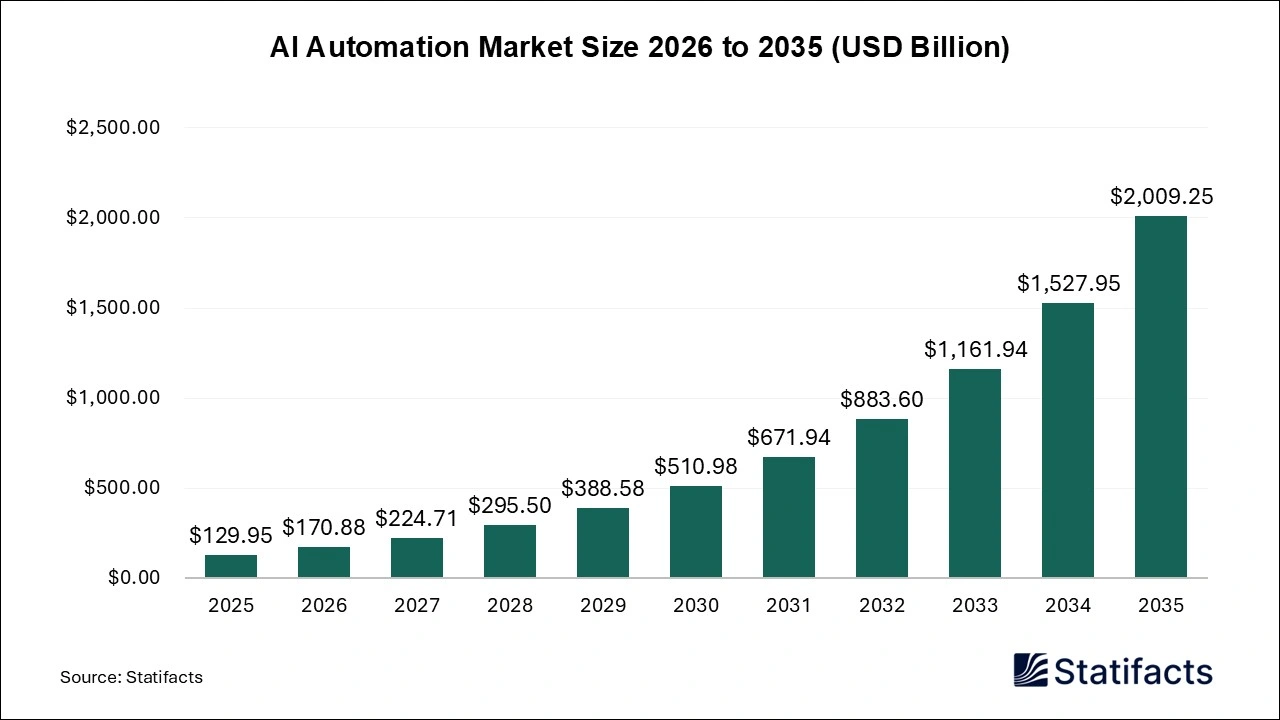
The global AI automation market reached USD 129.95 billion in 2025 and is projected to soar to USD 2,009.25 billion by 2035, expanding at a CAGR of 31.50%, driven by rapid digital transformation and rising adoption across industries.
| Reports Attributes | Statistics |
| Market Size in 2025 | USD 129.95 Billion |
| Market Size in 2026 | USD 170.88 Billion |
| Market Size in 2032 | USD 883.6 Billion |
| Market Size by 2035 | USD 2,009.25 Billion |
| CAGR 2026 to 2035 | 31.50% |
| Base Year | 2025 |
| Forecast Period | 2026 to 2035 |
The AI automation is a unification of automated systems, and AI is built to perform human-like tasks at the factories and operation sites. It’s a robust combination of NLP and ML for identifying patterns at operational sites and analysing huge data to confirm and proceed with the respective favorable action. AI’s computational vision is a huge support to the medical sector for medical imaging. The famous chatbots are a source for new ideas and smart interventions to discover solutions quickly.
The demand for employing predictive maintenance in manufacturing settings has evolved the market strength, enabling it to prove the potential of its promising features. In the healthcare sector, clinical decisions are extremely crucial, and the drug discovery volume has been accelerating consistently with growing health conditions. The AI automation is a seamless choice for this sector to fulfill its promise towards the patients’ health.
The banking and finance sector is known for its confidential task to keep customers' identities and valuable details safe, but in case of spam or any other unfavourable scenario, AI works as a real-time fraud detector. Its automated risk evaluation acts as an alert alarm for the bank. The customer service job has now been automated with chatbots and AI agents. Overall, the popularity of AI and its utilisation in almost all industries is elevating the expansion and footprint of the AI automation market.
Covering all the districts, the sports event market is expanding at great speed, with the bridge to smart deals and sports publicity. The FIFA World Cup 2026 and Milano-Cortina Winter Olympics are famous sports events in the history of sports. The tech unification adds more value and strength via its AI agent employment for managing the events workflow.
| Regions | Shares (%) |
| North America | 35% |
| Europe | 25% |
| Asia Pacific | 30% |
| LAMEA | 10% |
| Segments | Shares (%) |
| Intelligent Process Automation | 22% |
| Conversational AI Automation | 18% |
| Cognitive Decision Automation | 17% |
| Autonomous Systems Automation | 16% |
| Generative AI-based Automation | 27% |
| Segments | Shares (%) |
| Cloud | 55% |
| Hybrid | 25% |
| On-premises | 20% |
| Segments | Shares (%) |
| Large Enterprises | 65% |
| SMEs | 35% |
| Segments | Shares (%) |
| API-Based / Modular Integration | 40% |
| Embedded AI Automation | 35% |
| Standalone Intelligent Platforms | 251% |
Published by Yogesh Kulkarni





