

Share


Acetic Acid Market (By Application: Vinyl Acetate Monomer, Acetic Anhydride, Acetate Esters, Purified Terephthalic Acid, Ethanol, and Other Applications; By Region: North America, Europe, Asia Pacific, and LAMEA) Industry Size, Share, Growth, Trends 2026 to 2035

The global acetic acid market, valued at USD 15.96 million in 2025, is projected to reach approximately USD 33.24 million by 2035. Growing demand from chemicals, plastics, and industrial manufacturing is expected to drive steady expansion at a CAGR of 7.61%.
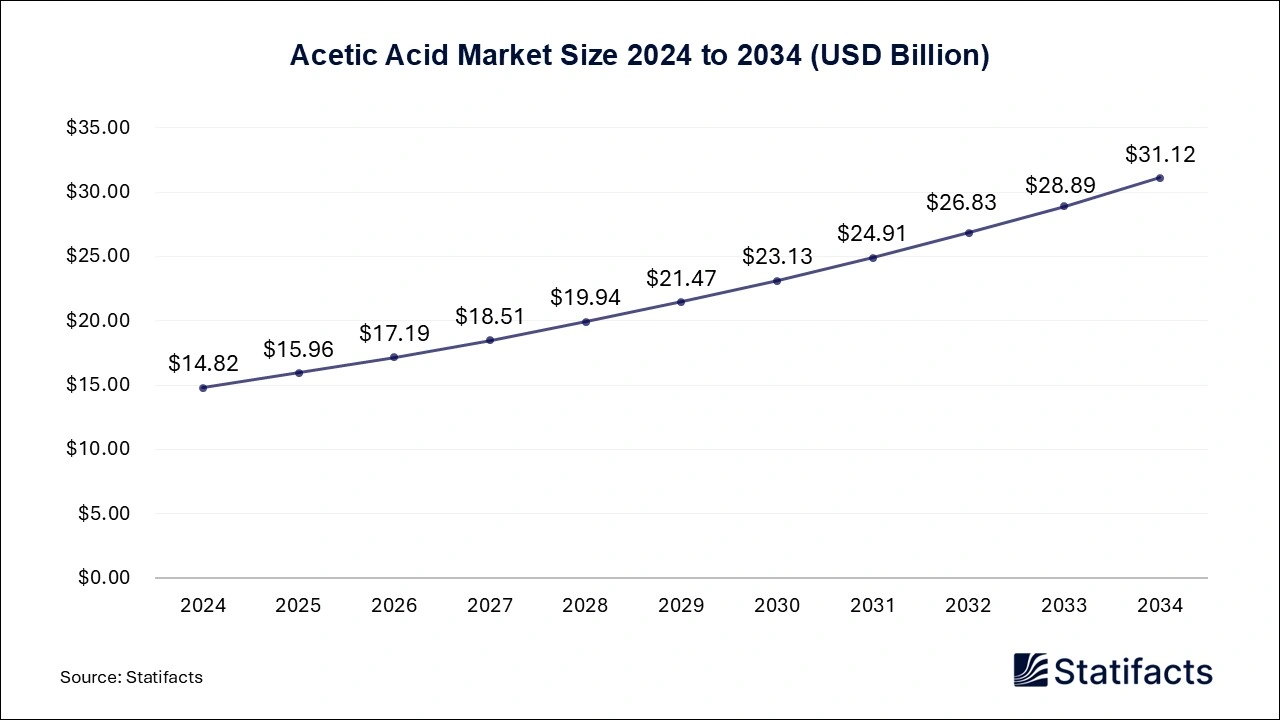
| Reports Attributes | Statistics |
| Market Size in 2025 | USD 15.96 Billion |
| Market Size in 2026 | USD 17.19 Billion |
| Market Size in 2032 | USD 26.83 Billion |
| Market Size by 2035 | USD 33.24 Billion |
| CAGR 2026 to 2035 | 7.61% |
| Base Year | 2025 |
| Forecast Period | 2026 to 2035 |
The acetic acid market is expanding rapidly due to rising demand for vinyl acetate monomer (VAM), which is widely used in paints, coatings, adhesives, and films. This has also been driving significant investment in the methanol market, as methanol is crucial for producing acetic acid. Additionally, rising demand in the construction and packaging industries is driving strong demand for acetic acid across multiple applications. The use of acetate fibers and PET plastics also plays a key role in attracting significant demand through the textile and food packaging applications.
The business flow of acetic acid depends on the methanol market, which is heavily reliant on crude oil prices and may also increase overall production costs. The rising geopolitical tensions are crucial to the fluctuating prices and supply chain disruptions. This further increases the overall cost of the required products across multiple industries and hampers the companies' profit margins.
The future of the acetic acid market is expected to offer major opportunities, as the industry has shifted its focus to bio-based acetic acid produced from renewable biomass. This initiative is expected to create crucial business opportunities for companies focusing on reducing carbon emissions. The growing demand for food and beverage applications is also expected to attract a new user base. For instance, acetic acid is a crucial component of vinegar, which might attract businesses in the food processing industry.
The rapid investments by companies in emerging economies such as China, Indonesia, India, and others are expected to create numerous business opportunities for new entrants. Additionally, the methanol market in these well-established regions acts as a positive factor for companies in the acetic acid market. The packaging and textile production are expected to be a game-changer for the region in the coming years. Other regions, such as the Middle East, are expected to grow more rapidly as chemical processing and infrastructure development support their development.
The manufacturing industry is highly focused on investing in technologies such as Artificial Intelligence (AI) and Machine Learning (ML), as they help monitor parameters such as temperature, pressure, catalyst activity, and more during methanol carbonylation. This is further helping companies optimize yield and reduce waste generation in their plants. Moreover, AI-powered monitoring systems are gaining wider popularity across multiple industries for their ability to predict equipment failures and reduce downtime.
| Regions | Shares (%) |
| North America | 24.76% |
| Asia Pacific | 2.02% |
| Europe | 43.76% |
| LAMEA | 29.46% |
| Segments | Shares (%) |
| Vinyl Acetate Monomer | 14.52% |
| Acetic Anhydride | 31.03% |
| Acetate Esters | 36.85% |
| Purified Terephthalic Acid | 2.80% |
| Ethanol | 11.27% |
| Other Applications | 3.52% |
Published by Vidyesh Swar





