

The global 4G security camera market, valued at USD 1,124 million in 2024, is projected to reach USD 3,522 million by 2034, growing at a CAGR of 12.1% driven by increasing demand for remote surveillance and enhanced security solutions across residential and commercial sectors.
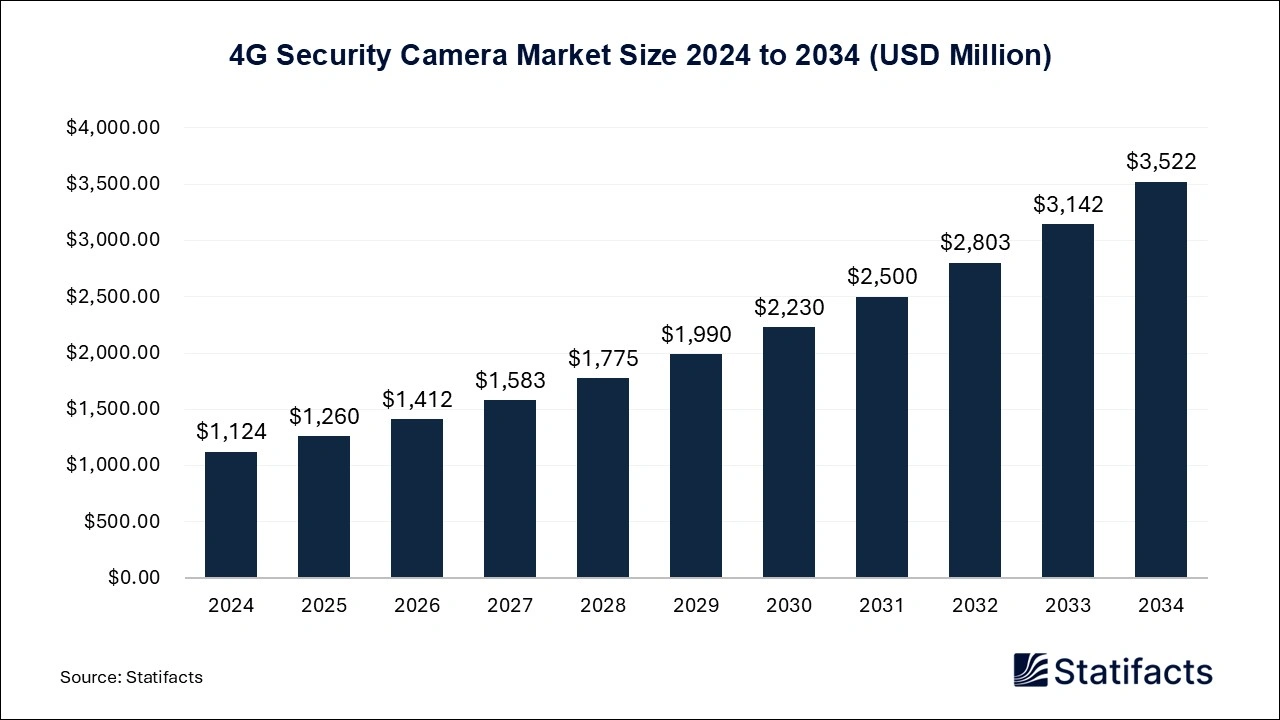
4G Security Camera Market Statical Scope
| Reports Attributes |
Statistics |
| Market Size in 2024 |
USD 1,124 Million |
| Market Size in 2025 |
USD 1,260 Million |
| Market Size in 2031 |
USD 2,500 Million |
| Market Size by 2034 |
USD 3,522 Million |
| CAGR 2025 to 2034 |
12.1% |
| Base Year |
2024 |
| Forecast Period |
2025 to 2034 |
The 4G security camera market is growing due to rising investment in commercial and industrial security, increasing applicability in traffic surveillance, rising demand for real-time monitoring, and strict government regulations. However, the high competition among manufacturers may require alternative power sources such as solar panels, and network dependence can impact profitability. Smart city initiatives, infrastructure expansion, rising security needs, technological innovations, mobility, and remote & off-grid locations are expected to generate more business in the future.
The 4G security camera market is expected to grow rapidly due to the integration of artificial intelligence (AI). One of the main benefits of artificial intelligence AI security cameras is that they help to drive productivity for security teams and organizations. AI-based camera systems can help to remove the potential of threats and incidents being missed by a security officer due to a lack of attention, fatigue, or genuine human error.
4G Security Camera Market Share, By Region, 2024 (%)
| Regions |
Shares (%) |
| North America |
30% |
| Asia Pacific |
35% |
| Europe |
28% |
| Latin America |
4% |
| Middle East & Africa |
3% |
- Asia-Pacific – Dominates with 35% of the market, due to rapid urbanization, increased surveillance demand, and government initiatives across countries like China and India.
- North America – Captures 30%, with strong demand from both residential and commercial sectors, driven by high-tech adoption and heightened security concerns.
- Europe – Holds 28% of the market, supported by regulatory requirements and growing infrastructure investments. Slightly behind North America in growth but still a key player in the global market.
- Latin America – Accounts for 4%, reflecting lower penetration rates due to economic factors and relatively less investment in security infrastructure. Does not dominate due to these constraints.
- Middle East & Africa – Holds 3%, with limited adoption mainly due to infrastructure challenges and varying regional security priorities. Does not dominate in this market.
4G Security Camera Market Share, By Type, 2024 (%)
| Segments |
Shares (%) |
| 1080p |
50% |
| 4MP (1440p) |
20% |
| 5MP (1920p) |
15% |
| 4K (8MP) |
10% |
| Others |
5% |
- 1080p – Represents the most popular resolution for consumer-grade cameras. Dominates due to its balanced quality and affordability, making it the go-to choice for residential and commercial users.
- 4MP (1440p) – Captures 20% of the market, offering higher resolution for clearer images. Gaining momentum as demand grows for better image quality without reaching the high cost of 4K.
- 5MP (1920p) – Holds 15% of the market, offering higher clarity for mid-to-large applications. Gaining traction as security needs evolve toward more detailed footage for surveillance systems.
- 4K (8MP) – Accounts for 10% of the market, providing ultra-high-definition resolution. Gaining momentum as technology becomes more affordable, particularly in high-end commercial and industrial security.
- Others – Comprises 5% of the market, including resolutions not as commonly used. Does not dominate due to niche applications and limited adoption compared to the major resolutions.
4G Security Camera Market Share, By Application, 2024 (%)
| Segments |
Shares (%) |
| Residential Security |
40% |
| Commercial Security |
35% |
| Public Safety |
15% |
| Industrial Security |
10% |
- Residential Security – Dominates with 40% of the market share, driven by rising concerns about home safety and the growing affordability of security cameras.
- Commercial Security – Holds 35% of the market, reflecting strong demand from businesses for robust security systems to protect assets and premises.
- Public Safety – Represents 15% of the market, with increasing use of cameras for urban surveillance and law enforcement. Gaining momentum as public safety measures become a higher priority for governments.
- Industrial Security – Accounts for 10%, driven by the need for surveillance in high-risk environments like factories and warehouses. Does not dominate, as industries are gradually shifting to smarter, AI-powered systems.
Published by
Vidyesh Swar



