

Share


LISIM BOPA Film Market (By Type: Single-side Corona, Both-side Corona; By Application: Food, Pharmaceuticals, Household Goods, Electronics, Others; By Region: North America, Europe, Asia-Pacific, Latin America, Middle East and Africa) Industry Size, Share, Growth, Trends 2026 to 2035.

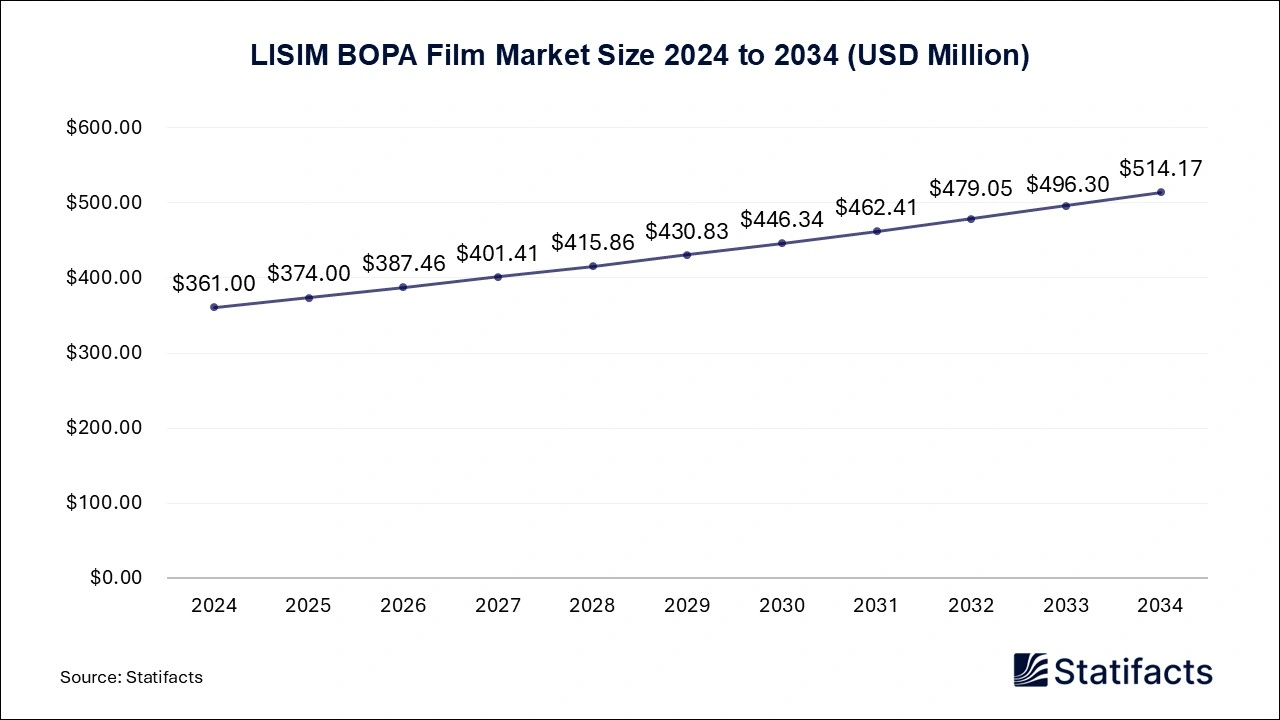
The global LISIM BOPA film market, valued at USD 374 million in 2024, is projected to reach USD 531.63 million by 2034, growing at a CAGR of 3.58% driven by rising demand for flexible, durable, and high-barrier packaging in food and pharmaceutical sectors.
| Reports Attributes | Statistics |
| Market Size in 2025 | USD 374 Million |
| Market Size in 2026 | USD 387.46 Million |
| Market Size in 2032 | USD 479.05 Million |
| Market Size by 2035 | USD 531.63 Million |
| CAGR 2026 to 2035 | 3.58% |
| Base Year | 2025 |
| Forecast Period | 2026 to 2035 |
LISIM BOPA films are polyamide films oriented in two directions, created using linear motor synchronous stretching technology. It offers outstanding dimensional stability, clarity, and printability, making it ideal for premium applications in the food, pharmaceutical, and functional packaging sectors. The increasing demand for adaptable packaging options in the food and beverage sector is a major factor driving the growth of BOPA films. BOPA films are preferred over alternative biaxially oriented films, such as BOPP and BOPET, due to their superior mechanical strength, increased transparency, chemical resistance, and gas barrier characteristics. Improvements in layer co-extrusion and the increasing application of the LISIM technique are enhancing the quality and performance of BOPA film.
There are opportunities to create innovative, high-barrier, and bio-based BOPP substitutes that align with consumer demands and stringent environmental standards. Targeted investments in capacity enhancement in rapidly developing areas such as the Asia-Pacific reveal considerable opportunities. Nonetheless, the market encounters hurdles such as variable raw material (polypropylene resin) prices, fierce competition causing pricing strain, and operational expenses tied to adhering to new recycling regulations, especially in markets like India.
Artificial intelligence (AI) is significantly transforming how these challenges are addressed and enhancing operational efficiency. AI and automation are utilized to enhance production parameters in real-time, minimizing waste and elevating product quality via accurate defect identification and visual evaluation. AI-powered predictive maintenance systems evaluate operational data to minimize unexpected downtime, while AI-fueled supply chain optimization enhances resilience and effectively manages inventory. Furthermore, AI can analyze market trends and consumer data to inform production planning, enabling a faster response to market shifts and customization requests.
| Regions | Shares (%) |
| North America | 30% |
| Asia Pacific | 35% |
| Europe | 25% |
| LAMEA | 10% |
| Segments | Shares (%) |
| Single-side Corona | 55% |
| Both-side Corona | 45% |
| Segments | Shares (%) |
| Food | 40% |
| Pharmaceuticals | 25% |
| Household Goods | 15% |
| Electronics | 10% |
| Others | 10% |
Published by Saurabh Bidwai





