

Share


Xenon Isotopes Market (By Type: Xenon 129, Xenon 131, Xenon 124; By Application: Medical, Research, Others; By Region: North America, Europe, Asia-Pacific, Latin America, Middle East and Africa) Industry Size, Share, Growth, Trends 2025 to 2034.

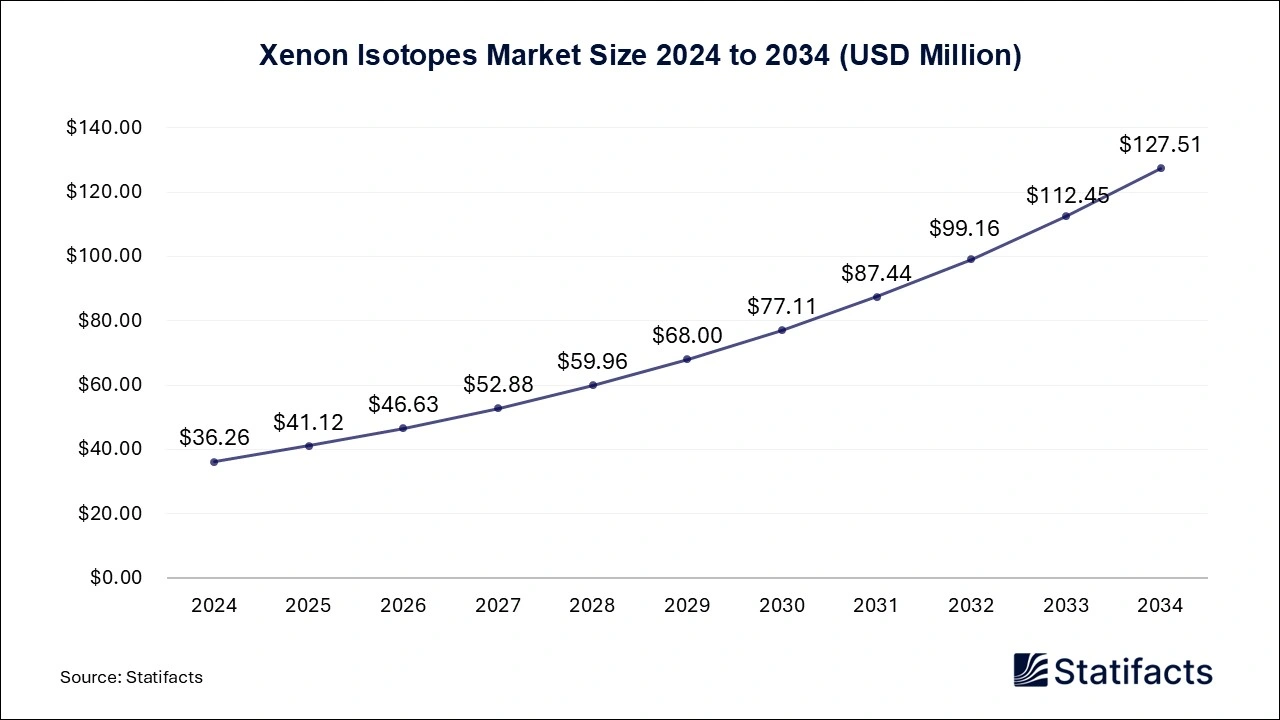
The global xenon isotopes market, valued at USD 41.12 million in 2025, is projected to reach USD 141.39 million by 2034, growing at a CAGR of 13.15% driven by increasing applications in medical imaging, nuclear energy, and environmental monitoring.
| Reports Attributes | Statistics |
| Market Size in 2025 | USD 41.12 Million |
| Market Size in 2026 | USD 46.63 Million |
| Market Size in 2032 | USD 99.16 Million |
| Market Size by 2035 | USD 141.39 Million |
| CAGR 2026 to 2035 | 13.15% |
| Base Year | 2025 |
| Forecast Period | 2026 to 2035 |
This growth is driven by rising demand in medical imaging, such as hyperpolarized xenon MRI for lung imaging, expansion of nuclear medicine and radiopharmaceuticals, and increasing adoption in scientific research in physics and tracer studies. The push for higher purity isotopes and advanced separation/purification technologies also fuels demand.
However, significant restraints include the rarity and cost of xenon, high purification and isotope separation costs, and regulatory/security constraints (given the radioactive or controlled nature of some isotopes). The supply chain is delicate, and any disruption or price volatility in raw xenon gas can strongly affect viability.
Opportunities lie in expanding applications such as new medical uses, tracer studies, quantum sensing, and advanced imaging techniques. Emerging markets (Asia, Latin America) with growing healthcare and research infrastructure may open new demand corridors. Technological advances in isotope enrichment, lower-cost purification, and novel delivery mechanisms could further broaden adoption. Artificial intelligence can significantly influence the xenon isotopes market by optimizing isotope separation and purification processes through process modeling, real-time control, and predictive maintenance.
| Regions | Shares (%) |
| North America | 12.71% |
| Asia Pacific | 19.94% |
| Europe | 38.43% |
| LAMEA | 28.93% |
| Segments | Shares (%) |
| Xenon 129 | 30.16% |
| Xenon 131 | 16.49% |
| Xenon 124 | 53.35% |
| Segments | Shares (%) |
| Medical | 10.69% |
| Research | 22.04% |
| Others | 67.27% |
Published by Saurabh Bidwai





