



UV Blocking Transparent Film Market (By Type: UV Absorber Coated Films, Nano Composite Films, Low Emissivity UV Films, Multi Layer Laminated Films, and Others; By Application: Packaging, Automotive, Construction, Electronics, and Others; By Region: North America, Europe, Asia Pacific, Latin America, and Middle East & Africa) Industry Size, Share, Growth, Trends 2026 to 2035.

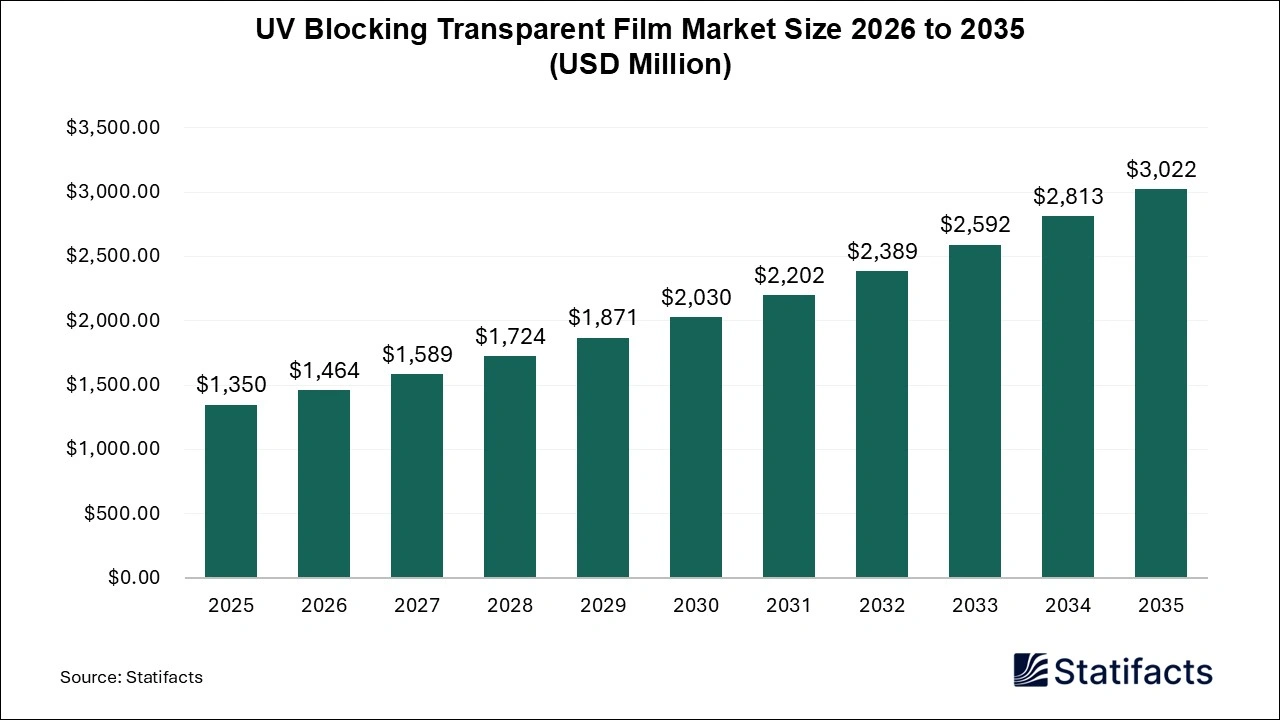
The global UV blocking transparent film market was valued at USD 1,350 million in 2025 and is projected to reach USD 3,022 million by 2035, growing at a CAGR of 8.39%. This growth is driven by rising demand for protective films in automotive, construction, and electronic applications, alongside increasing awareness of UV-related damage and the need for energy-efficient solutions.
| Reports Attributes | Statistics |
| Market Size in 2025 | USD 1,350 Million |
| Market Size in 2026 | USD 1,464 Million |
| Market Size in 2032 | USD 2,389 Million |
| Market Size by 2035 | USD 3,022 Million |
| CAGR 2026 to 2035 | 8.39% |
| Base Year | 2025 |
| Forecast Period | 2026 to 2035 |
The UV blocking transparent film market refers to the global industry involved in the production, distribution, and application of transparent films specifically engineered to filter or block harmful ultraviolet (UV) radiation. These films are designed to prevent the penetration of UV rays while maintaining clarity, making them suitable for a wide range of applications across packaging, automotive, construction, electronics, and other sectors.
UV blocking transparent films are manufactured using various technologies, including UV absorber coatings, nano-composite materials, low-emissivity coatings, and multi-layer lamination, each offering unique properties such as enhanced UV protection, durability, optical clarity, and thermal insulation. These films help protect sensitive products, reduce material degradation, enhance energy efficiency, and ensure safety for both consumers and equipment.
| Segments | Shares (%) |
| North America | 35% |
| Europe | 30% |
| Asia Pacific | 25% |
| LAMEA | 10% |
| Segments | Shares (%) |
| UV Absorber Coated Films | 30% |
| Nano Composite Films | 25% |
| Low Emissivity UV Films | 20% |
| Multi Layer Laminated Films | 15% |
| Others | 10% |
| Segments | Shares (%) |
| Packaging | 40% |
| Automotive | 25% |
| Construction | 15% |
| Electronics | 10% |
| Others | 10% |





