By clicking “Accept All Cookies” you agree to the storing of cookies on your device
to enhance site navigation, analyze site usage, and assist in our marketing efforts.
The U.S. peer-to-peer lending market size was calculated at USD 33.05 billion in 2024 and is predicted to attain around USD 342.02 billion by 2034, expanding at a CAGR of 26.32% from 2025 to 2034.
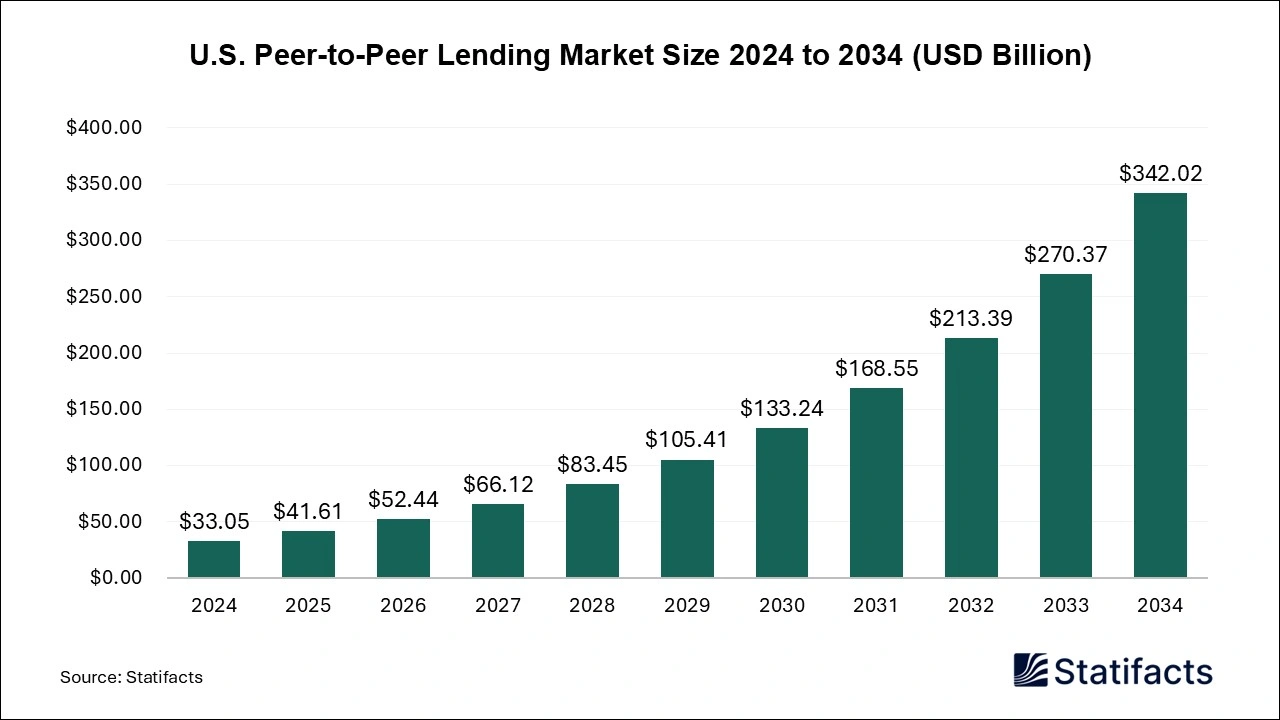
Highlights of the U.S. Peer-to-Peer Lending Market
By type, the consumer lending segment underwent notable growth in the U.S. peer-to-peer lending market during 2024.
By type, the business lending segment will gain a significant share of the market over the studied period of 2025 to 2034.
By end-user, the consumer credit loans segment enjoyed a prominent position in the U.S. peer-to-peer lending market in 2024.
By end-user, the student loans segment is predicted to witness significant growth in the market over the forecast period.
By business model, the traditional lending segment captured a significant portion of the U.S. peer-to-peer lending market in 2024.
By business model, the marketplace lending segment is projected to expand rapidly in the market in the coming years.
Industry Valuation and Growth Rate Projection
Industry Worth
Details
Market Size in 2025
USD 41.61 Billion
Market Size by 2034
USD 342.02 Billion
Market Growth Rate from 2025 to 2034
CAGR of 26.32%
Peer-to-peer lending is also abbreviated as P2P lending, is the practice of lending money to individuals or businesses through online services that match lenders with borrowers. The benefits of peer-to-peer lending include interest rates, lower credit ratings are not a barrier, quick decision, retain full control of business, simple to borrow, wide range of platforms, and easily accessible. The U.S. peer to peer lending market growth is driven by higher return for investors, alternative financing needs, and technological advancements.
The U.S. peer-to-peer lending market applications offer alternative form of business finance which allows businesses or individuals to lend directly to other people or businesses, bypassing traditional banks. The benefits of peer-to-peer payments include they are typically accessible through mobile apps or websites and allow people to send and receive money instantly, may within minutes or even seconds.
What are the Trends in the U.S. Peer-to-Peer Lending Market?
The trends in the U.S. peer-to-peer lending market are higher returns for investors, regulatory support, and diversification of investment options.
Higher returns for investors: Peer to peer lending transforming investment opportunities P2P lending may provides higher returns compared to traditional investment options like saving accounts or bonds. This is primarily because of the higher interest rates charged to borrowers with varying credit profiles.
Regulatory support: RBI regulations for P2P lending limits the total exposure of a lender to borrowers across all P2P platforms to INR 50 lakhs. RBI regulates P2P lending platforms
under NBFC-P2P norms, ensuring transparency, but caps borrowing and lending limits for individuals. P2P lending enables quicker loan disbursals and portfolio diversification for lenders.
Diversification of investment options: By spreading investment across different platforms and projects we will ensure a more stable return and reduce the risk of money becoming inactive. Investment diversification can reduce market volatility, which may lead to more stable returns over time.
What are the Restraints in the U.S. Peer-to-Peer Lending Market?
The restraints in the U.S. peer-to-peer lending market are cybersecurity threats and platform fraud.
Cybersecurity threats: Peer to peer attacks are cyber threats that exploit vulnerabilities of P2P networks. Cybersecurity threats mainly artificial intelligence and decentralized finance become more common place. It may also include injection attacks, denial of service (DoS), man in the middle (MitM)attacks, social engineering, and malware.
Platform fraud: Peer to peer lending is the risk of default by the borrower which not pay principal amount and the interest. If a borrower defaults, a P2P platform can assist the lenders in recovery and file legal notice against the defaulter. Online fraud may have consequences, including a loss of trust in online interactions, damage to credit scores, and emotional distress, identity theft, and financial loss.
Opportunity
Technological Innovation: Advanced technologies like generative AI, advanced data analytics, and machine learning are critical in improving the streamlining the operations, decision making processes, and enhancing risk assessment. AI algorithms are now employed by many platforms for risk assessment and credit scoring. Blockchain technology can help automate loan terms, including collateral management and repayment schedules, to help make loan agreements fairer and safer.
Recent Developments in the U.S. Peer-to-Peer Lending Market
In May 2025, a two-year pilot program to test peer to peer (P2P) lending, credit scoring, and open AI-based data sharing, according to Vietnam News was approved by Vietnam’s government.
In February 2025, across Europe, peer to business (P2B) lending was emerged as an attractive way for businesses to raise capital, benefiting small and medium sized enterprises (SMEs) in particular by offering faster approval processes, diverse funding sources, and access to capital that may be out of reach through traditional banking channels.





