By clicking “Accept All Cookies” you agree to the storing of cookies on your device
to enhance site navigation, analyze site usage, and assist in our marketing efforts.
The US motorcycle helmet market size was calculated at USD 375.63 million in 2024 and is predicted to attain around USD 751.36 million by 2034, expanding at a CAGR of 7.17% from 2025 to 2034.
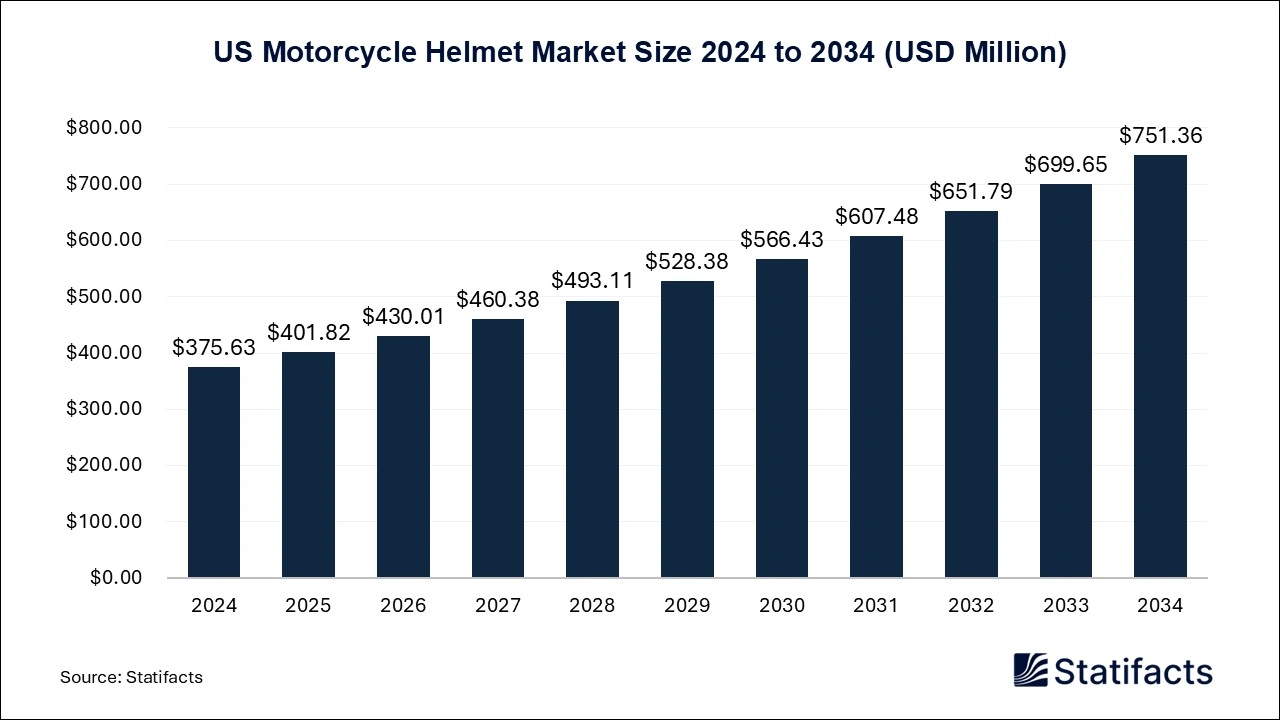
Highlights of the US Motorcycle Helmet Market
By product, the full-face segment dominated the market in 2024.
By product, the open face segment is anticipated to grow at the fastest rate in the market during the forecast period.
By end-user, the rider segment dominated the U.S. motorcycle helmet market in 2024.
By end-user, the passenger segment is anticipated to grow at the fastest rate in the market during the forecast period.
By distribution channel, the offline segment dominated the market in 2024.
By distribution channel, the online segment is anticipated to grow at the fastest rate in the market during the forecast period.
Industry Valuation and Growth Rate Projection
Industry Worth
Details
Market Size in 2025
USD 401.82 Million
Market Size by 2034
USD 751.36 Million
Market Growth Rate from 2025 to 2034
CAGR of 7.17%
Helmets for motorcyclists are often regarded as important safety gear. Many motorcycle helmet producers have also generated high-end features to encourage users to use helmets. Few producers provide helmets implementing Augmented Reality (A.R.) so that the visor can show GPS maps and a speedometer.
What are the U.S. Motorcycle Helmet Market Drivers?
Rising motorcycle registrations, growing demand for smart helmets, and the expansion of online sales channels are driving the U.S. motorcycle helmet market, with manufacturers focusing on ergonomic, lightweight designs for enhanced comfort and safety.
The increased number of motorcycle registrations, mainly in states such as California and Montana, is directly driving the requirement for helmets.
Smart helmets with features such as augmented reality and Bluetooth connectivity are becoming increasingly popular.
Online sales channels are expected to experience remarkable growth, offering convenience and accessibility for users.
Manufacturers aim to utilize ergonomic designs and lightweight materials to improve comfort while compromising safety.
What Are the Restraints in the U.S. Motorcycle Helmet Market?
The U.S. motorcycle helmet market faces restraints such as shifting consumer preference toward e-bikes and scooters, high costs of advanced helmets, and the proliferation of substandard or counterfeit products that undermine safety and consumer confidence.
The rising popularity of electric bicycles and scooters is diverting some users away from motorcycles and later impacting the need for motorcycle helmets.
The expenses of helmets with developed features and technologies can be a hindrance for some consumers, contributing to them opting for cheaper, potency less safe alternatives.
The market is influenced by the availability of substandard or counterfeit helmets, which usually don't meet safety standards and may not offer adequate protection in a crash. This can erode customer trust in legitimate brands and discourage the procurement of certified helmets.
What Are the Opportunities in the U.S. Motorcycle Helmet Market?
The growing number of registered motorcycles, rising use of two-wheelers for commuting, and innovations like smart features and improved aerodynamics are boosting demand in the U.S. motorcycle helmet market, especially among daily riders.
The number of registered motorcycles in the US continues to grow, a direct driving requirement for helmets.
Innovations such as smart communication systems, Bluetooth connectivity, and enhanced aerodynamics are creating helmets that are more appealing to riders.
With more people utilizing motorcycles and scooters for daily commuting, the requirement for helmets, mainly in the commuter segment, is anticipated to increase.
Recent Developments in the U.S. Motorcycle Helmet Market
Helicoid Industries Inc. discloses preliminary results of weight depletion in protective motorcycle helmet prototypes, by the achievement of up to 25% reduction in the number of composite materials utilized while maintaining industry safety ECE22.05 standards.
Rising motorcycle registrations, especially in states like California and Montana, along with stricter safety regulations and growing safety awareness, are key factors fueling market growth.
Smart helmets with features like Bluetooth connectivity, built-in cameras, and augmented reality displays are gaining popularity, alongside ergonomic designs using lightweight and impact-resistant materials.
Online sales channels are experiencing significant growth by offering wider product selections, competitive pricing, and the convenience of home delivery, particularly among younger and tech-savvy consumers.
Challenges include the availability of low-quality counterfeit products, high costs of premium smart helmets, and fluctuating demand influenced by seasonal riding trends and fuel prices.
Major companies include Bell Helmets, Shoei, Arai, HJC, and AGV, with growing competition from newer brands offering smart technology and enhanced safety features.
Proceed to Buy
Looking for a Customized Solution?
50% customization is on us! Shape the insights, trends and strategic planning your way.





