By clicking “Accept All Cookies” you agree to the storing of cookies on your device
to enhance site navigation, analyze site usage, and assist in our marketing efforts.
The U.S. machine learning market size was calculated at USD 22.79 billion in 2024 and is predicted to attain around USD 494.28 billion by 2034, expanding at a CAGR of 36.02% from 2025 to 2034.
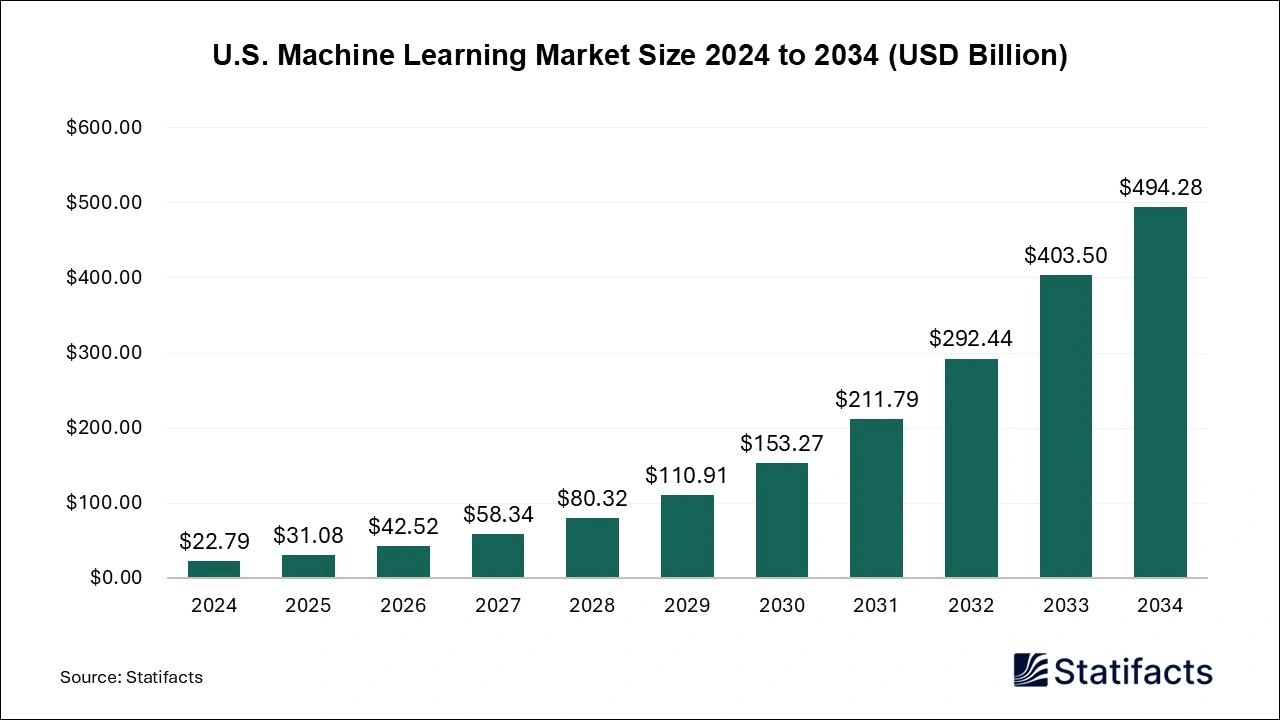
Highlights of the U.S. Machine Learning Market
By type, the large enterprises segment held a dominant presence in the market in 2024.
By type, the small and medium enterprise segment is expected to grow at the fastest rate in the market during the forecast period of 2025 to 2034.
By deployment, the cloud-based segment accounted for a considerable share of the U.S. machine learning market in 2024.
By deployment, the on-premises segment is projected to experience the highest growth rate in the market between 2025 and 2034.
By end-user, the healthcare segment maintained a leading position in the market in 2024.
By end-user, the IT & telecom segment is projected to expand rapidly in the U.S. machine learning market in the coming years.
Industry Valuation and Growth Rate Projection
Industry Worth
Details
Market Size in 2025
USD 31.08 Billion
Market Size by 2034
USD 494.28 Billion
Market Growth Rate from 2025 to 2034
CAGR of 36.02%
The U.S. machine learning market deals with a segment of AI that is centered around constructing systems that learn and get better with experience automatically. On the contrary, the growth of the market for machine learning systems is driven by the increasing demand for automated systems that can improve business processes, optimize decision-making, and provide insights for predictive purposes. Organizations of all kinds, in order to stay ahead in the competition, are resorting to the techniques of machine learning for advanced data analysis and on-demand forecasting. In machine learning, processes are seen to be error-prone in themselves, and thus, these are made more efficient through machine learning, ultimately resulting in a very vast expansion of the market because businesses now realize that incorporating data-driven intelligence will be a strategic tool for their growth.
What Are the Market Trends in the U.S. Machine Learning Market?
The market trends in the U.S. machine learning market are defined by expanding market applications, the rise of AutoML, and deep learning advancement.
Expanding Industry Applications: The applications of machine learning cut across many industries and are aimed at building efficiencies or helping in better decision-making.
Rise of AutoML: AutoML tools for model selection, training, and tuning have lowered entry barriers.
Modernizing Deep Learning: Neural networks are now coming into prominence for computer vision, speech recognition, and natural language processing.
Rise of No-Code ML Platforms: No-code enables SMEs to deploy machine learning models without needing any coding skills.
Rise of Autonomous AI Agents: Autonomous AI agents open up new opportunities for intelligent task automation.
What Are the Restraints in the U.S. Machine Learning Market?
The growth of the U.S. machine learning market is restrained by factors such as data concerns, regulatory challenges, and a lack of skilled professionals.
Talent Scarcity: With very few professionals available, a lack of deployment slows AI innovation.
Issues in the Quality and Accessibility of Data: Any acclaimed model training gets hampered if unstructured or improper data is not suitably channelled or there are access restrictions to good data training resources.
Privacy and Regulatory Challenges: Data privacy issues set restrictions on how data can be used or shared.
Bias and Ethical Considerations: ML models may end up perpetuating or amplifying biases inherent in the data.
High Implementation Costs for SMEs: The initial investment in infrastructure, specialized labor, and custom integration can be discouraging.
What Are the Opportunities in the U.S. Machine Learning Market?
The opportunities in the U.S. machine learning market are associated with cloud and data integration, innovation and solutions, and technological advancements.
Bringing in digital transformation, innovation, and infrastructure build-out.
Competitive positioning of a business: ML refines business forecasts, personalization, and automation.
Cloud infrastructure and AI hardware: AI-centric cloud platforms, GPU computing, and scalable data storage fuel ML adoption.
Industry-headed innovation: Opportunities to build ML tools targeted at specific industries such as healthcare, retail, energy, and transportation.
Growth of AI-as-a-Service (AIaaS): Cloud-based ML services empower non-tech companies to embed AI.
Increase public and private research and development financing: More grants mean faster development of newer ML applications and platforms.
Recent Developments in the U.S. Machine Learning Market:
In April 2025, Bank of America is investing $4 billion in AI initiatives, a third of its technology budget for this year, following its success with AI-powered virtual assistant Erica in 2018.
In September 2024, NVIDIA joins the US government's PGIAI, providing AI training, GPU credits, and grants to developing countries, aiming to harness AI's potential for sustainable development.
The U.S. machine learning market is characterized by expanding industry applications, the rise of AutoML, advancements in deep learning, and the emergence of no-code platforms. These trends are driving wider adoption, especially in sectors like healthcare, IT, and telecom.
The main drivers include the demand for automation, data-driven decision-making, and predictive analytics. Machine learning helps businesses optimize processes, improve forecasts, and drive innovation, contributing to its rapid growth.
Key challenges include a shortage of skilled professionals, data quality issues, privacy concerns, and ethical challenges like model bias. These factors hinder the full adoption and effectiveness of machine learning.
Opportunities lie in cloud-based AI services, AI-as-a-Service, industry-specific solutions, and AI hardware. The growing demand for machine learning in sectors like healthcare, retail, and transportation presents lucrative investment prospects.
Technological advancements, such as deep learning, neural networks, and AI-centric cloud platforms, are making machine learning more efficient and scalable, broadening its applications across industries and increasing its adoption.
The market is dominated by major players like Microsoft, Google, AWS, and NVIDIA. These companies lead in AI infrastructure, cloud services, and machine learning innovation, while smaller players also target niche markets.
The U.S. machine learning market is projected to grow from USD 22.79 billion in 2024 to USD 494.28 billion by 2034, driven by expanding applications, technological advancements, and increasing AI adoption across industries.
Proceed to Buy
Looking for a Customized Solution?
50% customization is on us! Shape the insights, trends and strategic planning your way.





