By clicking “Accept All Cookies” you agree to the storing of cookies on your device
to enhance site navigation, analyze site usage, and assist in our marketing efforts.
The US early toxicity testing market size surpassed USD 447.48 billion in 2024 and is predicted to reach around USD 880.2 billion by 2034, registering a CAGR of 6.99% from 2025 to 2034.
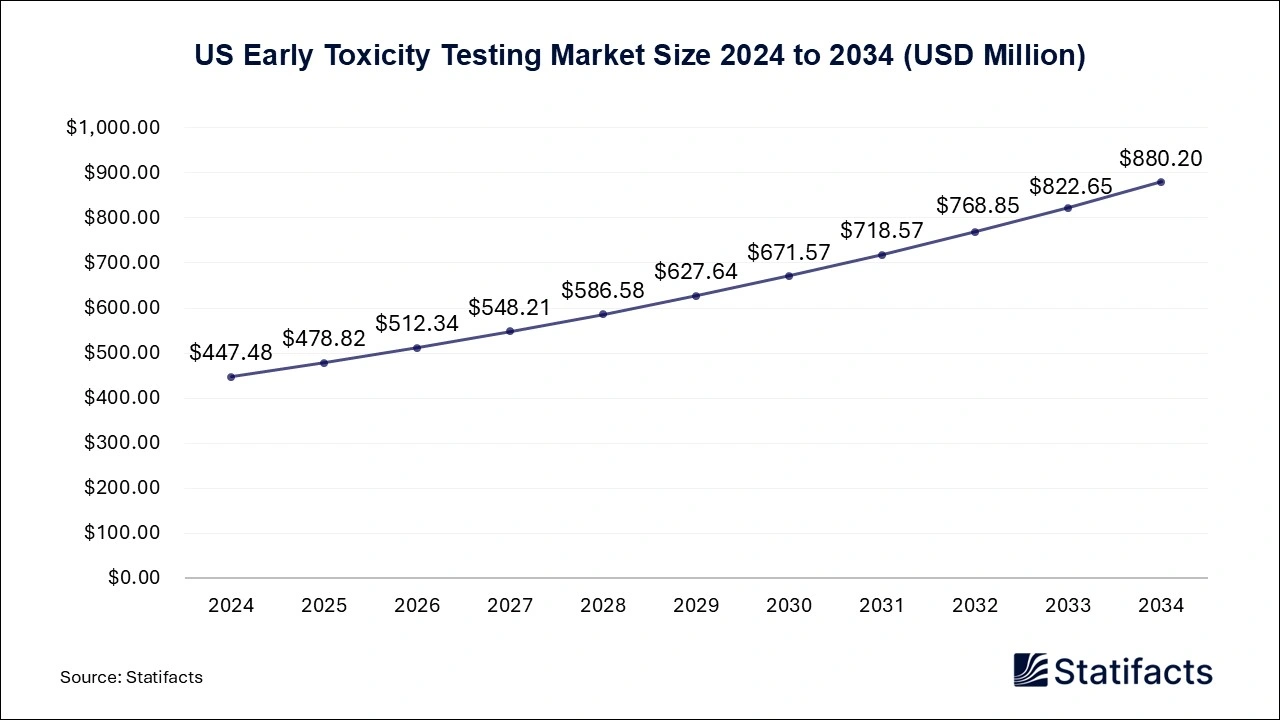
Highlights of the U.S. Early Toxicity Testing Market
By type, the in-vivo segment dominated the U.S. early toxicity testing market in 2024.
By type, the in vitro segment is anticipated to grow at the fastest rate in the U.S. early toxicity testing market during the forecast period.
By application, the pharmaceutical industry segment dominated the U.S. early toxicity testing market in 2024.
By application, the diagnostics segment is anticipated to grow at the fastest rate in the U.S. early toxicity testing market during the forecast period.
Industry Valuation and Growth Rate Projection
Industry Worth
Details
Market Size in 2025
USD 478.82 Billion
Market Size by 2034
USD 880.2 Billion
Market Growth Rate from 2025 to 2034
CAGR of 6.99%
Early toxicity testing is accomplished at the pre-clinical stages of a drug development process and is important as toxicity serves as the essential cause for the failure of a potency drug aspirant in the later stages of development contributing to huge financial losses to firms. Well-programmed and executed preclinical studies are vital to the success of any drug advancement program. Hence, they must reliably evaluate the safety of a new drug entity, laying down the basis for clinical trials and later, regulatory approval. However, these tests are essential as they can help prevent financial losses that happen during the failure of drugs in the late stages of drug development.
What Are the Trends in the U.S. Early Toxicity Testing Market?
The U.S. early toxicity testing market is trending toward earlier risk detection, increased regulatory scrutiny, and the adoption of advanced technologies like 3D cell culture, AI, and organ-on-a-chip systems to improve testing accuracy and efficiency.
Pharmaceutical and biotechnology firms are prioritizing early toxicity testing to detect potential risks and detrimental effects before clinical trials.
Regulatory bodies such as the FDA and EMA are growing their scrutiny of drug safety, contributing to greater acceptance of early toxicity testing.
Innovations such as 3D cell culture, AI-generated drug discovery platforms, and organ-on-a-chip systems are speeding up drug advancement and enhancing the accuracy of toxicity testing.
What Are the Restraints in the U.S. Early Toxicity Testing Market?
High costs of advanced technologies and a shortage of specialized expertise are key restraints in the U.S. early toxicity testing market, limiting adoption, especially among smaller firms and research institutions.
Early toxicity testing, mainly large-scale studies, can be costly. The expense of developing and incorporating new technologies, such as high-throughput screening platforms and microphysiological systems, can also be restrictive for some organizations. These high expenses act as an issue for entry for smaller businesses and restrict the acceptance of innovative testing approaches.
The expertise needed to generate and use new toxicity testing technologies may not be readily available, mainly in research institutions or smaller organizations. This can thus slow down the acceptance of these technologies and restrict the potential advantages of early toxicity testing.
What is the Opportunity in the U.S. Early Toxicity Testing Market?
Advancements in stem cell models, high-throughput screening, and organ-on-a-chip technologies, combined with rising regulatory demand, offer significant opportunities to improve drug safety, reduce late-stage failures, and lower development costs.
Innovations in stem cell-based models, high-throughput screening, and organ-on-a-chip technologies improve the accuracy and efficiency of early toxicity testing.
Early toxicity testing assists in minimizing late-stage drug advancement failures, saving remarkable costs linked with late-stage failures.
The FDA and other regulatory bodies are growingly demanding toxicity testing to guarantee drug safety and compliance, impelling the acceptance of advanced testing methods.
Recent Developments in the U.S. Early Toxicity Testing Market
In March 2025, 2seventy Bio, Inc. disclosed a definitive merger agreement under which Bristol Myers Squibb will obtain all the outstanding shares of 2seventy Bio for $5.00 according to share in an all-cash transaction, for an equity value of approximately $102 million or $286 million net of estimated cash.
Early toxicity testing helps identify potential harmful effects of drug candidates or chemicals at an early stage of development. It reduces late-stage failures, development costs, and risks to human health.
Growth is fueled by rising pharmaceutical R&D, demand for safer and faster drug development, regulatory pressure for early safety data, and advancements in in vitro and in silico testing technologies.
Common methods include in vitro assays using cell cultures, in silico modeling, and in vivo animal studies. There's a growing shift toward non-animal testing due to ethical and regulatory concerns.
Major end-users include pharmaceutical and biotechnology companies, academic research institutions, contract research organizations (CROs), and regulatory agencies.
Challenges include variability in test results, limitations in predicting long-term toxicity, high costs of advanced testing technologies, and the need for better correlation with human responses.
Proceed to Buy
Looking for a Customized Solution?
50% customization is on us! Shape the insights, trends and strategic planning your way.
Catalyst Screening Service Market (By Type: High Throughput Computing Screening Service, Industrial Recycling and Recycling Service, Quality Control a...





