By clicking “Accept All Cookies” you agree to the storing of cookies on your device
to enhance site navigation, analyze site usage, and assist in our marketing efforts.
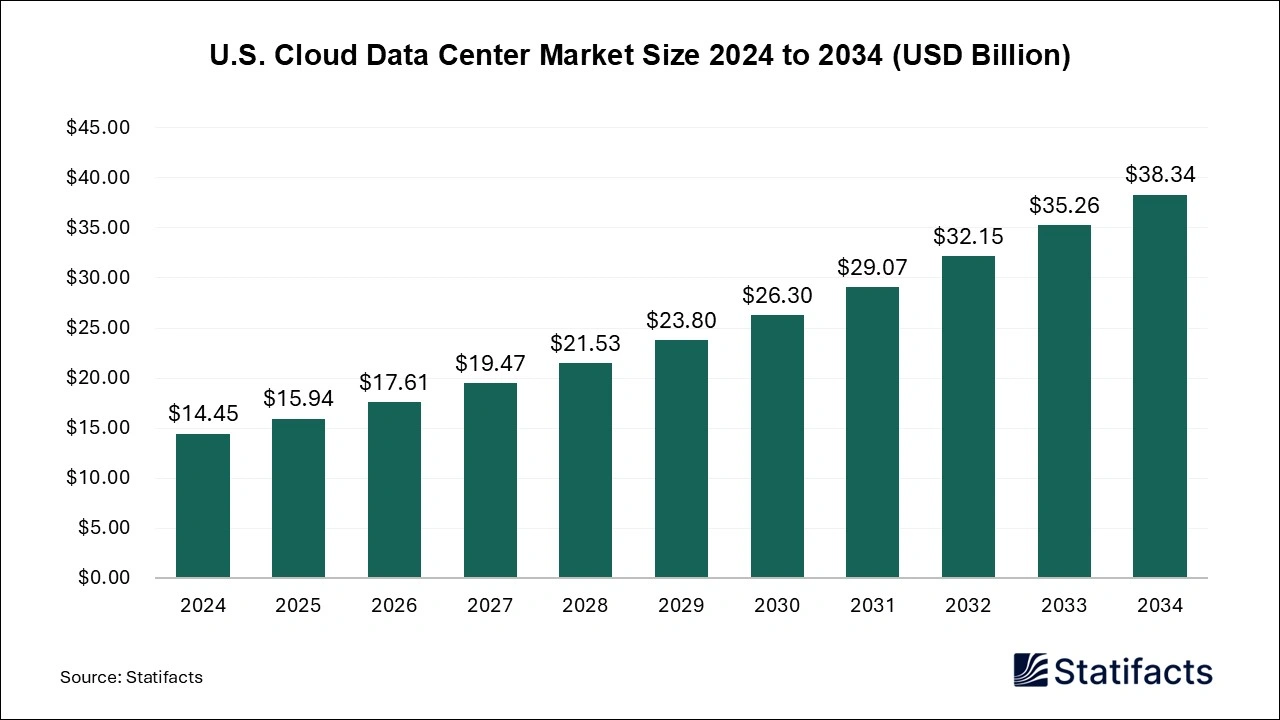
The U.S. cloud data center market size was calculated at USD 14.45 billion in 2024 and is predicted to attain around USD 38.34 billion by 2034, expanding at a CAGR of 10.25% from 2025 to 2034.
Highlights of the U.S. Cloud Data Center Market
By service, the software as a service (SaaS) segment underwent notable growth in the market during 2024.
By service, the infrastructure as a service (IaaS) segment will gain a significant share of the market over the studied period of 2025 to 2034.
By deployment, the hybrid cloud segment enjoyed a prominent position in the market during 2024.
By deployment, the public cloud data center segment is predicted to witness significant growth in the market over the forecast period.
By organization size, the large enterprises segment captured a significant portion of the market in 2024.
By organization size, the small/medium enterprises segment is projected to expand rapidly in the market in the coming years.
By end-user, the BFSI (Banking, financial services, and insurance) segment maintained a leading position in the U.S. cloud data center market in 2024.
By end-user, the colocation segment is anticipated to grow with the highest CAGR in the market during the studied years.
Industry Valuation and Growth Rate Projection
Industry Worth
Details
Market Size in 2025
USD 15.94 Billion
Market Size by 2034
USD 38.34 Billion
Market Growth Rate from 2025 to 2034
CAGR of 10 25%
A cloud data center is a centralized facility equipped with computing resources like networking equipment, storage systems, servers, and cooling infrastructure that is used for the delivery of cloud services over the internet. Cloud data centers require high levels of scalability, reliability, and availability. The U.S. cloud data center market growth is driven by increasing data storage and processing needs, government initiatives for cloud computing, and the growth of e-commerce and online services.
The U.S. cloud data center market applications are they allow organizations to support daily operations, ensure data availability & reliability, facilitate cloud services, and provide a secure environment for critical applications. They host the infrastructure that powers popular applications and platforms, including e-commerce websites, social media networks, and enterprise software solutions.
What are the Trends in the U.S. Cloud Data Center Market?
The market trends in the U.S. cloud data center market highlight increasing data storage & processing needs, rising digitalization in many industries, and government initiatives for cloud computing.
Increasing data storage & processing needs: A data center is a physical location that stores computing machines and their related hardware equipment. It contains the computing infrastructure that IT systems need, like network equipment, servers, and data storage drives. It is the physical facility that stores a company's digital data. The benefits of cloud storage include disaster recovery, scalable, convenience, synchronization, multiple users, automation, convenient sharing of files, cost efficiency, security, and usability & accessibility.
Rising digitalization in many industries: Cloud computing is the backbone of cloud data centers that support a range of diverse services like applications, platforms, and infrastructure, thereby acting as an enabler for digital transformation and innovation. Digital transformation benefits for businesses include continued relevancy, increased revenue, faster time to market, greater innovation, increased responsiveness, improved customer engagement, greater agility, more resiliency, better resource management, and increased efficiency & productivity.
Government initiatives for cloud computing: Government support for cloud computing. The benefit of cloud computing for e-government is that it can increase security. Cloud-based storage can be valuable due to the data stored in cloud computing is guaranteed secure, and many regulations and standards of information safety practices. The government has a major role in the efficacy of a functioning society.
What are the Restraints in the U.S. Cloud Data Center Market?
The restraints in the U.S. cloud data center market include data privacy & security and the complexity of cloud infrastructure.
Data privacy & security: Data privacy & security challenges include integration with existing systems, insider threats, ineffective privacy safeguards, increasing maintenance costs, increased data volumes, evolving regulatory landscape, improved security awareness, encryption, embedding data privacy, data management complexity, data loss prevention, data breaches, complex implementation, and privacy concerns.
Complexity of cloud infrastructure: Challenges in cloud infrastructure include scalability, service availability & reliability, governance & control, integration with existing systems, skill gaps, vendor lock-in, data management, performance management, security & compliance, and cost management & optimization.
What is the Opportunity in the U.S. Cloud Data Center Market?
The opportunity in the U.S. cloud data center market is linked to the increasing adoption of IoT devices.
Increasing adoption of IoT devices: The benefits of IoT devices include sustainable manufacturing, investment needs, improved operational efficiency, improved supply chain, environmental benefits, energy management, broadened business opportunities, improved quality control, cybersecurity risks, real-time monitoring, increased revenue, asset performance optimization, improved efficiency, data driven decisions, cost reduction, automation, improved safety, improve business decisions, and more.
What are the Recent Developments in the U.S. Cloud Data CenterMarket?
In June 2025, hyperscale and AI data center campuses in Thailand were launched by Data Edge Holdings (Singapore) in collaboration with B. Grimm Power.
In June 2025, a new data center in the cloud center in South Korea was launched by Alibaba Cloud.
U.S. Cloud Data Center Market Revenue, By End-User, 2024 to 2034 (USD Million)
Subsegment
2024
2025
2026
2027
2028
2029
2030
2031
2032
2033
2034
BFSI
2,673.90
2,955.00
3,268.70
3,619.50
4,007.70
4,435.60
4,907.60
5,429.80
6,009.10
6,663.30
7,267.50
Colocation
3,255.80
3,603.00
3,990.30
4,423.30
4,902.80
5,431.30
6,014.50
6,659.80
7,375.80
8,249.80
9,018.40
Energy
1,036.20
1,137.50
1,250.50
1,376.70
1,516.30
1,669.90
1,839.20
2,026.40
2,233.80
2,362.10
2,543.20
Government
1,628.60
1,791.10
1,972.40
2,174.90
2,399.00
2,645.70
2,917.70
3,218.40
3,551.80
3,807.60
4,115.10
Healthcare
1,891.70
2,082.40
2,295.10
2,532.80
2,795.80
3,085.40
3,404.70
3,757.80
4,149.30
4,477.40
4,847.80
Manufacturing
1,354.10
1,488.20
1,637.80
1,805.00
1,990.00
2,193.50
2,417.90
2,666.00
2,941.00
3,137.70
3,386.70
IT & Telecom
2,141.20
2,377.00
2,640.10
2,934.40
3,260.40
3,619.90
4,016.80
4,456.10
4,943.60
5,640.90
6,198.30
Others
466.60
507.10
552.20
602.60
658.10
719.20
786.30
860.40
942.40
916.60
962.70
Last Updated: 23 Jun 2025
Source: Statifacts

References
Primary Research Interviews
Industry Analysts & Consultants: Engage with experts from firms like Gartner, Forrester, and IDC for insights on market trends and forecasts.
Data Center Operators: Conduct interviews with executives from companies such as Equinix, Digital Realty, and QTS Realty Trust to understand operational challenges and strategies.
Tech Giants: Speak with representatives from Amazon Web Services (AWS), Microsoft Azure, Google Cloud, and Meta to gain perspectives on infrastructure investments and innovations.
Stakeholders
Cloud Service Providers: AWS, Microsoft Azure, Google Cloud, Oracle, and emerging AI-focused providers like CoreWeave and Lambda.
Data Center Operators: Equinix, Digital Realty, QTS Realty Trust, and CyrusOne.
Utility Companies: Duke Energy, Dominion Energy, and NextEra Energy, which supply power to data centers.
Regulatory Bodies: Federal Energy Regulatory Commission (FERC), state-level public utility commissions, and environmental agencies.
Databases
Uptime Institute: Provides data center tier classifications and operational benchmarks.
CBRE Data Center Solutions: Offers market intelligence on leasing activity, vacancy rates, and construction trends.
North American Data Center Trends (CBRE): Tracks supply, demand, and pricing in primary and secondary markets.
Magazines
Data Economy: Focuses on business strategy, finance, and investment within the IT infrastructure space, particularly data centers.
Lightwave: Covers fiber optics and optoelectronics, technologies that enable the growth and integration of data communications networks.
Technology Decisions Magazine: Provides industry news, articles, and case studies related to data centers.
Cabling Installation & Maintenance: Offers information on structured cabling systems serving enterprises and data centers.
Journals
IEEE Transactions on Cloud Computing: Publishes research on cloud computing architectures, systems, and applications.
Journal of Cloud Computing: Advances, Systems and Applications: Focuses on cloud computing technologies and their applications.
International Journal of Computer Applications: Covers a wide range of topics in computer science, including cloud computing.
Newspapers
The Wall Street Journal: Provides coverage on data center investments, market dynamics, and technology trends.
The New York Times: Offers insights into the economic and regulatory aspects of the data center industry.
The Washington Post: Reports on policy decisions affecting data center development and operations.
Associations
Data Center Coalition: Advocates for policies that support the data center industry and provides industry insights.
Open Commons Consortium: Manages cloud computing and data commons resources to support scientific, environmental, medical, and healthcare research.
Open Data Center Alliance: An organization that coordinates the development of standards for cloud computing.
Public Domain Sources
U.S. Energy Information Administration (EIA): Provides data on energy consumption and generation, including information relevant to data centers.
Federal Communications Commission (FCC): Offers reports on broadband infrastructure and internet access, which are critical for data center operations.
U.S. Census Bureau: Supplies demographic and economic data that can be useful for market analysis.
Proprietary Elements
Market Research Reports: Firms like Market Research Future, Grand View Research, and Credence Research offer detailed market analyses and forecasts.
Company Filings: Publicly traded data center operators and cloud service providers disclose financial performance and strategic initiatives in their annual reports and SEC filings.
Industry Surveys: Conducted by consulting firms and industry associations, these surveys provide insights into market trends and customer preferences.
U.S.
Market Statistics
U.S. Cloud Data Center Market Revenue, By End-User 2024 to 2034 (USD Billion)
The primary growth drivers include surging data generation from enterprises and consumers, rising digital transformation across industries, and strong government support for secure cloud infrastructure. Additionally, the increasing deployment of SaaS and IaaS platforms and the demand for hybrid and public cloud models are accelerating market momentum. These factors are encouraging massive investment in scalable, efficient, and AI-ready data centers.
With a projected CAGR of 10.25% from 2025 to 2034 and an estimated market size increase from USD 14.45 billion in 2024 to USD 38.34 billion by 2034, the sector offers high-return opportunities. Strategic investors are focusing on hyperscale expansions, AI-data integration, and green data centers, particularly in high-demand verticals like BFSI, e-commerce, and government.
BFSI remains a dominant user due to its need for secure, always-on cloud infrastructure. However, colocation services are expected to register the highest CAGR, reflecting growing demand from small to medium enterprises (SMEs) and startups seeking scalable, low-CAPEX IT environments.
Major challenges include increasing complexity in managing multi-cloud and hybrid environments, escalating data security threats, and compliance burdens associated with evolving data protection laws like CCPA and HIPAA. These factors necessitate higher operational sophistication and increased cybersecurity spending.
Disruptive forces include AI-driven data center automation, liquid cooling systems, next-gen GPU integration for AI workloads, and software-defined infrastructure. The rise of edge computing and 5G is also pushing cloud providers to build micro data centers closer to end-users for low-latency services.
SMEs are projected to be a high-growth segment due to increased adoption of cloud-native tools and demand for affordable, flexible IT infrastructure. This growth is supported by rising SaaS deployment and the shift toward colocation and public cloud models, which reduce capital expenditure barriers.
The outlook is robust, with sustained growth driven by the convergence of AI, big data, and IoT technologies. Market leaders are expanding capacity and investing in greener infrastructure to meet ESG expectations. By 2034, the market will be defined by hyperconnected, decentralized, and highly secure ecosystems capable of supporting real-time digital economies.
Proceed to Buy
Looking for a Customized Solution?
50% customization is on us! Shape the insights, trends and strategic planning your way.
Metaverse Interactive Experience Market (By Type: Desktop, Mobile; By Application: Game, Social Contact, Shopping, Others; By Region: North America, E...