


By clicking “Accept All Cookies” you agree to the storing of cookies on your device
to enhance site navigation, analyze site usage, and assist in our marketing efforts.
The U.S. buy now pay later market size was evaluated at USD 4.31 billion in 2024 and is expected to grow around USD 21.41 billion by 2034, registering a CAGR of 17.38% from 2025 to 2034.
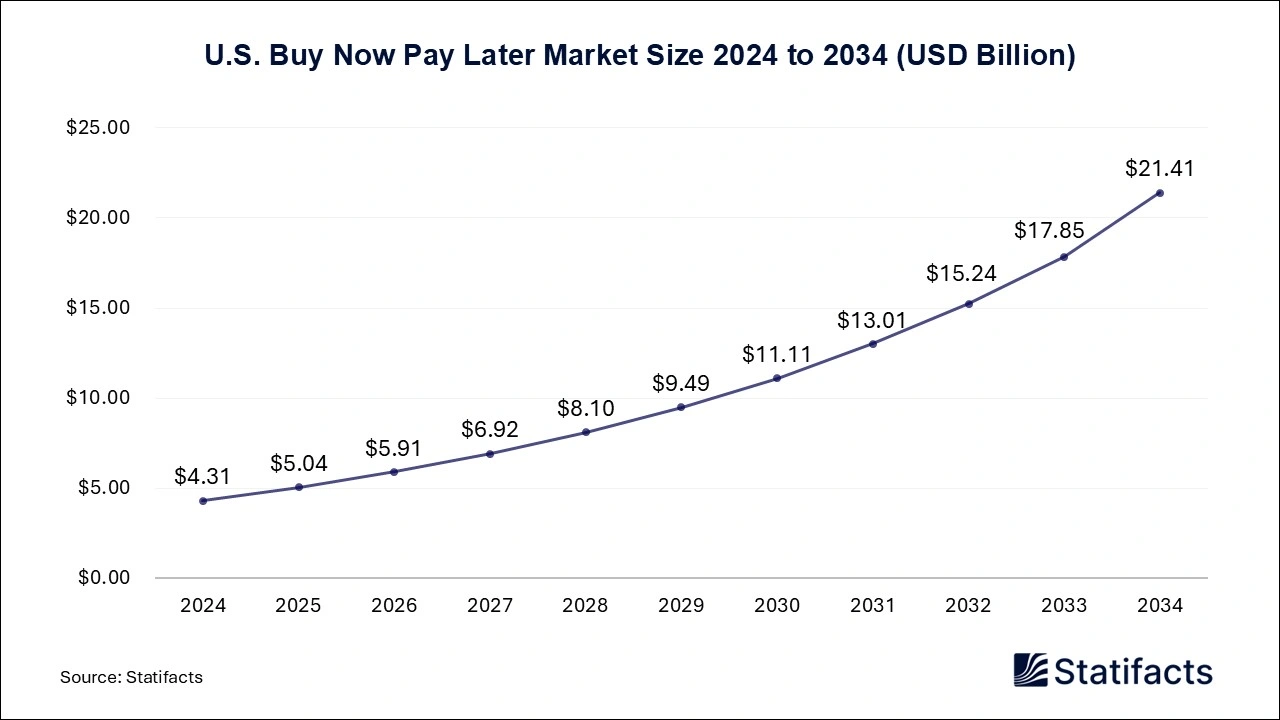
Highlights of the U.S. Buy Now Pay Later Market
By component, the platform/solutions segment underwent notable growth in the market during 2024.
By component, the services segment is anticipated to expand rapidly.
By purchase ticket size, the small ticket item (up to US$ 300) segment experienced significant expansion in the market.
By purchase ticket size, the mid ticket items (US$ 300 - US$ 1000) segment is expected to see notable performance in growth between 2025–2034.
By business model, the business driven segment showed substantial gains in the market.
By business model, the customer driven segment is set to experience the most robust growth across the market.
By mode, the online segment saw a surge in market performance.
By mode, the offline segment is anticipated to demonstrate steady upward momentum during the forecast period.
By vertical, the electronics segment achieved considerable growth within the market.
By vertical, the fashion segment is positioned to show promising growth in the coming years.
Industry Valuation and Growth Rate Projection
Industry Worth
Details
Market Size in 2025
USD 5.04 Billion
Market Size by 2034
USD 21.41 Billion
Market Growth Rate from 2025 to 2034
CAGR of 17.38%
The U.S. buy now pay later market is expanding at a rapid pace as consumers seek greater financing flexibility and online shopping gains prominence. The services offer consumers the ability to make purchases and arrange payments over time, attracting different demographic groups of shoppers, including most who do not like to use regular credit cards or those who have no form of conventional credit. Retailers are, thus, incorporating buy now pay later options within checkout flows to optimize the shopping experience and amplify sales. Usually, fintechs provide the buy now pay later services that generate revenue from fees for each transaction and penalties in case of late payment. Strategic alliances between buy now pay later providers and retailers have been furthering market expansion. The rise of digital payments innovations, together with the changes in consumer behavior and financial inclusion measures, will facilitate the sustained growth of the U.S. buy now pay later market.
Market Trends
E-commerce Integration: BNPL is increasingly embedded into online retail checkout systems to boost conversion rates and average order values.
Mobile-first Adoption: BNPL apps are optimized for smartphones, aligning with consumer preferences for mobile shopping.
Expansion into In-store Retail: BNPL is moving beyond online purchases into brick-and-mortar stores via QR codes and digital wallets.
“Pay-in-4” Model Popularity: The four-instalment repayment plan remains the most widely adopted format, offering simplicity and predictability.
Younger Demographic Targeting: BNPL is highly popular among Gen Z and Millennials who prefer alternatives to credit cards.
Restraints
Interest Post-Interest-Free Period: Interest begins to accrue on any remaining balance as soon as the interest-free window closes, and the interest rate charged may be quite substantial.
Stacked Late Fees: Usually, missed or late payments entail penalty charges that accumulate, dramatically increasing the total return amount.
Opaque Fees: The true price of borrowing can become hidden behind a maze of interest charges, late fees, and potential account-management fees.
When the Penalties Come In, In Comparative Terms, It's More Expensive: When penalties come in, buy now pay later becomes costlier than credit cards or personal loans, at which the value proposition of BNPL melts away.
Risk of Consumers Going Overboard: The promise of cheap deferral might spur purchases beyond capacity into a cycle of fees and debts.
The Merchant's Commission Effect: Fees paid by merchants might then be passed on to consumers in the form of increased product prices.
Opportunity
Access Younger Buyers: BNPL appeals to Gen Z and millennials, who constitute the growing base of customers refusing to adopt credit from traditional sources, helping merchants access this segment.
Lower Chargeback Risk: A buy now pay later provider is liable for credit risk and fraud, providing greater protection to merchants.
Marketing Angle: Use promotion of BNPL payable options to highlight competitive pricing and draw in price-conscious shoppers.
Greater Visibility: Partnering with myriad retailers ensures greater awareness among and adoption by users across a spectrum of industries.
Higher Revenues: Essentially, a provider charges transaction fees from merchants and interest or penal fees from consumers, wherever applicable.
Get Consumer Data: Merchant partnerships provide deep insight into shopper behavior, aiding in the personalization and driving product development.
Recent Developments in the U.S. Buy Now Pay Later Market:
According to a 2025 survey by J.D. Power, buy now pay later services saw continued growth in the number of consumers using them, with the highest usage among
consumers from Generations Y1 and Z. The number of consumers using BNPL products grew significantly year over year, especially during the holiday season.
In November 2024, a US-based buy now pay later group Affirm launched in the United Kingdom, as an alternative to lenders charging late fees in an increasingly regulated sector.


