

Share


Thermochromic Polymer Films Market (By Type: Reversible Thermochromic Films, Irreversible Thermochromic Films, and Others; By End-use: Smart Packaging & Temperature Indicators, Labels & Stickers, Textiles & Smart Wearables, Sensors & Electronics, Automotive & Aerospace, and Others; By Region: North America, Europe, Asia Pacific, Latin America, and Middle East & Africa) Industry Size, Share, Growth, Trends 2026 to 2035

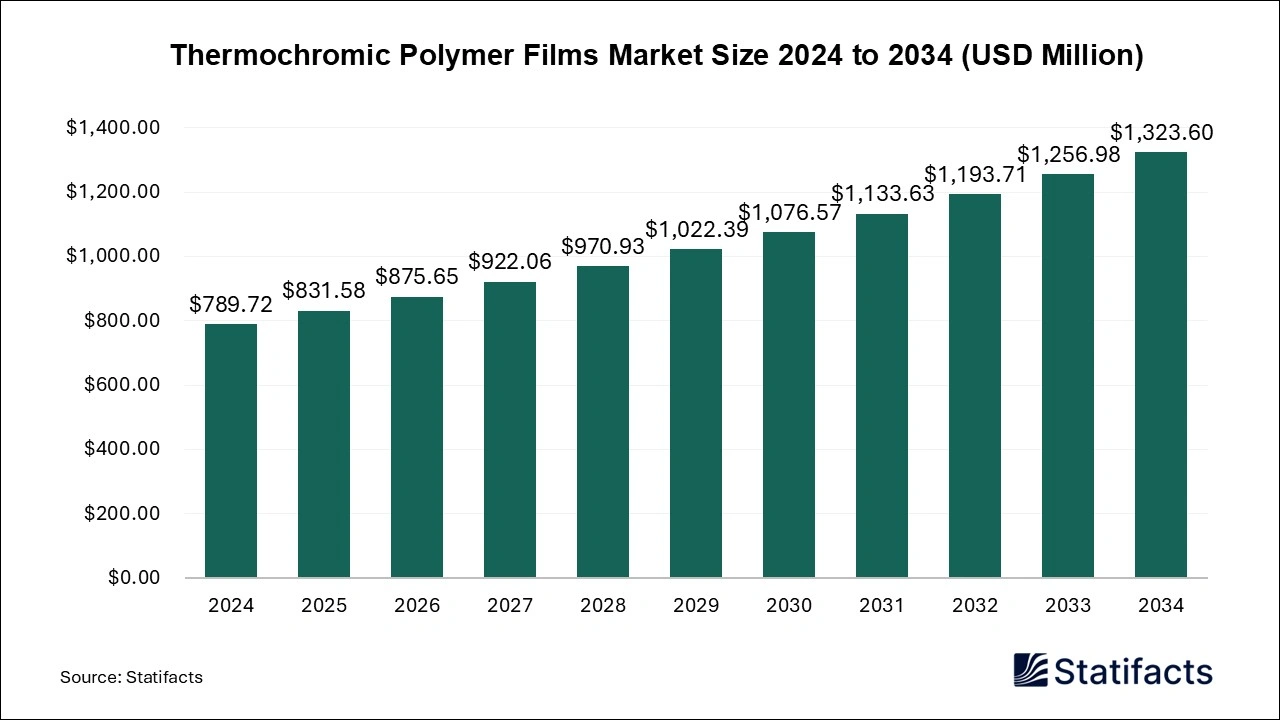
The global thermochromic polymer films market size was valued at USD 831.58 million in 2025, is projected to reach approximately USD 1,387.99 million by 2035. This growth, driven by rising demand in smart packaging, textiles, and sensors, is expected at a CAGR of 5.3%.
| Reports Attributes | Statistics |
| Market Size in 2025 | USD 831.58 Million |
| Market Size in 2026 | USD 875.65 Million |
| Market Size in 2032 | USD 1,193.71 Million |
| Market Size by 2035 | USD 1,387.99 Million |
| CAGR 2026 to 2035 | 5.26% |
| Base Year | 2025 |
| Forecast Period | 2026 to 2035 |
The thermochromic polymer films market is expanding rapidly, driven by the growing demand for temperature-sensitive packaging in food, beverage, and pharmaceutical applications to enhance visual appeal and safety. Thermochromic polymer films are smart materials that change color with temperature. The rising consumer goods business is driving the growth of premium products, which in turn is driving strong demand for these polymer films. The use of thermochromic polymer films in smart windows is also expected to drive greater demand, as these settings require regulation of heat and light transmission. The rising frequency of weather events in many regions is expected to drive greater manufacturing demand.
The use of smart materials often introduces complications in manufacturing and other processes, which increase the overall cost of these thermochromic films. This may create demand for alternatives to traditional products, potentially affecting the growth of the thermochromic polymer films market. Additionally, the use of these films is limited in food applications due to food-contact risks, which may also affect the business.
The growing investments from pharmaceutical and biotech companies are expected to drive more business, driven by the higher need for tamper-evident temperature monitoring. The companies are focusing on improving the R&D process to achieve greater durability and enhance thermochromic compounds, thereby increasing the lifespan of these products. The growing adoption of applications such as wearable electronics is expected to drive more business, as they are used for temperature sensing and thermal comfort regulation. The rapid expansion of the FMCG industry is driving strong demand for businesses, especially in emerging economies.
The United States possesses strong business opportunities in the thermochromic polymer films market due to the rise of smart packaging and cold-chain integrity. The companies in the country are highly focused on expanding their businesses through continuous innovation across multiple sectors. Moreover, the country's healthcare industry has been focusing on adopting the latest technologies to enhance safety and accuracy through smart labels and packaging.
The use of artificial intelligence (AI) and Machine Learning in the thermochromic polymer market is expected to play an influential role in attracting several developments through predicting polymer compositions. This helps identify and target a specific temperature range without the time and expense of physical experiments. Most importantly, AI models are being used to design polymer structures, helping reduce errors made by traditional approaches.
| Regions | Shares (%) |
| North America | 30% |
| Asia Pacific | 34% |
| Europe | 25% |
| LAMEA | 11% |
| Segments | Shares (%) |
| Reversible Thermochromic Films | 58% |
| Irreversible Thermochromic Films | 29% |
| Others | 13% |
| Segments | Shares (%) |
| Smart Packaging & Temperature Indicators | 26% |
| Labels & Stickers | 18% |
| Textiles & Smart Wearables | 15% |
| Sensors & Electronics | 17% |
| Automotive & Aerospace | 14% |
| Others | 10% |
Published by Vidyesh Swar





