



Telecom Energy Storage Market (By Type: Stationary Energy Storage and Distributed Energy Storage; By Application: Data Center, Telecommunications Infrastructure, and Others; By Region: North America, Europe, Asia Pacific, and LAMEA) Industry Size, Share, Growth, Trends 2026 to 2035

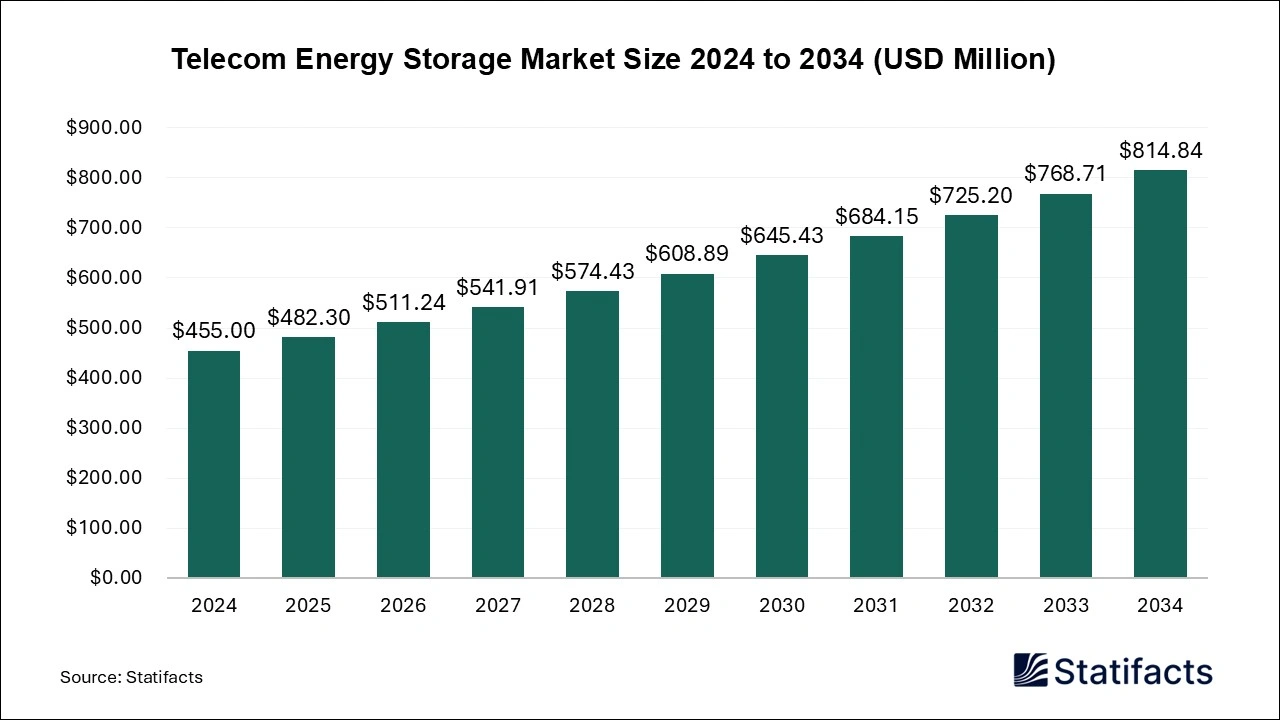
The global telecom energy storage market size with valued at USD 482.3 million in 2025, is projected to reach approximately USD 859.22 million by 2035. This growth, driven by increasing demand for reliable power solutions in telecom infrastructure, is expected at a CAGR of 5.94%.
| Reports Attributes | Statistics |
| Market Size in 2025 | USD 482.3 Million |
| Market Size in 2026 | USD 511.24 Million |
| Market Size in 2032 | USD 725.2 Million |
| Market Size by 20345 | USD 859.22 Million |
| CAGR 2026 to 2035 | 5.94% |
| Base Year | 2025 |
| Forecast Period | 2026 to 2035 |
The telecom energy storage market is expanding steadily as mobile network operators and data service providers invest in robust energy infrastructure to ensure uninterrupted connectivity. With the growing deployment of 5G networks, data centers, and edge computing facilities, energy storage systems have become essential to maintaining a consistent power supply, especially in areas prone to grid instability. Battery technologies such as lithium-ion, lead-acid, and emerging solid-state systems are widely used to provide efficient, scalable, and maintenance-friendly solutions for telecom towers and base stations. The rise of hybrid energy systems, integrating solar, wind, and fuel cell technologies, has further accelerated the market, reducing operational costs and carbon footprints.
However, high initial investment costs, limited energy density in certain storage technologies, and challenges in recycling used batteries remain key restraints. Supply chain disruptions for critical raw materials like lithium and cobalt can also affect pricing and availability. Despite these challenges, increasing adoption of renewable-powered telecom sites and innovations in battery management systems (BMS) are expected to unlock new growth opportunities.
The telecom energy storage market is expected to grow more rapidly as artificial intelligence (AI) and digital energy management technologies transform power optimization and predictive maintenance. Artificial intelligence enables real-time monitoring of battery health, temperature, and discharge cycles, ensuring maximum lifespan and performance. Machine learning algorithms can forecast energy demand, optimize charging schedules, and detect anomalies before failures occur.
| Regions | Shares (%) |
| North America | 20% |
| Asia Pacific | 15% |
| Europe | 30% |
| LAMEA | 35% |
| Segments | Shares (%) |
| Stationary Energy Storage | 33.69% |
| Distributed Energy Storage | 66.31% |
| Segments | Shares (%) |
| Data Center | 13.66% |
| Telecommunications Infrastructure | 42.53% |
| Others | 43.81% |





