

Share


Sustainable TPE Materials Market (By Type: Post-industrial (PIR), Post-consumer (PCR), Bio-based, and Marine-based; By Application: Automotive Interior & Exterior Trims, Consumer Goods, Construction Material, Wire & Cable, and Others; By Region: North America, Europe, Asia Pacific, Latin America, and Middle East & Africa) Industry Size, Share, Growth, Trends 2026 to 2035

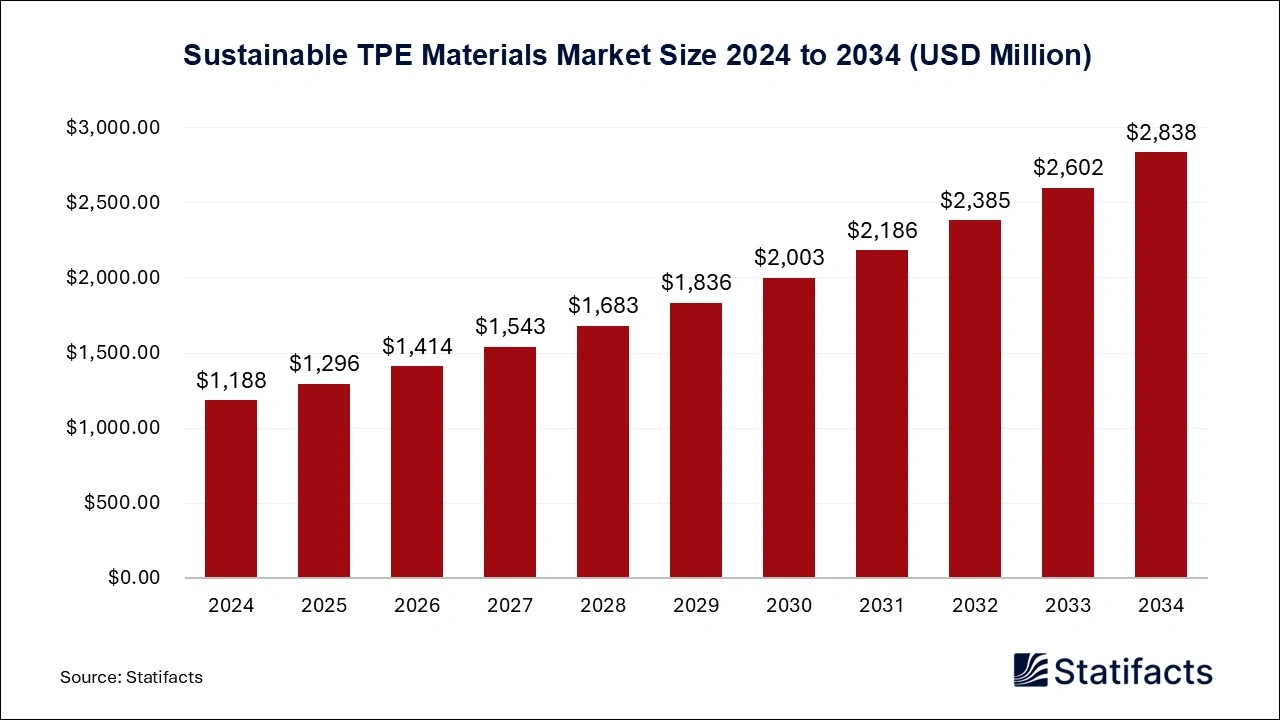
The global sustainable TPE materials market, valued at USD 1,296 million in 2025, is projected to reach approximately USD 3,061 million by 2035. This growth, fueled by rising demand for eco-friendly and recyclable polymers across industries, is expected at a CAGR of 8.97%.
| Reports Attributes | Statistics |
| Market Size in 2025 | USD 1,296 Million |
| Market Size in 2026 | USD 1,414 Million |
| Market Size in 2032 | USD 2,385 Million |
| Market Size by 2035 | USD 3,061 Million |
| CAGR 2026 to 2035 | 8.97% |
| Base Year | 2025 |
| Forecast Period | 2026 to 2036 |
The sustainable TPE materials market is increasingly gaining traction, and this is due to increasing demand in the healthcare equipment, automotive, electronics, and consumer goods sectors. These green thermoplastic elastomers are recyclable, have a smaller carbon footprint, and, with performance comparable to traditional TPEs, they are getting more popular in the areas that demand both flexibility and sustainability. Increasing regulatory demand for more sustainable materials and increased understanding of the principles of a circular economy are also contributing to adoption. Its comparatively high price of sustainable feedstocks and difficulties in obtaining uniform material qualities are both hindrances, which restrict quicker infiltrations in cost-focused markets.
The sustaining TPE materials market will gain momentum as the firms adopt artificial intelligence and data analytics in the context of R&D, optimization of processes, and quality management. Predictive modeling, which is based on AI, can be used to select the best bio-based monomers and additives to improve mechanical performance and stability. In the manufacturing sector, artificial intelligence AI has the potential to reduce manufacturing errors, waste, and simplify the process of scaling up new recipes. This is advantageous to high-reliability designs of medical equipment, flexible electronics, and car interior designs, where the accuracy, uniformity, and sustainability of materials are essential.
| Regions | Shares (%) |
| North America | 26.82% |
| Asia Pacific | 29.75% |
| Europe | 24.46% |
| LAMEA | 18.97% |
| Segments | Shares (%) |
| Post-industrial (PIR) | 30.42% |
| Post-consumer (PCR) | 26.69% |
| Bio-based | 25.77% |
| Marine-based | 17.12% |
| Segments | Shares (%) |
| Automotive Interior & Exterior Trims | 27.01% |
| Consumer Goods | 22.49% |
| Construction Material | 17.58% |
| Wire & Cable | 16.94% |
| Others | 15.99% |
Published by Saurabh Bidwai





