

Share


Spatter Sheet Market (By Type: Glass Fiber & Silicone Fiber, Carbonized Fiber & Carbon Fiber, and Others; By Application: Industrial and Commercial; By Region: North America, Europe, Asia Pacific, and LAMEA) Industry Size, Share, Growth, Trends 2026 to 2035

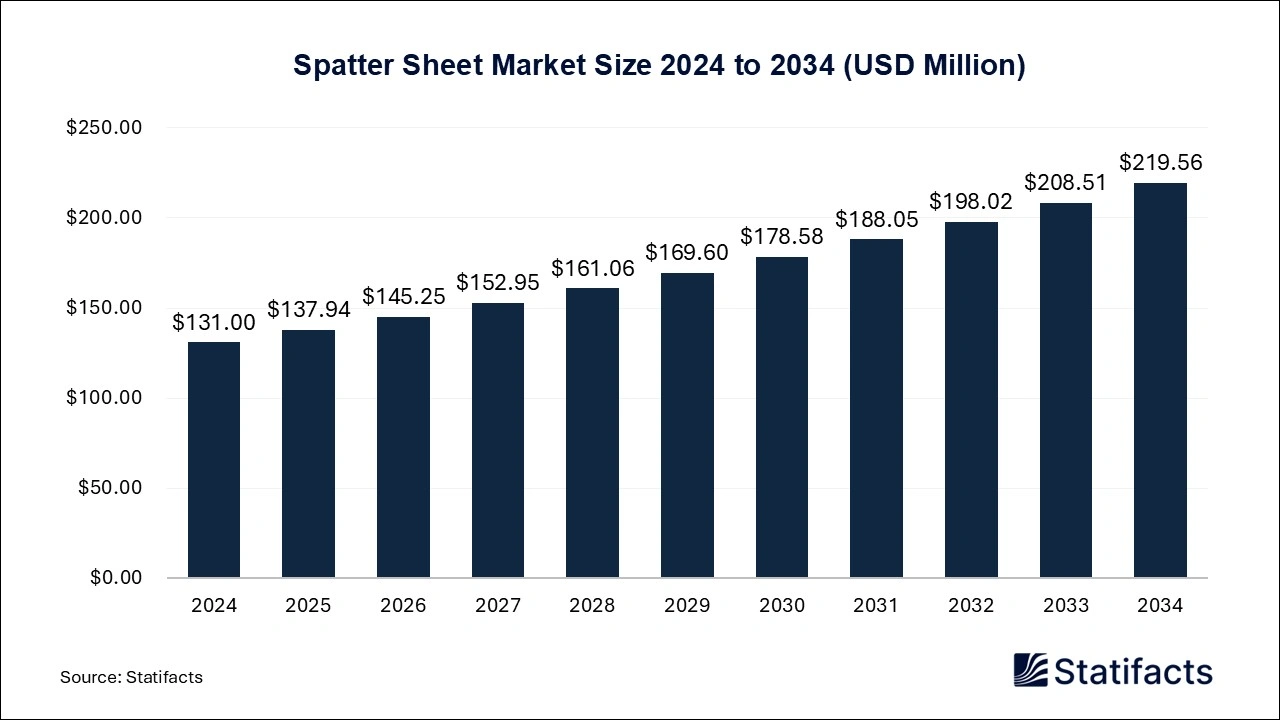
The global spatter sheet market size was valued at USD 137.94 million in 2025, is projected to reach approximately USD 230.24 million by 2034. This growth, driven by increasing demand in industrial and commercial applications, is expected at a CAGR of 5.26%.
| Reports Attributes | Statistics |
| Market Size in 2025 | USD 137.94 Million |
| Market Size in 2026 | USD 145.25 Million |
| Market Size in 2032 | USD 198.02 Million |
| Market Size by 2035 | USD 230.24 Million |
| CAGR 2026 to 2035 | 5.26% |
| Base Year | 2025 |
| Forecast Period | 2026 to 2035 |
The spatter sheet market is witnessing steady growth as industries focus on workplace safety, equipment protection, and operational efficiency. Spatter sheets, typically made from silicone-coated fiberglass, aluminum foil, or heat-resistant fabrics, are used to prevent sparks, molten metal, and welding debris from damaging surrounding surfaces or causing fire hazards. The growing global emphasis on industrial safety standards and the rise in metal fabrication, automotive, shipbuilding, and heavy machinery production are fueling market expansion.
However, market growth is restrained by the availability of low-cost alternatives with limited heat resistance, as well as price fluctuations in raw materials such as silicone and fiberglass. The durability and reusability of spatter sheets can also reduce replacement frequency, slightly impacting recurring demand. Despite these challenges, the market is expected to benefit from rising demand for lightweight, flame-retardant, and eco-friendly materials that align with industrial sustainability goals.
The spatter sheet market is expected to grow more rapidly as artificial intelligence AI and smart manufacturing technologies transform production and quality assurance. Artificial intelligence enables precise monitoring of material performance at high temperatures, predictive defect detection, and optimization of coating formulations to enhance thermal resistance. Machine learning algorithms can analyze usage data from industrial environments to recommend product improvements and predict replacement cycles.
| Regions | Shares (%) |
| North America | 25% |
| Asia Pacific | 40% |
| Europe | 25% |
| LAMEA | 10% |
| Segments | Shares (%) |
| Glass Fiber & Silicone Fiber | 29.85% |
| Carbonized Fiber & Carbon Fiber | 58.14% |
| Others | 12.01% |
| Segments | Shares (%) |
| Industrial | 74.73% |
| Commercial | 25.27% |
Published by Saurabh Bidwai





