

Share


Solvent Market (By Type: Alcohols, Hydrocarbons, Ketones, Esters, Chlorinated Solvents, and Others; By End-use: Paints & Coatings, Printing Inks, Pharmaceuticals, Cosmetics & Personal Care, and Others; By Region: North America, Europe, Asia Pacific, and LAMEA) Industry Size, Share, Growth, Trends 2026 to 2035

The global solvent market, valued at USD 38.29 billion in 2025, is expected to reach USD 70.14 billion by 2035. Growing demand from pharmaceuticals, coatings, and chemical processing is driving steady expansion at a 6.24% CAGR.
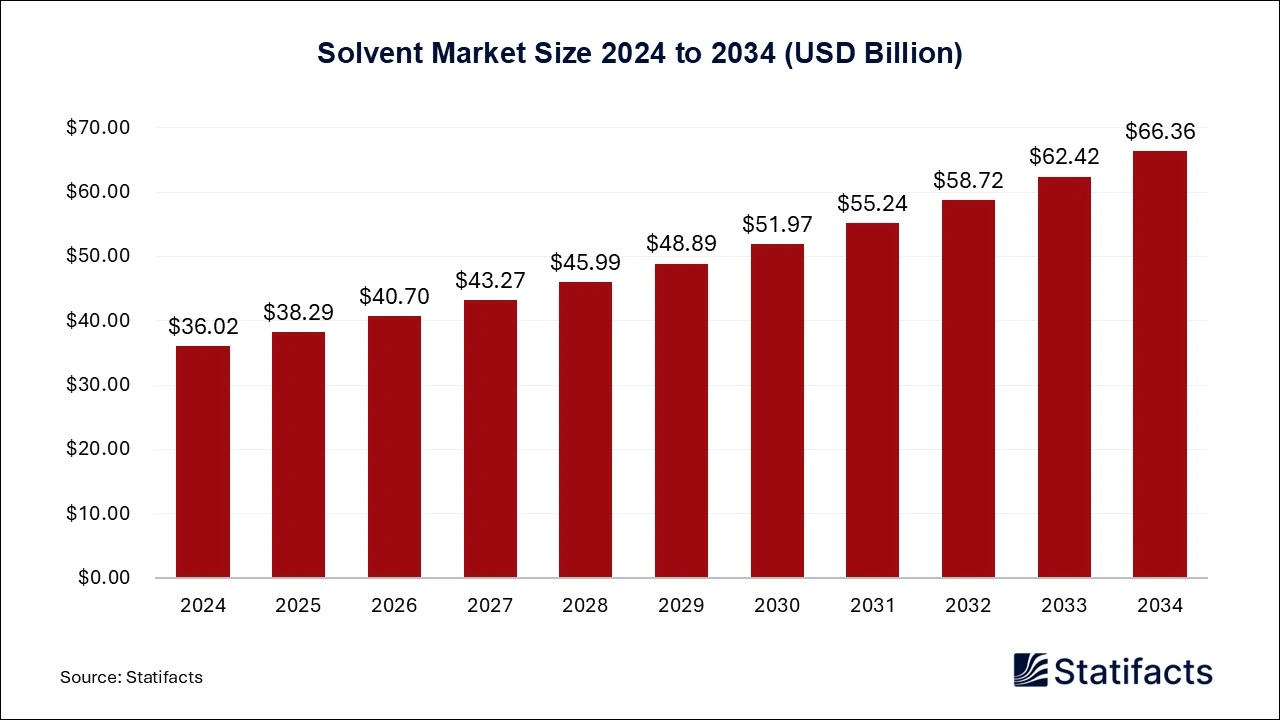
| Reports Attributes | Statistics |
| Market Size in 2025 | USD 38.29 Billion |
| Market Size in 2026 | USD 40.7 Billion |
| Market Size in 2032 | USD 58.72 Billion |
| Market Size by 2035 | USD 70.14 Billion |
| CAGR 2026 to 2035 | 6.24% |
| Base Year | 2025 |
| Forecast Period | 2026 to 2035 |
The solvent market is growing at a decent pace, driven by rising demand for paints and coatings. The majority of the growth is driven by rising global urbanization, which increases the user base across applications such as cosmetics, paints, and inks. The use of solvents is crucial in drug formulation and purification, which has attracted a user base in the pharmaceutical sector. The involvement of regulatory bodies is also leading to investments in better-quality solvents that can be used in pharmaceuticals. Additionally, cosmetic product standards have risen in recent years due to regulatory pressure and consumer preferences, which demand improved texture and stability.
The higher use of traditional solvents has created certain challenges due to higher emissions, and these regulations can limit their use in many settings. Additionally, petrochemical feedstocks are highly dependent on trade relations between nations, which are also facing increased costs.
The rising focus on developing bio-based and low-VO solvents is expected to create several business opportunities for companies in the solvent market. The majority of industries are also shifting towards adopting these sustainable alternatives for reducing their carbon footprint. The growing use of solvents in the automotive industry is also expected to expand the user base for coatings and automotive components.
At the regional level, countries in the Asia Pacific, such as India, China, and Japan, have a broader business scope due to demand in end-use industries like construction, automotive, and pharmaceuticals. The rising development in their tier II and tier III cities is driving a higher demand for solvents in other cosmetic products, too. Additionally, the U.S. is still a key player in the methanol market, where companies are increasingly shifting towards bio-based solutions under pressure from regulatory bodies like the FDA. Additionally, the MEA region is also expected to create opportunities through the expansion of its infrastructure projects and industrial settings.
The solvent market is integrating technologies such as Artificial Intelligence (AI) and Machine Learning (ML) to design solvent blends with improved solubility and environmental focus for their targeted applications. The main reason for adopting the technology in this process is to reduce trial-and-error while also saving operational costs. Additionally, these monitoring systems are expected to detect emissions and other parameters in real time and provide necessary suggestions.
| Regions | Shares (%) |
| North America | 21.79% |
| Asia Pacific | 34.68% |
| Europe | 23.56% |
| LAMEA | 19.97% |
| Segments | Shares (%) |
| Alcohols | 28.31% |
| Hydrocarbons | 21.58% |
| Ketones | 13.71% |
| Esters | 13.46% |
| Chlorinated Solvents | 10.92% |
| Others | 12.02% |
| Segments | Shares (%) |
| Paints & Coatings | 32.44% |
| Printing Inks | 17.66% |
| Pharmaceuticals | 16.92% |
| Cosmetics & Personal Care | 16.38% |
| Others | 16.60% |
Published by Saurabh Bidwai





