



Smartphone Controlled Smart Parking Barrier Market (By Type: Mobile App Control and Multi-Control Systems; By Application: Residential Parking Lots, Commercial Parking Lots, and Others; By Region: North America, Europe, Asia Pacific, Latin America, and Middle East & Africa) Industry Size, Share, Growth, Trends 2026 to 2035.

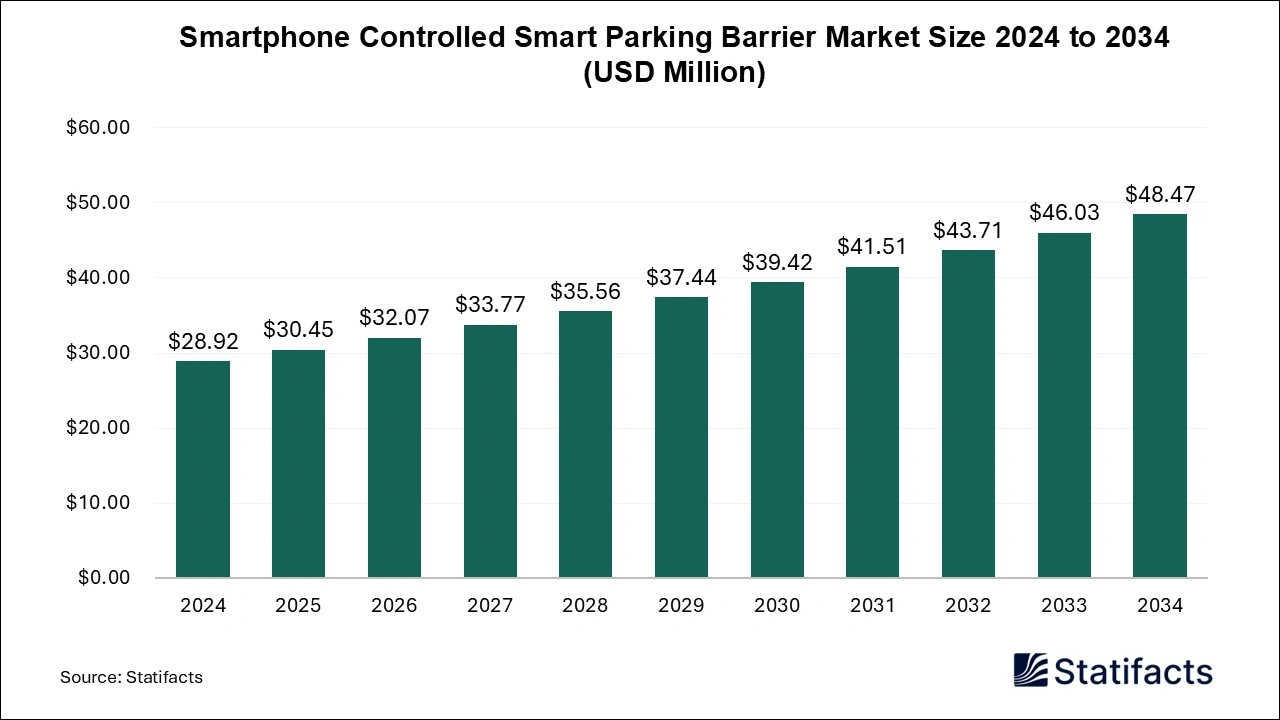
The global smartphone-controlled smart parking barrier market, valued at USD 30.45 million in 2025, is projected to reach approximately USD 50.83 million by 2035. This growth, driven by rising adoption of smart city solutions and IoT integration, is expected at a CAGR of 5.26%.
| Reports Attributes | Statistics |
| Market Size in 2025 | USD 30.45 Million |
| Market Size in 2026 | USD 32.07 Million |
| Market Size in 2032 | USD 43.71 Million |
| Market Size by 2035 | USD 50.83 Million |
| CAGR 2026 to 2035 | 5.26% |
| Base Year | 2025 |
| Forecast Period | 2026 to 2035 |
Smart cities are rapidly increasing their popularity in the market with a shift toward smart infrastructure, therefore, implementing the automation of parking facilities to provide access through smartphones, effective real-time monitoring, and integration of digital payments. The rising volume of cars and the scarcity of parking areas are forcing both the government and the private sector to implement interconnected options that make parking spaces more efficient and less congested. The smart parking barrier market is expanding rapidly due to AI, sensors, and cloud-based technology, enabling users to control barriers remotely via mobile apps.
The technologies make the process more convenient for users, more efficient in operations and security, but reduce human interference. The need for smart city solutions and cashless systems is further fueled by governments encouraging their adoption. The high cost of installation and maintenance, incompatibility with the existing parking infrastructure, and the required expertise in the technology are, however, limiting factors, particularly for small-scale operators and developing economies.
It can be predicted that the market will further develop innovations in solar-powered barriers, artificial intelligence AI access control, and connection with the electric vehicle charging infrastructure. The emergence of the smart mobility ecosystem will significantly benefit the world, with smartphone-controlled smart parking barriers helping to establish a seamless, automated, and sustainable parking experience in the city.
| Regions | Shares (%) |
| North America | 29.40% |
| Asia Pacific | 33.20% |
| Europe | 24.80% |
| LAMEA | 12.60% |
| Segments | Shares (%) |
| Mobile App Control | 57.30% |
| Multi-Control Systems | 42.70% |
| Segments | Shares (%) |
| Residential Parking Lots | 38.10% |
| Commercial Parking Lots | 44.70% |
| Others | 17.20% |
Published by Vidyesh Swar





