



Smart Parking Barrier Market (By Type: Remote Control, Mobile Phone Control, and Multi-Control Systems; By Application: Residential Parking Lots, Commercial Parking Lots, and Others; By Region: North America, Europe, Asia Pacific, Latin America, and Middle East & Africa) Industry Size, Share, Growth, Trends 2026 to 2035.

The global smart parking barrier market, valued at USD 62.9 million in 2025, is projected to reach approximately USD 142.09 million by 2035. This growth, driven by expanding smart infrastructure and automated parking systems, is expected at a CAGR of 8.49%.
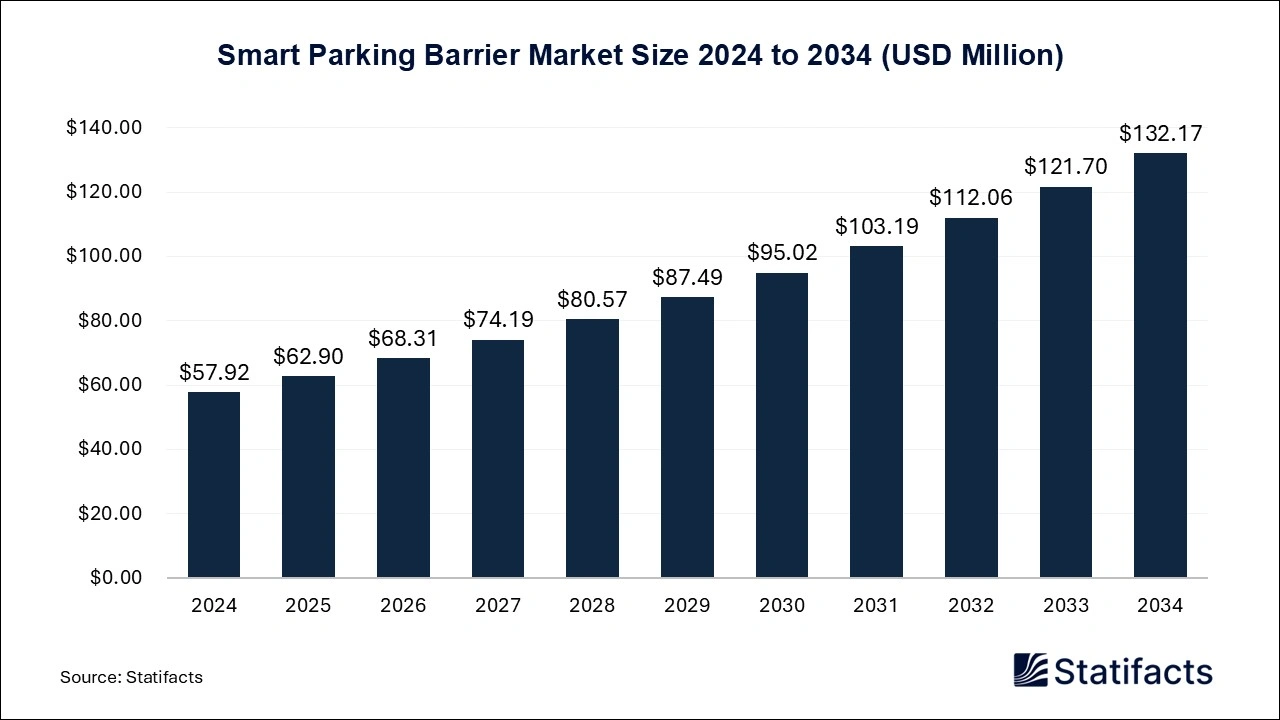
| Reports Attributes | Statistics |
| Market Size in 2025 | USD 62.9 Million |
| Market Size in 2026 | USD 68.31 Million |
| Market Size in 2032 | USD 112.06 Million |
| Market Size by 2035 | USD 142.09 Million |
| CAGR 2026 to 2035 | 8.49% |
| Base Year | 2025 |
| Forecast Period | 2026 to 2035 |
The smart parking barrier market with smartphone control is evolving at an accelerated pace through the improved connectivity technologies like Bluetooth, Wi-Fi, and NB-IoT. The systems are extensively used in commercial facilities, residential buildings, and parking lots to streamline access control and optimize operations. The need for smart parking systems to maximize space and minimize congestion is growing as urbanization accelerates and more cars hit the roads. Controllable barriers are built on smartphones, allowing a client to reserve and unlock the parking lot, track its location remotely, and integrate digital payments, making the process convenient and secure.
Market growth is accelerated by the increasing use of smart city projects and the government's transition to digitalizing urban infrastructure. There are, however, limitations to this situation, including high installation costs, maintenance problems, and compatibility issues with traditional parking systems, especially in developing areas.
The market has a bright future due to the introduction of artificial intelligence and data analytics in the management of parking. The artificial intelligence AI-based algorithms can forecast parking demand, automate barrier operations, and enrich user experience with real-time data. Besides, AI-based video analytics and voice-controlled systems will enhance safety and efficiency. With the development of smart mobility ecosystems, the world is set to be transformed by automated, sustainable, and intelligent parking systems through AI-based smartphone parking barriers.
| Regions | Shares (%) |
| North America | 31.2% |
| Asia Pacific | 29.8% |
| Europe | 26.8% |
| LAMEA | 12.2% |
| Segments | Shares (%) |
| Remote Control | 36.5% |
| Mobile Phone Control | 32.7% |
| Multi-Control Systems | 30.8% |
| Segments | Shares (%) |
| Residential Parking Lots | 34.2% |
| Commercial Parking Lots | 44.1% |
| Others | 21.7% |





