



Selective Laser Melting in Mining Market (By Component: Equipment, Materials, Services, and Others; By Region: North America, Europe, Asia Pacific, Latin America, and Middle East & Africa) Industry Size, Share, Growth, Trends 2025 to 2034

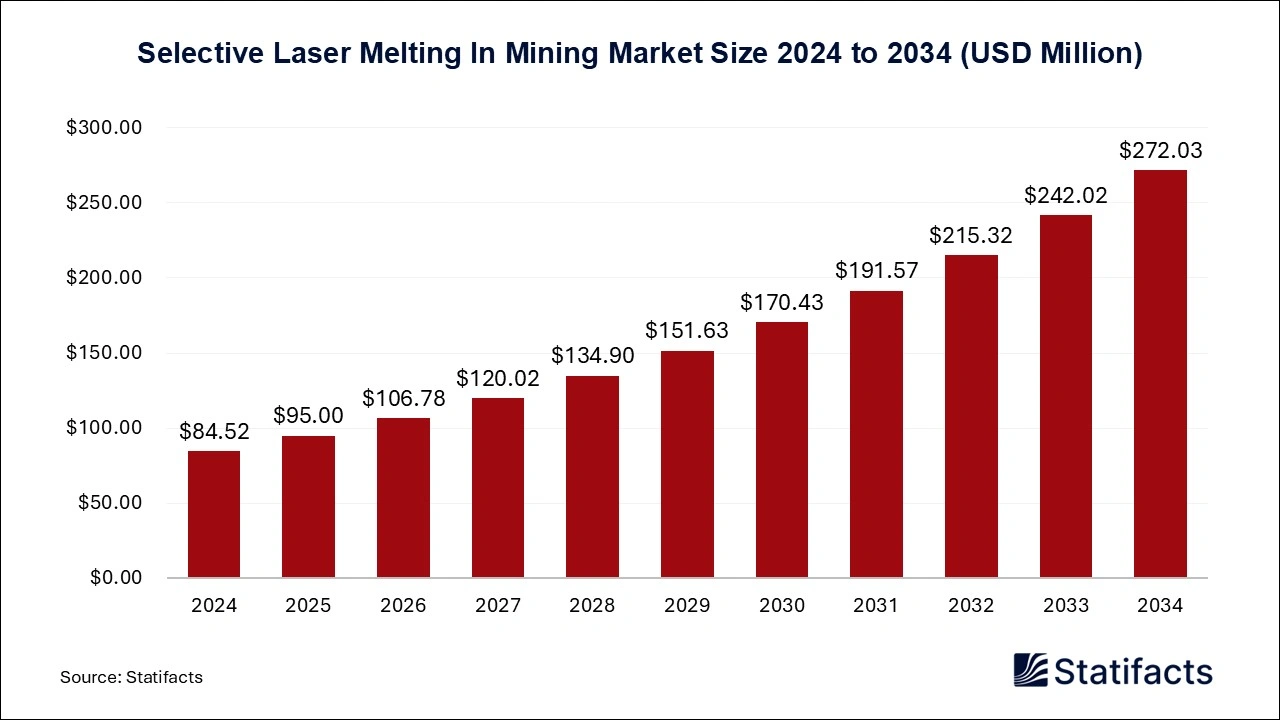
The global selective laser melting in mining market, valued at USD 84.52 million in 2024, is projected to reach approximately USD 272.03 million by 2034. This rapid growth, Driven by the increasing need for lightweight, durable, and customizable metal components in mining equipment, along with the rising adoption of 3D printing technologies to optimize spare parts production and reduce downtime. The growing emphasis on sustainable manufacturing and operational efficiency in the mining sector is further accelerating the adoption of selective laser melting technology.
| Reports Attributes | Statistics |
| Market Size in 2024 | USD 84.52 Million |
| Market Size in 2025 | USD 95 Million |
| Market Size in 2031 | USD 191.57 Million |
| Market Size by 2034 | USD 272.03 Million |
| CAGR 2025 to 2034 | 12.4% |
| Base Year | 2024 |
| Forecast Period | 2025 to 2034 |
Selective laser melting is gaining traction in the mining industry as companies look for new ways to improve component performance, reduce supply chain dependencies, and enhance operational flexibility. Mining operations often rely on heavy, specialized machinery that frequently wears out in harsh environments. selective laser melting enables on-demand production of complex metal parts that are lighter, stronger, and more wear-resistant than those produced using traditional casting or forging methods.
The need to reduce equipment downtime is a major growth driver. With SLM technology, mining companies can print spare parts on-site or near the point of use, significantly reducing lead times for ordering and transporting replacement components. This not only improves operational efficiency but also reduces costs associated with inventory management.
In addition, mining equipment manufacturers are increasingly exploring additive manufacturing to create parts that are optimized for performance, such as improved heat dissipation, reduced weight, and enhanced structural integrity. The technology supports the production of intricate geometries that would otherwise be impossible or too costly with conventional methods.
Advancements in materials science and additive manufacturing processes are expanding the scope of selective laser melting applications in mining. Modern machines can work with a broader range of metals, including titanium, stainless steel, and aluminum alloys. These materials are known for their durability and corrosion resistance, making them ideal for extreme mining environments.
Improved laser precision and multi-laser systems are increasing printing speeds and part accuracy, making the technology more viable for industrial-scale production. Integration with computer-aided design (CAD) and simulation tools allows engineers to optimize part geometry before printing, ensuring that each component meets required performance standards.
Moreover, hybrid manufacturing systems that combine additive and subtractive techniques are being adopted to streamline finishing processes and improve surface quality. The growing availability of portable and modular selective laser melting printers is also expanding the potential for on-site manufacturing in remote mining locations.
Despite its potential, SLM adoption in mining faces several challenges. High initial setup costs, limited operator expertise, and the need for specialized post-processing are key barriers for many mining companies. In addition, material certification and quality assurance standards are still evolving, making it difficult to implement selective laser melting for mission-critical components.
Energy consumption is another area of concern, as the laser-melting process requires substantial power. However, ongoing research into energy-efficient lasers and optimized printing parameters is gradually mitigating this challenge.
The market presents strong opportunities in the areas of equipment maintenance, tooling, and customized component production. Mining companies are exploring partnerships with additive manufacturing service providers to develop spare parts libraries that can be accessed digitally and printed on demand. This approach reduces dependence on long supply chains and promotes operational resilience.
Additionally, SLM technology supports sustainability goals by minimizing material waste and enabling repairs rather than full replacements. It also facilitates the recycling of metal powders, aligning with the mining sector’s broader sustainability commitments.
Emerging economies with growing mining operations, such as Australia, South Africa, and Chile, are expected to drive demand for selective laser melting solutions as they invest in digital transformation and advanced manufacturing infrastructure.
Artificial intelligence is playing an increasingly important role in optimizing the selective laser melting process. AI algorithms analyze vast datasets generated during printing to fine-tune parameters such as laser power, scan speed, and layer thickness, thereby improving print quality and reducing defects. Machine learning models also help predict part performance and identify potential failures before they occur.
In mining applications, AI-driven monitoring systems are being integrated into additive manufacturing setups to ensure consistent part quality and reduce downtime. Predictive maintenance models powered by AI further enable manufacturers to schedule servicing before mechanical issues arise.
| Regions | Shares (%) |
| North America | 30% |
| Asia Pacific | 28% |
| Europe | 25% |
| LAMEA | 17% |
| Segments | Shares (%) |
| Equipment | 50% |
| Materials | 20% |
| Services | 25% |
| Others | 5% |
Published by Saurabh Bidwai





