

Share


Remote Simultaneous Interpretation Platform Market (By Type: Cloud-based, Web-based; By Application: Webinars, Telemedicine, Legal Proceedings, Education and Training, Others; By Region: North America, Europe, Asia-Pacific, Latin America, Middle East and Africa) Industry Size, Share, Growth, Trends 2026 to 2036.

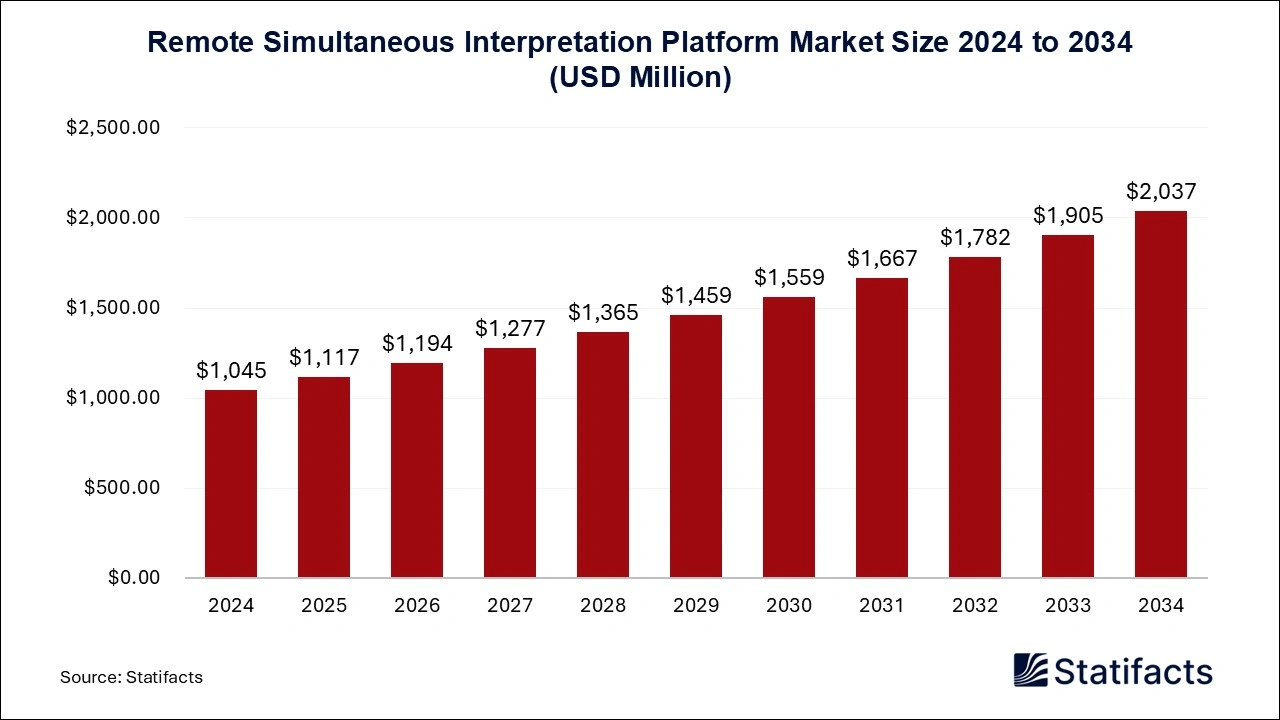
The global remote simultaneous interpretation platform market, valued at USD 1,117 million in 2025, is projected to reach USD 2,163 million by 2035, growing at a CAGR of 6.83% driven by increasing demand for multilingual communication solutions in global events.
| Reports Attributes | Statistics |
| Market Size in 2025 | USD 1,117 Million |
| Market Size in 2026 | USD 1,194 Million |
| Market Size in 2032 | USD 1,782 Million |
| Market Size by 2035 | USD 2,163 Million |
| CAGR 2026 to 2035 | 6.83% |
| Base Year | 2025 |
| Forecast Period | 2026 to 2035 |
In the years to come, more people will participate in meetings and events from various parts of the world. This growing hybrid work culture is increasing the need for real-time language translation. Businesses, schools, hospitals, and conferences want to connect smoothly across multiple languages without requiring travel. RSI platforms enable interpreters to join online meetings and translate instantly for all participants. As global teamwork becomes the norm, these tools are transforming translation from a challenging task into a quick, easy, and essential online service for companies and event organizers.
Additionally, significant opportunities will arise from AI-powered interpretation tools and industry-specific platforms. Instead of replacing human interpreters, new systems will support them by utilizing smart speech recognition and AI suggestions to enhance translation speed and accuracy. Platforms designed for healthcare, law, or finance can include special word lists and security features. Companies that mix AI tools with trained interpreters will offer better quality and earn more from subscriptions and long-term clients. This human-plus-Al approach will define the next stage of RSI platform growth.
One of the main challenges in the RSI market is maintaining fast, accurate, and private translation at the same time. Real-time interpretation needs almost zero delay, but using heavy artificial intelligence (AI) software can slow things down. Mistakes in translation can cause big problems, especially in legal or medical meetings. Additionally, many companies are concerned about their private data being recorded or stored online. Until RSI platforms prove they can offer quick, correct, and safe translation, some organizations will be slow to adopt these digital solutions.
| Regions | Shares (%) |
| North America | 35% |
| Asia Pacific | 28% |
| Europe | 25% |
| LAMEA | 12% |
| Segments | Shares (%) |
| Cloud-based | 60% |
| Web-based | 40% |
| Segments | Shares (%) |
| Webinars | 30% |
| Telemedicine | 18% |
| Legal Proceedings | 16% |
| Education and Training | 22% |
| Others | 14% |
Published by Yogesh Kulkarni





