



Research Antibodies and Reagents Market (By Type: Flow Cytometry, ELISA, Immunofluorescence, Western Blotting, and Others; By Application: Pharmaceutical & Biotechnological Companies, Academic & Research Institutes, Contract Research Organizations, and Others; By Region: North America, Europe, Asia Pacific, Latin America, and Middle East & Africa) Industry Size, Share, Growth, Trends 2026 to 2035

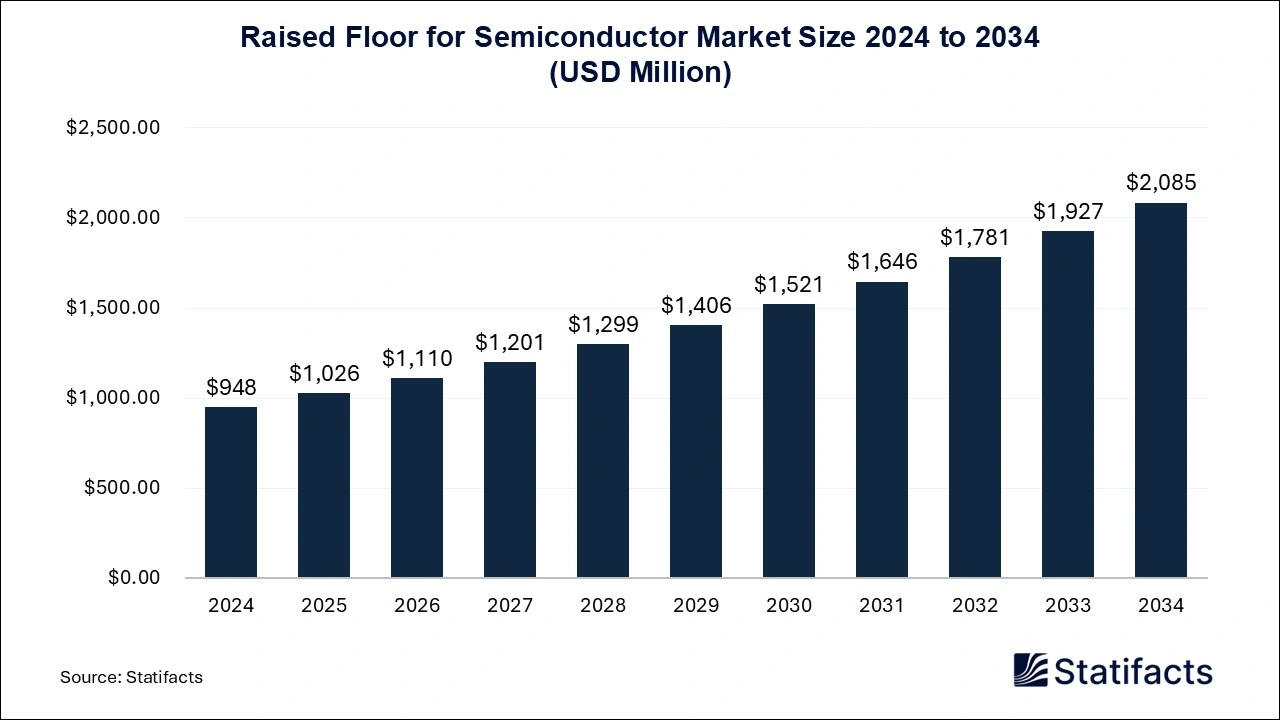
The global raised floor for semiconductor market, valued at USD 1,026 million in 2025, is projected to reach approximately USD 2,235 million by 2035. This growth, driven by rising cleanroom infrastructure demand in semiconductor manufacturing, is expected at a CAGR of 8.10%.
| Reports Attributes | Statistics |
| Market Size in 2025 | USD 1,026 Million |
| Market Size in 2026 | USD 1,110 Million |
| Market Size in 2032 | USD 1,781 Million |
| Market Size by 2035 | USD 2,235 Million |
| CAGR 2026 to 2035 | 8.10% |
| Base Year | 2025 |
| Forecast Period | 2026 to 2035 |
Market growth is being driven by the global expansion of semiconductor manufacturing capacity, rising investments in advanced chip fabrication plants, and the growing demand for ultra-clean and vibration-controlled environments. As countries such as the U.S., China, South Korea, and Taiwan accelerate semiconductor production through national initiatives, the need for specialized infrastructure like raised flooring systems has surged. The trend toward miniaturization of chips and increasing use of automated wafer-handling systems further enhances the need for stable, anti-static, and airflow-optimized flooring designs.
Key restraints include the high installation and maintenance costs associated with cleanroom-grade flooring systems, along with the complexity of retrofitting older facilities. The semiconductor industry’s cyclical demand patterns and high capital intensity can also impact the timing of new floor system installations.
Opportunities lie in the development of smart raised flooring systems integrated with sensors for real-time monitoring of temperature, vibration, and air pressure. The shift toward advanced packaging and next-generation chip manufacturing nodes creates additional demand for adaptable flooring solutions that can support heavy, high-precision equipment. Sustainable materials and modular designs that reduce installation time and environmental impact are also gaining traction.
Artificial intelligence AI is expected to enhance the raised floor for the semiconductor market by optimizing facility layout design, airflow modeling, and vibration control. Through predictive analytics, AI can help manufacturers plan maintenance schedules, reduce downtime, and monitor environmental stability under raised floors.
| Regions | Shares (%) |
| North America | 35% |
| Asia Pacific | 25% |
| Europe | 30% |
| LAMEA | 10% |
| Segments | Shares (%) |
| Aluminum Alloy Floor | 45% |
| Stainless Steel Floor | 40% |
| Others | 15% |
| Segments | Shares (%) |
| Fab | 70% |
| OAST | 30% |





