



Preclinical Bioanalytical Testing Services Market (By Molecule: Small Molecule, Large Molecule; By Test: ADME, Pharmacokinetics (PK), Pharmacodynamics (PD), Bioavailability, Bioequivalence, Biomarker Testing, Cell-based Assay, Virology Testing, Other Tests; By Workflow: Sample Collection and Preparation, Method Development and Validation, Sample Analysis, Other Processes; By End Use: Pharma & BioPharma Companies, CDMO, CRO, Others; By Region: North America, Europe, Asia Pacific, LAMEA) Industry Size, Share, Growth, Trends 2026 to 2035

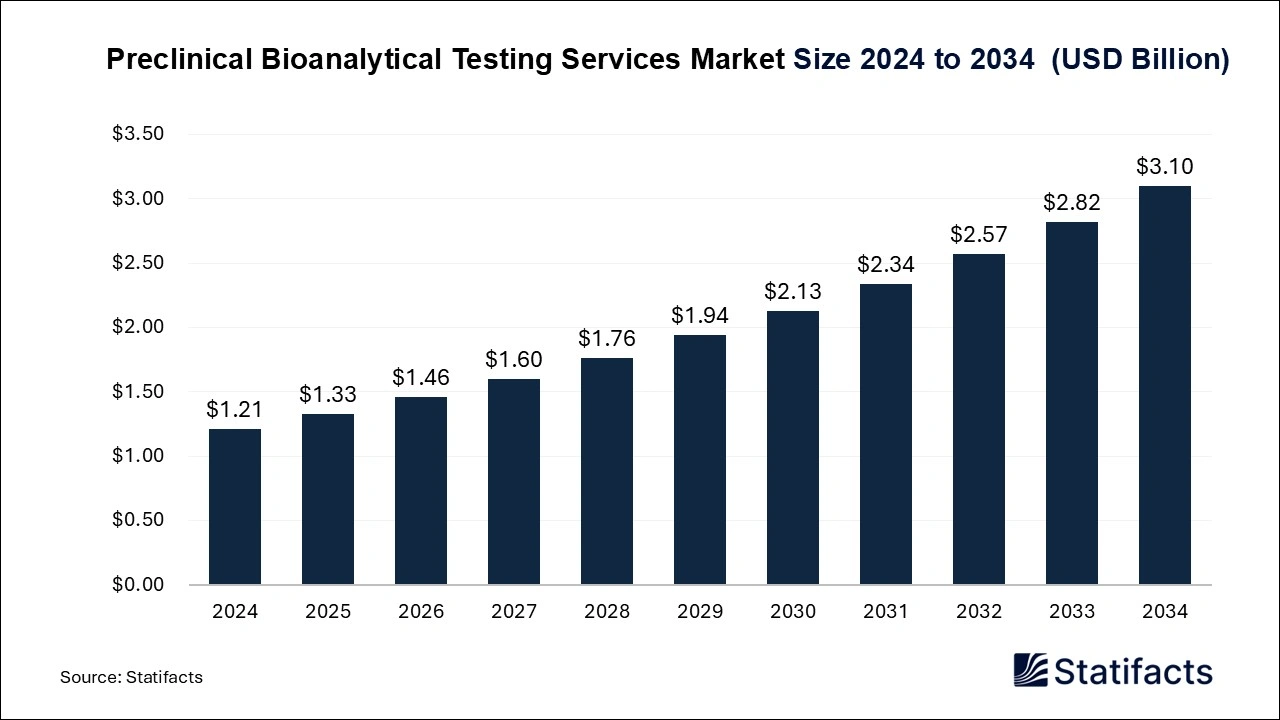
The global preclinical bioanalytical testing services market size was valued at USD 1.33 billion in 2025, is forecast to reach USD 3.36 billion by 2035, driven by strong demand for early-stage drug analysis and a robust 9.71% CAGR.
| Reports Attributes | Statistics |
| Market Size in 2025 | USD 1.33 Billion |
| Market Size in 2026 | USD 1.46 Billion |
| Market Size in 2032 | USD 2.57 Billion |
| Market Size by 2035 | USD 3.36 Billion |
| CAGR 2026 to 2035 | 9.71% |
| Base Year | 2025 |
| Forecast Period | 2026 to 2035 |
The preclinical bioanalytical testing services market is gaining momentum due to the increasing pre-clinical research and development (R&D) programs across the pharmaceutical and biotech sectors. These services are lab-based, which measure and analyze the samples from animal studies to evaluate a new drug candidate’s safety, efficacy, and behavior in the body before human trials. The importance of these services is rising in drug development as they provide data on a drug’s pharmacokinetics and pharmacodynamics, which gives a better understanding of the research about its usability in human testing. The outsourced services are also increasing through the expansion of pre-clinical ADME, PK, TK, and biomarkers. The increasing popularity of large-molecule testing is also promoting business through CRO partnerships.
The healthcare sector has been adopting technologies mainly in the urbanized areas due to higher financial availability and well-established infrastructure. However, there are many concerns in some underdeveloped regions, which may tend to hamper the market growth. The major challenge is the presence of skilled professionals, i.e., scientists, in the industry, which would make up for the growing demand. The rural areas face challenges in adopting these platforms due to higher cost and maintenance, which can hinder the adoption of these services.
The increasing investments in biosimilars are expected to be a crucial growth factor behind the growing popularity of analytical services. The companies are focused on expanding the cell and gene therapy pipelines that will also support business opportunities for the CROs in immunogenicity, viral load, and gene expression in the coming years. The outsourcing trends among small and mid-sized companies will also aid in the expansion of PK, TK, and biomarker analysis, thereby maintaining business frequency for them. The governments are also introducing funds for R&D in drug development, which will help in advancing healthcare demand among the patients.
The integration of Artificial Intelligence (AI) and Machine Learning (ML) is playing an influential role in attracting significant demand through data processing and detecting anomalies, and reducing errors. This is reducing the requirement for human intervention in such processes and making it more accurate within a shorter period. ML is also predicting retention times and separating conditions, which improves the method development cycle significantly. The laboratories have highly adopted these technologies to improve their sampling and innovation process, which will continue to make improvements in the preclinical bioanalytical testing services market.
North America marked its dominance by registering the highest revenue share in the market, mainly driven by the presence of well-established research and healthcare infrastructure. On the other hand, the Asia Pacific is poised to emerge as the fastest-growing region due to growing pharmaceutical and biotechnology projects in countries like China, Japan, and India.
The United States stands as the global leader due to the presence of pharmaceutical and biotech companies, which constantly focus on drug development and advancements for a better business base. The U.S. government has also been supportive of drug discovery, which creates a huge demand for these services in the country. Additionally, this growing popularity is also leading to a greater demand for CROs advancing rapidly. The presence of the FDA in drug approvals is also becoming stricter, which will drive more growth in the preclinical bioanalytical testing services market in the future.
Canada is also expanding a huge business in biotech innovation backed by the educational and research institutions. The government has also been funding the companies to focus on drug development, which tackles the early-stage diseases.
| Regions | Shares (%) |
| North America | 41% |
| Asia Pacific | 23% |
| Europe | 28% |
| LAMEA | 8% |
| Segments | Shares (%) |
| Small Molecule | 61.92% |
| Large Molecule | 38.08% |
| Segments | Shares (%) |
| ADME | 17.58% |
| Pharmacokinetics (PK) | 16.74% |
| Pharmacodynamics (PD) | 12.86% |
| Bioavailability | 10.54% |
| Bioequivalence | 8.05% |
| Biomarker Testing | 10.36% |
| Cell-based Assay | 8.62% |
| Virology Testing | 6.58% |
| Other Tests | 8.67% |
| Segments | Shares (%) |
| Sample Collection and Preparation | 25% |
| Method Development and Validation | 30% |
| Sample Analysis | 32% |
| Other processes | 13% |
| Segments | Shares (%) |
| Pharma & BioPharma Companies | 46% |
| CDMO | 21% |
| CRO | 26% |
| Others | 7% |
Published by Ajit Bansod





