

Share


Global Power Module Packaging Market (By Type: SiC MOSFET Module, IGBT Module, Intelligent Power Module (IPM); By Application: Automotive & EV/HEV, Industrial Control, Consumer Appliances, Wind Power, PV, Energy Storage, Traction, Military & Avionics, Others; By Region: North America, Europe, Asia-Pacific, Latin America, Middle East and Africa) Industry Size, Share, Growth, Trends 2026 to 2035.

The global power module packaging market, valued at USD 11.06 billion in 2025, is projected to reach USD 34.90 billion by 2035, growing at a CAGR of 12.18% driven by the rise of electric vehicles, renewable energy systems, and high-efficiency power electronics.
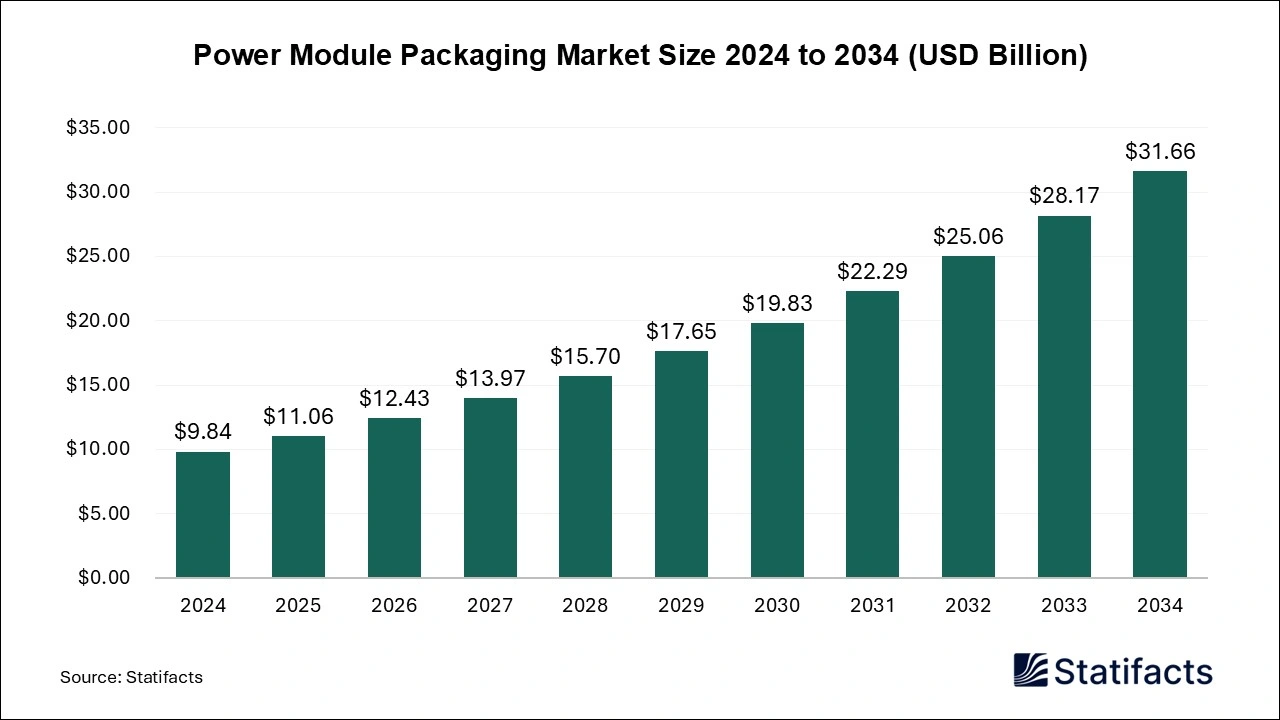
| Reports Attributes | Statistics |
| Market Size in 2025 | USD 11.06 Billion |
| Market Size in 2026 | USD 12.43 Billion |
| Market Size in 2032 | USD 25.06 Billion |
| Market Size by 2035 | USD 34.90 Billion |
| CAGR 2026 to 2035 | 12.18% |
| Base Year | 2025 |
| Forecast Period | 2026 to 2035 |
The power module packaging market is gaining momentum, driven by the rapid adoption of electric vehicles (EVs), which require high-performance modules in both chargers and powertrains. At the same time, renewable energy inverters are creating additional demand for compact, high-power modules that support energy efficiency. The transition toward advanced semiconductor materials such as silicon carbide (SiC) and gallium nitride (GaN) is also reshaping the industry, as these materials enable smaller, faster, and more reliable power systems. The expansion of data centers and AI-driven computing workloads further amplifies demand for robust packaging solutions that ensure higher performance and reliability.
However, the market faces cost-related challenges. Advanced packaging materials remain expensive, which may slow adoption in less developed economies. Even so, opportunities are emerging from the growing electrification of transportation, the deployment of renewable energy, and the increasing need for efficient power management in cloud and AI infrastructure. These trends are expected to sustain long-term growth and create new revenue opportunities for market participants.
Artificial intelligence (AI) and machine learning (ML) are transforming packaging design and testing in this sector. ML algorithms are being applied to optimize layouts and improve manufacturing yields, while AI tools are increasingly used to predict fatigue and aging in power modules through advanced simulations. By enabling predictive maintenance and design optimization, AI is enhancing both the reliability and cost efficiency of power module packaging, thereby accelerating innovation across the industry.
| Regions | Shares (%) |
| North America | 20% |
| Asia Pacific | 40% |
| Europe | 25% |
| LAMEA | 15% |
| Segments | Shares (%) |
| SiC MOSFET Module | 35% |
| IGBT Module | 40% |
| Intelligent Power Module (IPM) | 25% |
| Segments | Shares (%) |
| Automotive & EV/HEV | 25% |
| Industrial Control | 20% |
| Consumer Appliances | 10% |
| Wind power, PV, Energy Storage | 15% |
| Traction | 10% |
| Military & Avionics | 5% |
| Others | 15% |





