

Share



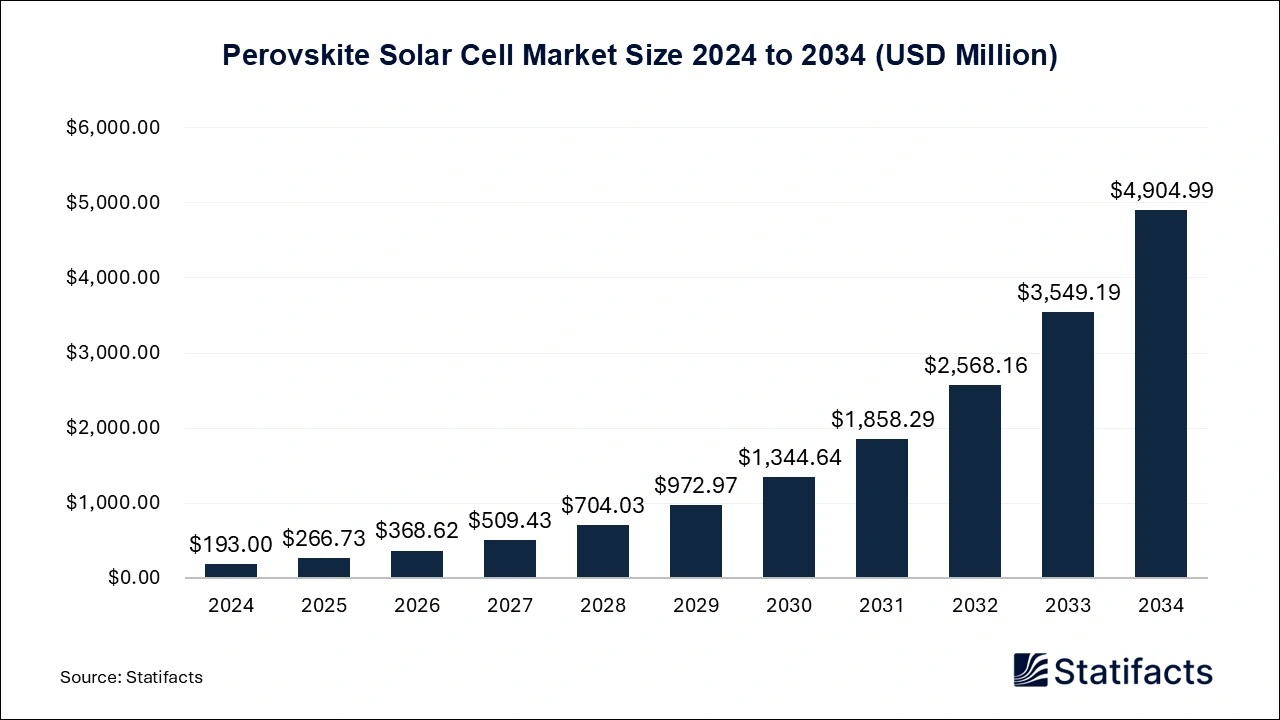
The global perovskite solar cell market size was estimated at USD 193 million in 2024 and is projected to be worth around USD 4,904.99 million by 2034, growing at a CAGR of 38.2% from 2025 to 2034.
| Industry Worth | Details |
| Market Size in 2025 | USD 266.73 Million |
| Market Size by 2034 | USD 4,904.99 Million |
| Market Growth Rate from 2025 to 2034 | CAGR of 38.2% |
Perovskite solar cells (PSCs) are a promising prospect for replacing traditional silicon-based solar cells and hold better options because of excellent light absorption and charge-carrier properties, with energy conversion efficiency. These cells happen to be elastic, lightweight, and easy to fabricate, showing the potential to be better alternatives to silicon-based solar cells. However, the perovskite solar cell market arc for PSCs has suffered successive odysseys since disruption in supply chains and labor shortages, to operational restrictions. Policymaking and some logistical exemptions may be a tool for these governments to support the recovery of the market to guarantee the continuity of projects.
Production developments improved the performance of PSCs; nevertheless, the application of gold as an electrode and the presence of lead as an environmental concern generate potential toxicity. The offsetting factor to these hurdles remains the potential of PSCs to fabricate large quantities at costs much lower than that of any other existing photovoltaic technology, which is hence attracting sufficient research interest and investment. Its wide range of adaptability for various uses and combinations for diverse energy systems is the justification for its importance in the renewable energy future. For PSCs to become a mainstream solar technology, environmental and cost-related constraints will have to be addressed.
“The LAPERITIVO project stands out for its commitment to manufacturability and aims for a technology readiness level close to 7.”
"Launching PeroNova marks a significant milestone in our journey to redefine the landscape of renewable energy through advanced perovskite technology. Our team has diligently worked to create a best-in-class American-made product that offers affordable and reliable renewable energy globally."
The global perovskite solar cell market is experiencing significant growth, with APAC maintaining its position as the dominant region while North America emerges as the fastest-growing market.
APAC
Asia-Pacific dominated the market in 2024. The perovskite solar cell market is poised for rapid expansion in the Asia Pacific region, driven by swift urbanization and even greater energy demands. This will find government support through various initiatives, subsidies, and strategic initiatives to induce the use of renewable energy. The strong manufacturing ecosystem and consumer electronics industry in the region support growth in the market.
Japanese plastics manufacturer Sekisui Chemical is investing in a 100 MW production line to make lightweight perovskite solar panels for low load-bearing rooftops, with an operational start in 2027.
North America
North America is expected to grow at the fastest rate during the forecast period. North America occupies a large chunk of the world market owing to its highly developed infrastructure and much advancement in technology, along with increased awareness and concern regarding clean energy. The automotive sector, together with various end-use industries, accounts for a very large extent of the expansion of this market. Lead market players and the innovation-based strategies thrown at them tilt the competition in favor of the region.
US perovskite company Tandem PV has raised US$50 million in Series A funding and debt. Tandem PV claimed the investment will allow the company to build a commercial-scale perovskite manufacturing plant in the US.
Europe
Europe-the other component of a commitment to sustainability and carbon neutrality, emerged as a strong player in renewable energy. It is supportive regulatory frameworks and investment in technologies for greening the crystalline solar cell, which drives the adoption of these cells. Research states that partnerships and industry leaders enhance this standing in Europe for advancing solar energy technologies.
The perovskite solar cell market is highly competitive, with leading companies such as Fraunhofer ISE, Frontier Energy Solution, FrontMaterials Co. Ltd., FUJIFILM Wako Pure Chemical Corporation, G24 Power Ltd., Greatcell Energy, IDTechEx Ltd, Microquanta, Semiconductor Co. Ltd., Oxford PV, Panasonic Corporation. The global perovskite solar cell market faces intense competition due to evolving consumer preferences, innovation, and product development, with brand managers focusing on global market share and differentiation.
The market is dominated by several companies renowned for their significant contributions to material science solutions. Based on recent data, the top three companies are:
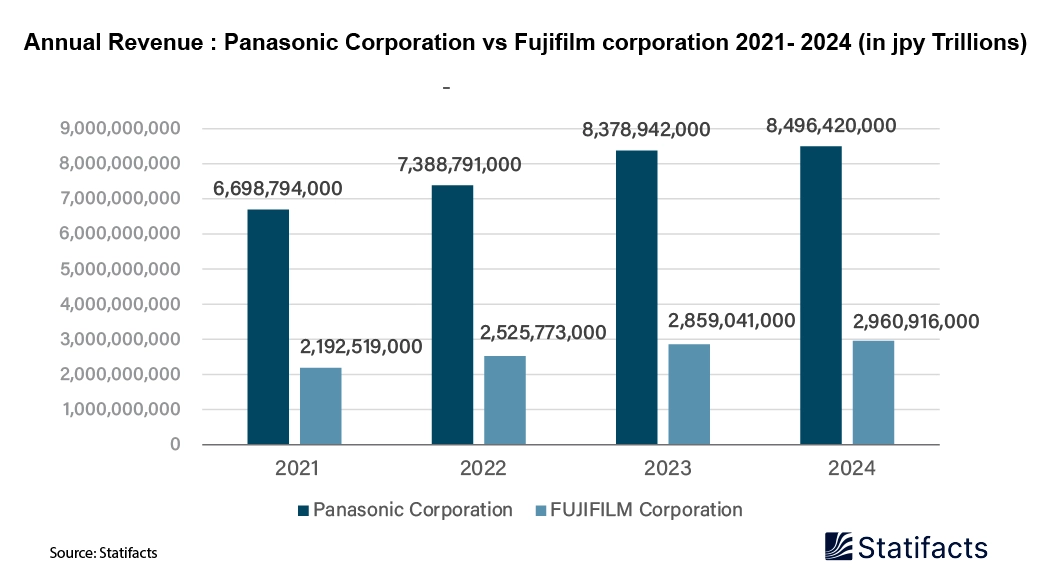
In the fiscal year ended March 31, 2023, the Fujifilm group recorded a yen 2,850.0 billion in consolidated revenue.
According to Panasonic's latest financial reports, the company's current revenue (TTM ) is ₹4.951 trillion. In 2023, the company made a revenue of ₹4.964 Trillion, a decrease over the revenue in the year 2022, that were of ₹5.092 Trillion.
Sekisui Chemical's net sales for FY2022 were 1.242521 trillion yen, up from 1.157945 trillion yen in FY2021.
Published by Shubham Desale





