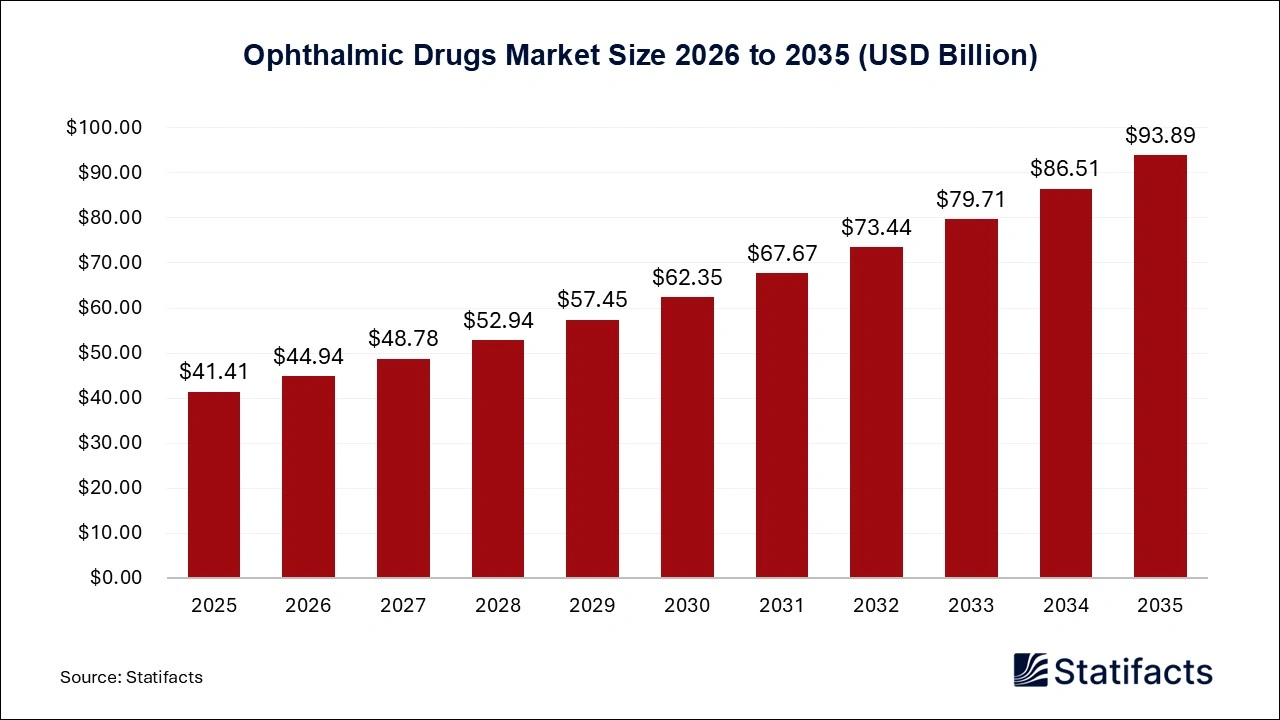
The global ophthalmic drugs market is projected to expand from USD 41.41 billion in 2025 to USD 93.89 billion by 2035, driven by a robust CAGR of 8.53%. This growth is fueled by increasing eye disease prevalence, advancements in treatment technologies, and a rising demand for innovative therapies.
Ophthalmic Drugs Market Statical Scope
| Reports Attributes |
Statistics |
| Market Size in 2025 |
USD 41.41 Billion |
| Market Size in 2026 |
USD 44.94 Billion |
| Market Size in 2032 |
USD 73.44 Billion |
| Market Size by 2035 |
USD 93.89 Billion |
| CAGR 2026 to 2035 |
8.53% |
| Base Year |
2025 |
| Forecast Period |
2026 to 2035 |
The accelerating century aging population and changing lifestyle structures of each individual are paving the way and scope for the market to accommodate visionary approaches of the regional markets. The strategies for the same bring more value to regional market leaders' initiatives.
The ophthalmic drugs are best-in-class sterile medications with promising formulations suitable for the eye-based applications focusing on ocular issues. The sensitive eye treatment involves a fragile anatomical structure, and thus the standard of care for the same accompanies the medication effectiveness. There are various routes for the delivery of ophthalmic medications to treat eye-based conditions. The drug classes harness the major factor of growth and effectiveness, spurring approaches to the market to continue with confident treatments.
The growing eye-condition cases mostly consist of the geriatric population, which expands the recognition of the market and stimulates the constant demand for ophthalmic drugs. The tech innovations like sustained-release systems, digital health, Artificial Intelligence and gene and cell therapy are doubling the profit in the market. The storm of chronic diseases, popularly diabetes, is elevating the demand for retinal therapies.
Ophthalmic Drugs Market Share, By Region, 2025 (%)
| Regions |
Shares (%) |
| North America |
43% |
| Europe |
24% |
| Asia-Pacific |
21% |
| Latin America |
7% |
| Middle East & Africa |
5% |
- North America – The North America regional segment dominated the market by 43% share with the valuable involvement of regional market leaders. The strong base of the R&D area cooperates best with regional tech initiatives, managing the rising advanced needs of the geriatric patient population.
- Asia-Pacific – Asia Pacific leads with 21% of share, with the growing awareness of crucial care patterns and rising cases of retinal disorders fueling more expansion of ophthalmic drugs. Thus, the eye drops segmental growth helps the region to retain its position in the market.
- Europe – Europe is at the forefront due to its growing lifestyle diseases and aging cohort rise, covering almost 24% of the share. The anti-inflammatory drugs and gene therapies secure more value in the regional market.
- Latin America – Latin America successfully acquired 7% of the share with the digital affirmation of telemedicine and online pharmacies. The sub-regional leaders' initiatives have been elevated due to the rising healthcare demand to fit the accessibility criteria.
- Middle East & Africa – MEA region grows by 5% with its power of tech innovation and growing condition prevalence. South Africa’s predicted profit in this market builds more trust in the ongoing advancements in the regional market.
Ophthalmic Drugs Market Share, By Drug Class, 2025 (%)
| Segments |
Shares (%) |
| Anti-VEGF Agents |
35% |
| Anti-inflammatory |
18% |
| Anti-allergy |
14% |
| Anti-glaucoma |
20% |
- Anti-VEGF Agents – The Anti-VEGF agents segment dominated the market by 35% of share of profit, with the growing diabetes stress calling for life-changing treatments for diabetic retinopathy and wet AMD.
- Anti-inflammatory – The segment announces 18% of share in its advanced delivery systems, favoring hydrogels, nanoparticles and nanotechnology-related formulations. The topical drug trends and heavy adoption volume of technologies strengthen the segment.
- Anti-allergy – The anti-allergy segment grows by 14% with its high range of smart, popular products and comprehensive novel delivery mechanisms. The transition in dual-acting agents and the establishment of preservative-free formulations stimulate the segmental growth.
- Anti-glaucoma – The segment acquires 20% of the market share with the high dominance volume of therapeutic classes. The creative agents supporting new medications encourage a unique mechanism to unlock the market strength.
Ophthalmic Drugs Market Share, By Route of Administration, 2025 (%)
| Segments |
Shares (%) |
| Topical |
60% |
| Local Ocular |
28% |
| Systemic |
12% |
- Topical – The topical segment dominated the market by 60% with its clear tech dominance featuring nanotechnology, In Situ Gelling Systems and Drug-Eluting Contact Lenses. The high patient compliance stimulates the segmental market growth.
- Local Ocular – The local ocular segment acquires 28% of the share with its powerful intravitreal injections and nanotechnology. The non-invasive procedures and sustained-release technologies encourage the segmental growth.
- Systemic – The segment grows by 12% as a sincere alternative solution to traditional tropical due to growing retinal conditions. The targeted delivery systems and combination therapies boost the systemic route of administration pattern.
Ophthalmic Drugs Market Share, By Dosage Form, 2025 (%)
| Segments |
Shares (%) |
| Eye Drops |
37% |
| Eye Solutions and Suspensions |
22% |
| Ointments |
17% |
| Capsules and Tablets |
14% |
| Gels |
10% |
- Eye Drops – The eye drops dosage segment dominated the market by 37% as it successfully alleviates the systemic procedure side effects and works brilliantly, matching the actual potential of the eye.
- Eye Solutions and Suspensions – The segment covers 22% of the share due to its emerging improved solutions to manage frequent dosing and sustain the lower bioavailability without any negligence to the dosing.
- Ointments – The segment moves ahead with 17% of share suitable for the lower conjunctival sac. This segment is beneficial for prolonged drug delivery. Alongside, it improves ocular retention, promoting the popular advantages of ocular delivery.
- Capsules and Tablets – The segment leads with 14% of share due to the growing systemic ocular infections, chronic disease, and posterior eye conditions. The effective complementary nature of topical treatments brings out the core potential of the segment.
- Gels – The segment covers 10% of the share with its one-time or as prescribed timely use, without any constant wash boost the effectiveness and easy usage. The growing inflammation and infection rate bolsters the segmental growth.
Ophthalmic Drugs Market Share, By Product, 2025 (%)
| Segments |
Shares (%) |
| Prescription Drugs |
58% |
| OTC |
42% |
- Prescription Drugs – The prescription drugs segment dominated the market by 58% share, with the growing demand for eye drops, mainly in rural areas, holding a vast number of geriatric and eye-infectious populations.
- OTC – The OTC segment acquires 42% of share with its observed dominance of the dry eye segment, while product innovation stays promising with the popular transition in preservative-free formulations.
Ophthalmic Drugs Market Share, By Drug Type, 2025 (%)
| Segments |
Shares (%) |
| Branded Drugs |
65% |
| Generic Drugs |
35% |
- Branded Drugs – The branded drugs segment dominated the market by 65% due to the growing interest in innovation and higher investment rate in R&D. This builds more brand integration in the healthcare sector with the perk of commercialization.
- Generic Drugs – The demand for generic drugs and constant demand and supply volume helped the segment to cover 35% of the market share. The cost-effective alternatives promote affordability for the patient group.