

Share


North America Corporate Wellness Market (By Service: Fitness, Health Risk Assessment, Health Screening, Smoking Cessation, Stress Management, Nutrition & Weight Management, Others; By Category: Psychological Therapists, Fitness & Nutrition Consultants, Organizations/Employers; By Delivery Model: Offsite, Onsite; By End-use: Large Scale Organizations, Medium Scale Organizations, Small Scale Organizations) Industry Size, Share, Growth, Trends 2026 to 2035

The North America corporate wellness market was valued at USD 27.4 billion in 2025 and is expected to reach USD 52.92 billion by 2035, growing at a 6.80% CAGR, driven by rising employee well-being programs and workplace health initiatives.
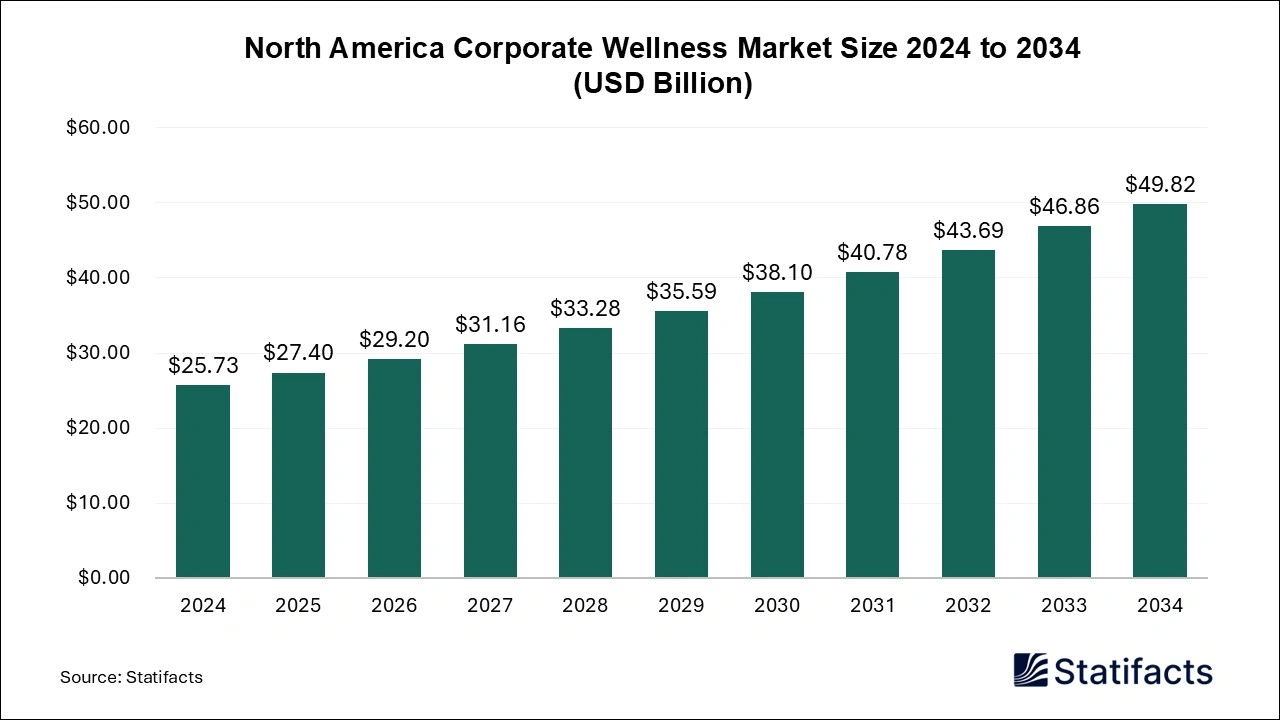
| Reports Attributes | Statistics |
| Market Size in 2025 | USD 27.4 Billion |
| Market Size in 2026 | USD 29.2 Billion |
| Market Size in 2032 | USD 43.69 Billion |
| Market Size by 2035 | USD 52.92 Billion |
| CAGR 2026 to 2035 | 6.80% |
| Base Year | 2025 |
| Forecast Period | 2026 to 2035 |
Demand is rising because employers across the United States and Canada are prioritizing workforce wellness as a strategic tool to improve productivity, reduce absenteeism and enhance job satisfaction. North America has one of the highest prevalences of lifestyle-related health issues, and the CDC has highlighted that preventable chronic diseases account for a major share of employer healthcare costs. This has encouraged companies to expand wellness programs that include physical fitness, nutritional counselling, stress management, mindfulness training, and biometric screening.
Mental health has become one of the strongest drivers of corporate wellness investment. The U.S. Surgeon General’s Advisory in 2022 emphasized the growing mental health crisis among workers and called for stronger organizational policies to support well-being. Employers have responded by adding digital mental health platforms, confidential counselling, burnout prevention tools and improved psychosocial support programs. In Canada, the Public Health Agency of Canada reported in 2023 that workplace stress is one of the primary contributors to lost productivity, which has accelerated demand for comprehensive and accessible wellness solutions.
Another driver is the growth of hybrid and remote work models. Employers have shifted toward digital wellness platforms, virtual coaching, telehealth services and personalized dashboards that allow employees to track their physical and mental wellbeing from home. Wearable devices and health apps are also widely integrated into company wellness programs, offering real time monitoring of activity levels, sleep and cardiovascular patterns.
Despite strong demand, several challenges limit market expansion. The first major obstacle is uneven participation. Many employees remain hesitant due to concerns about data privacy, digital tracking or stigma related to disclosing mental health needs. The National Institute for Occupational Safety and Health noted in 2022 that employees may avoid wellness programs if they fear misuse of health information or lack trust in employer confidentiality policies.
Another constraint is cost. Smaller companies with limited budgets struggle to implement advanced or personalized wellness solutions. Additionally, not all programs demonstrate fast return on investment, leading some employers to reduce or scale back offerings. Research published in the American Journal of Health Promotion in 2023 found that while wellness programs improve engagement, measurable health outcomes and healthcare cost reductions may take several years to materialize. Variation in program quality and the presence of non-standardized offerings also affect adoption across industries.
North America has one of the most mature corporate wellness ecosystems globally. Employers in both the United States and Canada are expanding wellness budgets, enhancing mental health support and adopting technologies that improve personalized care. The region benefits from strong public health guidance, advanced digital infrastructure and high awareness of workplace wellness benefits.
In the United States, high healthcare costs encourage employers to invest in preventive health programs that target chronic diseases and stress related conditions. The presence of large corporations, robust insurance markets and a strong digital health ecosystem supports widespread adoption. Canada, with its public healthcare framework, focuses on reducing workplace stress, improving mental health access and addressing chronic disease risks through structured employer partnerships and provincial wellness initiatives.
The United States is the dominant contributor to the regional market due to its large workforce, high burden of chronic disease and strong corporate investment culture. The CDC’s Workplace Health Resource Center emphasizes structured employer engagement in health promotion, which has led to widespread adoption of wellness platforms, on-site screenings, stress management programs and virtual coaching. Companies are increasingly adopting AI driven health tools, data-driven risk assessment and digital behavioural therapy to support worker wellbeing across both office-based and remote teams.
Canada’s market is expanding due to rising awareness of workplace mental health, improved access to employee assistance programs and supportive government frameworks. Health Canada and provincial ministries have strengthened guidelines for psychological health and safety in the workplace, increasing employer adoption of wellness solutions that target stress, burnout and chronic disease prevention. Canadian employers increasingly integrate virtual mental health therapy, ergonomic programs and wellness analytics platforms into standard benefits packages.
| Segments | Shares (%) |
| Fitness | 13.92% |
| Health Risk Assessment | 14.15% |
| Health Screening | 12.87% |
| Smoking Cessation | 13.71% |
| Stress Management | 11.98% |
| Nutrition & Weight Management | 17.22% |
| Others | 16.15% |
| Segments | Shares (%) |
| Psychological Therapists | 33.48% |
| Fitness & Nutrition Consultants | 31.27% |
| Organizations/Employers | 35.25% |
| Segments | Shares (%) |
| Offsite | 41.15% |
| Onsite | 58.85% |
| Segments | Shares (%) |
| Large Scale Organizations | 45.12% |
| Medium Scale Organizations | 33.27% |
| Small Scale Organizations | 21.61% |
Published by Ajit Bansod





