

Share


North America Biofuels Market (By Fuel Type: Biodiesel, Ethanol; By Feedstock: Coarse Grains, Non-agri Feedstock, Biomass, Vegetable Oil, Sugar Crop, Jatropha, Others) Industry Size, Share, Growth, Trends 2026 to 2035

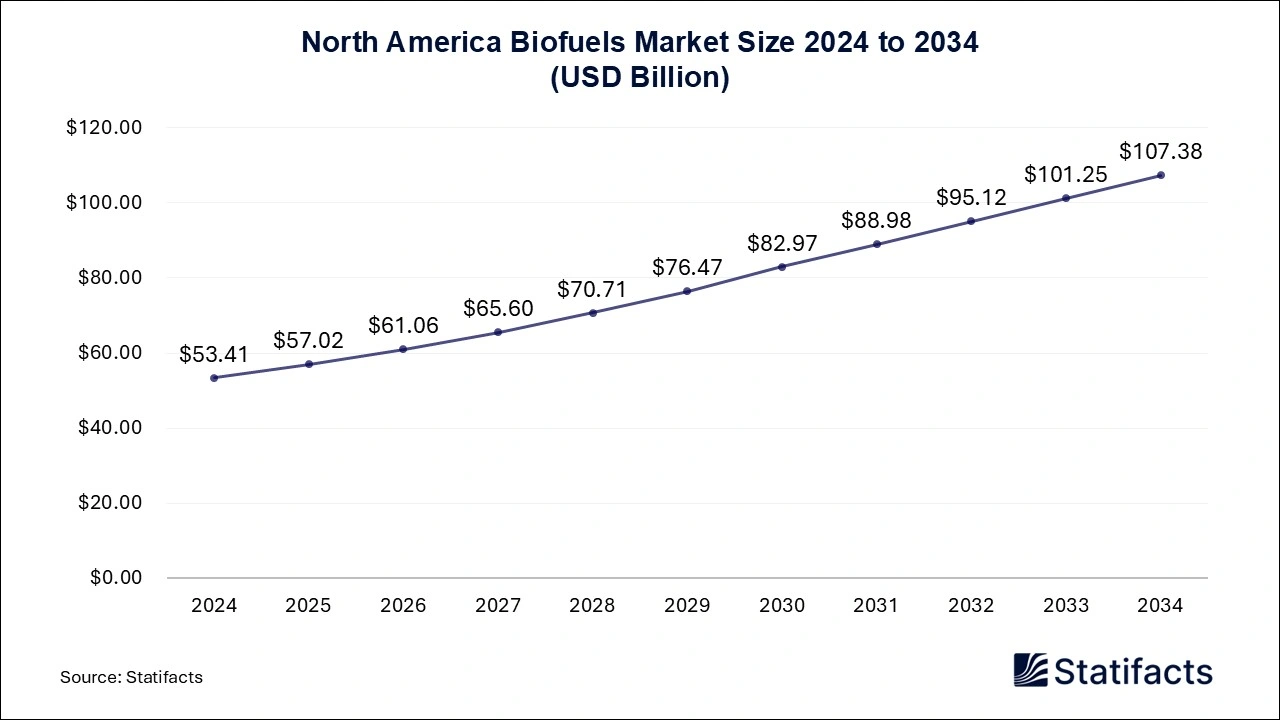
The North America biofuels market reached USD 57.02 billion in 2025 and is projected to grow to nearly USD 113.51 billion by 2035, registering a 7.13% CAGR, fueled by rising renewable energy demand, supportive policies, and decarbonization goals.
| Reports Attributes | Statistics |
| Market Size in 2025 | USD 57.02 Billion |
| Market Size in 2026 | USD 61.06 Billion |
| Market Size in 2032 | USD 95.12 Billion |
| Market Size by 2035 | USD 113.51 Billion |
| CAGR 2026 to 2035 | 7.13% |
| Base Year | 2025 |
| Forecast Period | 2026 to 2035 |
Demand is increasing because the United States and Canada continue to prioritise renewable fuels in their climate action and transportation strategies. The U.S. Renewable Fuel Standard remains one of the strongest policy drivers, requiring obligated parties to blend renewable fuels into the national transportation fuel supply. This sustains high demand for ethanol, biodiesel and renewable diesel across major fuel distributors. In Canada, the Clean Fuel Regulations that took effect in 2022 require reductions in the carbon intensity of fuels, reinforcing the need for domestic biofuel supply growth.
Another driver is the rapid expansion of renewable diesel capacity. Renewable diesel meets stringent fuel quality and engine compatibility requirements, making it a preferred option for freight, logistics fleets and municipal transport. Airlines in North America are also expanding their use of sustainable aviation fuel, supported by incentives and long-term decarbonisation commitments. Ethanol remains widely used due to its established refining and distribution network, and its role in supporting octane requirements in gasoline. Biodiesel demand is strong among agricultural and commercial transport fleets, especially in states with additional blending incentives.
Despite strong policy frameworks, several challenges limit higher adoption. One major obstacle involves feedstock constraints and price volatility. The U.S. Department of Agriculture has reported fluctuations in soybean oil, corn and waste greases, which affect production costs for biodiesel and renewable diesel. Competition between food and fuel uses also remains a policy debate in the region.
Infrastructure gaps present another challenge. While ethanol is well-integrated into fuel networks, higher ethanol blends require additional fuel dispensing equipment that is not uniformly available across states. For renewable diesel, geographic distribution is uneven, with production concentrated in a few states. Capital-intensive biorefinery development also slows expansion, especially as permitting, financing and environmental compliance are lengthy processes.
North America is characterised by a mature ethanol industry, growing renewable diesel capacity and steady biodiesel production. The United States is the leading producer and consumer of biofuels in the region, with significant infrastructure, policies and agricultural capacity. Canada is expanding quickly due to climate regulations that encourage low carbon fuels, increased investment in flexible feedstock biorefineries and partnerships between provincial governments and industry.
Regional differences are notable. The U.S. Midwest dominates ethanol production due to its corn supply and concentration of refineries. Renewable diesel production is rising on the West Coast, supported by California’s Low Carbon Fuel Standard, which creates strong market incentives. Canada’s Western provinces lead in biodiesel and renewable diesel use due to established agricultural supply chains and provincial emission reduction requirements.
The United States is the largest contributor to the regional market. The Renewable Fuel Standard, state-level low carbon fuel policies and strong agricultural output support ongoing expansion. The U.S. Department of Energy in 2023 highlighted that new investments in renewable diesel and sustainable aviation fuel capacity are among the fastest-growing segments. Several large-scale biorefineries are being converted or constructed to meet rising demand from freight, logistics and aviation. Ethanol maintains a stable position in the gasoline pool, while innovation in cellulosic biofuels is advancing through federally funded research programmes.
Canada’s market is accelerating due to the Clean Fuel Regulations, which require fuel suppliers to lower carbon intensity through blending and credit generation. Provinces such as British Columbia and Ontario have introduced stronger renewable fuel mandates, supporting biodiesel and renewable diesel expansion. Investments in next-generation feedstocks, including forestry residues, agricultural waste and municipal organic waste, are strengthening Canada’s role in advanced biofuel development. Public-private partnerships and federal funding initiatives are helping expand domestic supply capacity and reduce dependence on imported low carbon fuels.
| Segments | Shares (%) |
| Biodiesel | 47.06% |
| Ethanol | 52.94% |
| Segments | Shares (%) |
| Coarse Grains | 13.84% |
| Non-agri Feedstock | 14.02% |
| Biomass | 15.65% |
| Vegetable oil | 12.79% |
| Sugar crop | 13.58% |
| Jatropha | 16.23% |
| Others | 13.89% |
Published by Vidyesh Swar





