

Share


Non-magnetic Cables Market (By Type: Polyimide Sheath, Fluorinated Ethylene Propylene Sheath, PTFE Sheath, PVC Sheath, Other; By Application: Military and Aerospace, Medical, Other; By Region: North America, Europe, Asia-Pacific, Latin America, Middle East and Africa) Industry Size, Share, Growth, Trends 2026 to 2035.

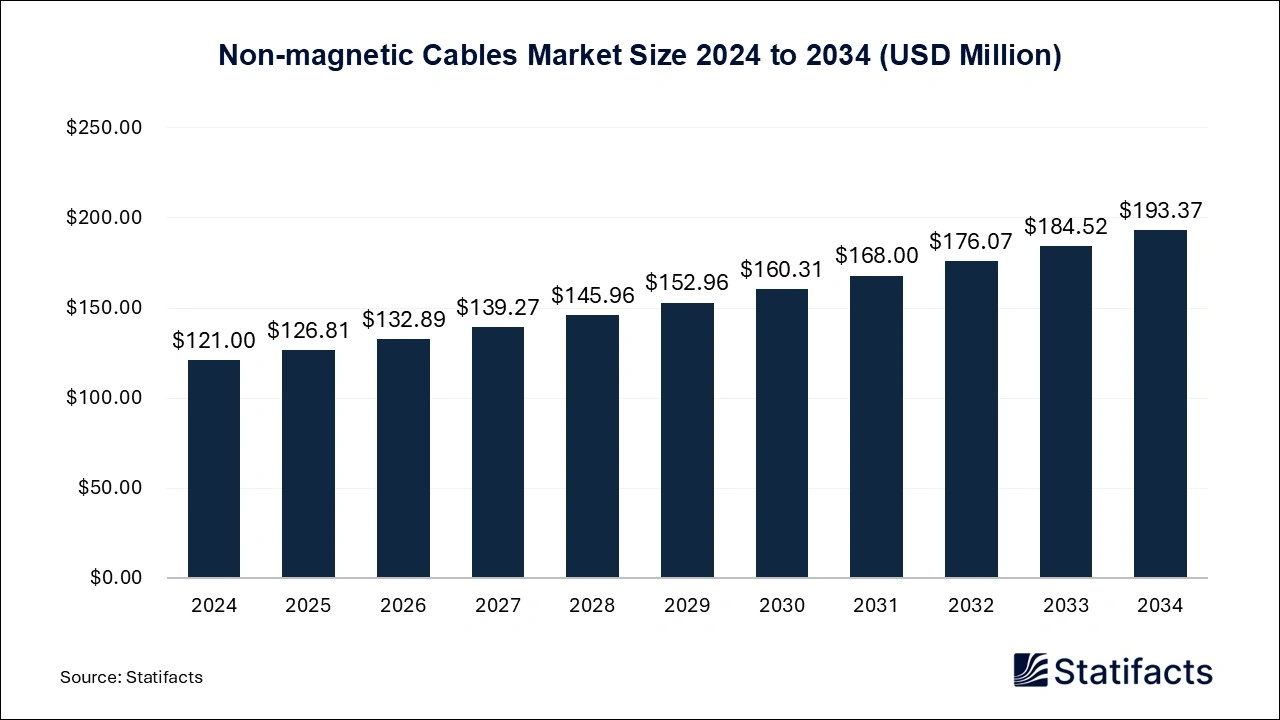
The global non-magnetic cables market, valued at USD 126.81 million in 2025, is projected to reach USD 201.95 million by 2035, growing at a CAGR of 4.76% driven by increasing demand for non-interfering, high-performance cables in military, medical, and telecommunications applications.
| Reports Attributes | Statistics |
| Market Size in 2025 | USD 126.81 Million |
| Market Size in 2026 | USD 132.89 Million |
| Market Size in 2032 | USD 176.07 Million |
| Market Size by 2035 | USD 201.95 Million |
| CAGR 2025 to 2035 | 4.76% |
| Base Year | 2025 |
| Forecast Period | 2026 to 2035 |
The non-magnetic cables market is growing at a faster pace, owing to the rising need for non-magnetic cables in medical imaging, like MRI and others. The use of these cables becomes crucial as they prevent any magnetic interference that can affect the procedure. The growing investment in healthcare infrastructure is creating a massive user base for non-magnetic cables in emerging countries. The limited raw material availability stands as a barrier, as it may also affect the overall pricing of these specialized cables. The growing popularity of various applications in the defence and aerospace sector, like in communication systems, aircraft, and others, is also expected to create multiple business opportunities in the upcoming years. The major focus is on expanding miniaturization, which can help them in the adoption of more applications like robotics.
The non-magnetic cables market is expected to grow more rapidly as companies are focusing on AI adoption, which can be used in optimizing cable design, material selection, and predictive maintenance. By integrating AI-driven simulations and data analytics, manufacturers can enhance performance characteristics such as durability, flexibility, and signal integrity while minimizing electromagnetic interference. Additionally, artificial intelligence AI can streamline production processes, reduce waste, and forecast demand more accurately, enabling faster innovation cycles and cost efficiency. This technological shift is particularly beneficial for applications in medical imaging, aerospace, and defense, where precision and reliability are critical.
| Regions | Shares (%) |
| North America | 32% |
| Asia Pacific | 29% |
| Europe | 27% |
| LAMEA | 12% |
| Segments | Shares (%) |
| Polyimide Sheath | 22% |
| Fluorinated Ethylene Propylene Sheath | 20% |
| PTFE Sheath | 24% |
| PVC Sheath | 26% |
| Other | 8% |
| Segments | Shares (%) |
| Military and Aerospace | 55% |
| Medical | 30% |
| Other | 15% |





