



Natural Language Processing Market (By Type: Statistical NLP, Rule-Based NLP, and Hybrid NLP; By Application: Sentiment Analysis, Data Extraction, Risk and Threat Detection, Automatic Summarization, Content Management, Language Scoring, and Others; By Component: Solution and Services; By Deployment: Cloud and On-Premises; By Enterprise Size: Large Enterprises and Small & Medium Enterprises; By End-use: BFSI, IT & Telecommunication, Healthcare, Education, Media & Entertainment, Retail & E-commerce, and Others; By Region: North America, Europe, Asia Pacific, Latin America, and Middle East & Africa) Industry Size, Share, Growth, Trends 2025 to 2034

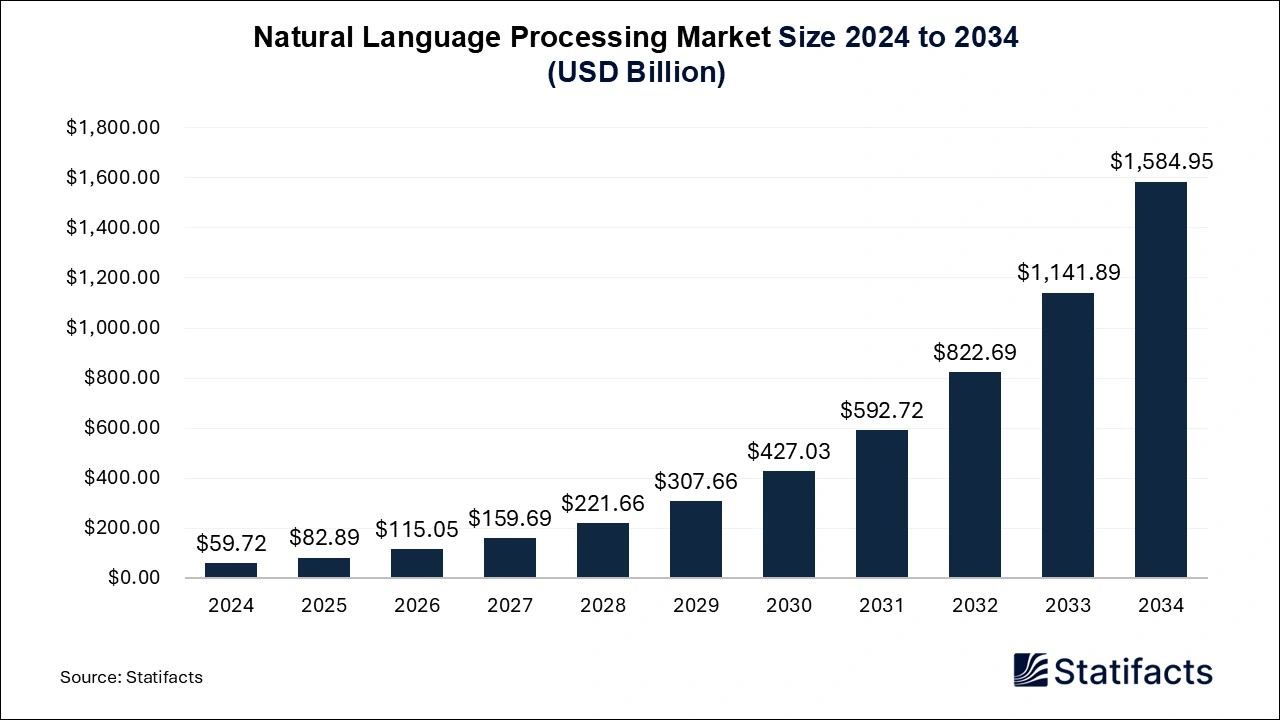
The global natural language processing market, valued at USD 59.72 billion in 2024, is projected to surge to nearly USD 1,584.95 billion by 2034. Driven by rapid AI adoption, automation needs, and enterprise digitization, the market is set to expand at a remarkable CAGR of 38.8%.
| Reports Attributes | Statistics |
| Market Size in 2024 | USD 59.72 Billion |
| Market Size in 2025 | USD 82.89 Billion |
| Market Size in 2031 | USD 592.72 Billion |
| Market Size by 2034 | USD 1,584.95 Billion |
| CAGR 2025 to 2034 | 38.8% |
| Base Year | 2024 |
| Forecast Period | 2025 to 2034 |
The natural language processing market is growing rapidly, driven by the adoption of voice-driven AI assistants such as Alexa, Siri, and Google Assistant. Natural language processing (NLP) is a field of artificial intelligence that enables computers to understand, respond to, and interpret human language in text and voice. NLP is primarily used in chatbots, translation tools, virtual assistants, and more. The rising adoption of smart devices is a major driver of NLP technologies, creating multiple opportunities in the AI industry. These technologies have become an integral part of businesses across industries, which analyze large volumes of unstructured data from social media, calls, emails, and online reviews to drive business growth.
The rise of NLP has been a huge success, but the industry still faces challenges due to language diversity, which complicates context in voice or text. This requires a significant increase in technical expertise and may increase investment costs and hamper adoption in some applications.
However, the natural language processing market is expected to grow more rapidly as deep learning models advance, increasing the accuracy and context understanding of NLP systems. This is leading to more AI-based research, which will benefit multiple companies in the long run by enabling personalized solutions. The implementation of these technologies in the healthcare sector is also expanding rapidly, including for electronic health records, documentation, and patient sentiment analysis, which can be used in subsequent procedures. Additionally, the use of virtual assistants and chatbots across multiple sectors is expected to drive investment to reduce response times and enhance the overall quality of services.
The North American region holds an upper hand in the natural language processing market due to the dominance of countries like the U.S. and Canada in AI. Most of the NLP is attracted to the region because chatbots and other services originate in the U.S. As a result, the country attracts the highest venture capital and investment to accelerate the growth of artificial intelligence. The U.S. government is accelerating AI-based research with collaborations and partnerships with companies. Countries in the Asia Pacific region, China, India, Japan, and South Korea, are among the most opportune areas for investment, where investments can yield significant business profits due to factors such as digital transformation and language diversity.
| Regions | Shares (%) |
| North America | 35% |
| Asia Pacific | 25% |
| Europe | 30% |
| LAMEA | 10% |
| Segments | Shares (%) |
| Statistical NLP | 30% |
| Rule Based NLP | 20% |
| Hybrid NLP | 50% |
| Segments | Shares (%) |
| Sentiment Analysis | 20% |
| Data Extraction | 15% |
| Risk And Threat Detection | 10% |
| Automatic Summarization | 10% |
| Content Management | 15% |
| Language Scoring | 5% |
| Others | 25% |
| Segments | Shares (%) |
| Solution | 70% |
| Services | 30% |
| Segments | Shares (%) |
| Cloud | 75% |
| On-Premises | 25% |
| Segments | Shares (%) |
| Large Enterprises | 55% |
| Small & Medium Enterprises | 45% |
| Segments | Shares (%) |
| BFSI | 20% |
| IT & Telecommunication | 25% |
| Healthcare | 15% |
| Education | 10% |
| Media & Entertainment | 10% |
| Retail & E-commerce | 10% |
| Others | 10% |
Published by Rohan Patil





