

Share


Mold Flux Market (By Type: Powder Form, Granule Form; By Application: Open Casting, Closed Casting; By Region: North America, Asia-Pacific, Europe, Latin America, Middle East & Africa) Industry Size, Share, Growth, Trends 2026 to 2035.

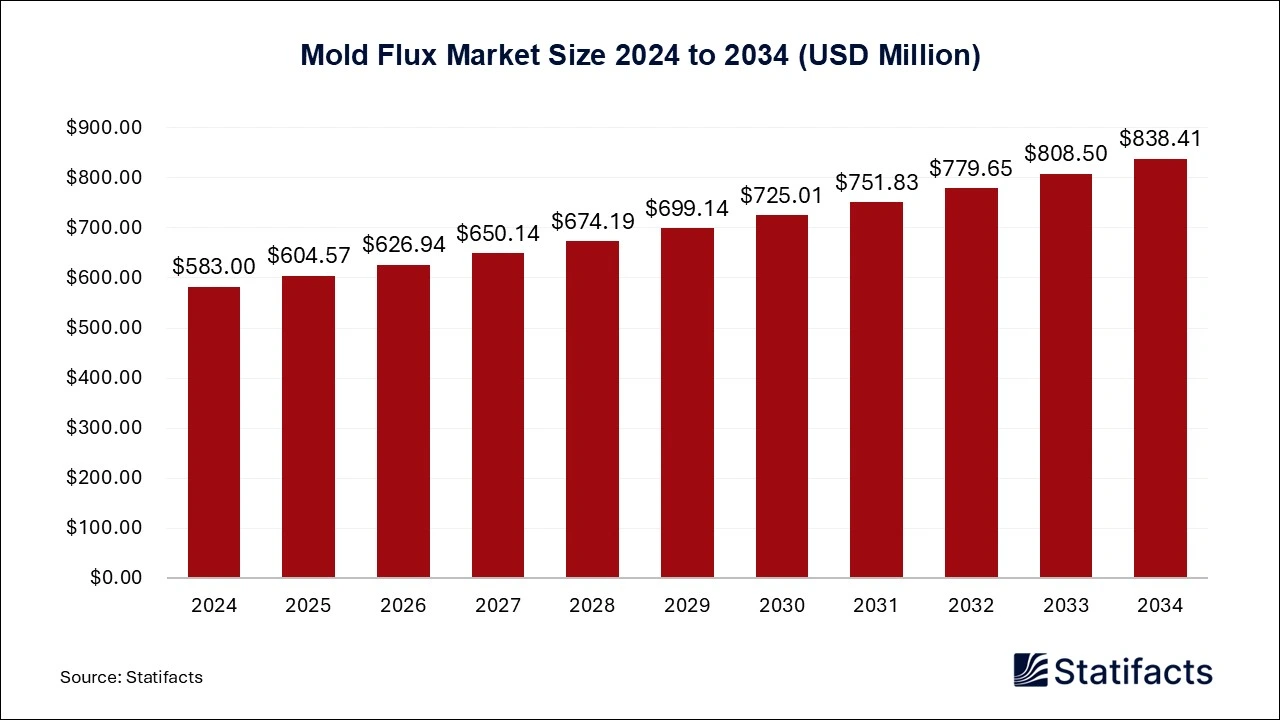
The global mold flux market, valued at USD 604.57 million in 2025, is projected to reach USD 867.61 million by 2035, growing at a CAGR of 3.68% driven by the increasing demand for efficient casting solutions in the steel, automotive, and manufacturing industries.
| Reports Attributes | Statistics |
| Market Size in 2025 | USD 604.57 Million |
| Market Size in 2026 | USD 626.94 Million |
| Market Size in 2032 | USD 779.65 Million |
| Market Size by 2035 | USD 867.61 Million |
| CAGR 2026 to 2035 | 3.68% |
| Base Year | 2025 |
| Forecast Period | 2026 to 2035 |
The mold flux market growth is driven by improved flux performance, automation, industry 4.0, continuous research and development (R&D), demand for specialized products, innovations in continuous casting, growing demand for steel, and the trend toward higher casting speeds. However, the challenging factors of the market includes workforce, cost, process optimization, developing alternatives, fluoride reduction, flux consumption, melting & crystallization, viscosity & heat transfer, quality control, and surface defects. Improving the melting and flowing mold flux behaviour, controlling the heat flux, higher casting speeds, and rising demand for continuous casting will help the growth of the market in the future.
The mold flux market is expected to grow rapidly due to the integration of artificial intelligence (AI). AI is used to design and build injection molds, resulting in better quality parts. AI helps to identify defects and problems in production, reducing material consumption, and improving efficiency. AI-based process optimization reduces cycle times and minimizes waste, leading to cost savings and faster production.
| Regions | Shares (%) |
| North America | 25% |
| Asia Pacific | 35% |
| Europe | 18% |
| LAMEA | 22% |
| Segments | Shares (%) |
| Powder Form | 55% |
| Granule Form | 45% |
| Segments | Shares (%) |
| Open Casting | 60% |
| Closed Casting | 40% |
Published by Saurabh Bidwai





