



Middle East and Africa Fertility Market (By Offering: Assisted Reproductive Technology (IVF, Artificial Insemination, Surrogacy, Others) and Fertility Drugs (Gonadotropin, Anti-estrogen, Others); By End User: Fertility Clinics, Hospitals, and Clinical Research Institutes) Industry Size, Share, Growth, Trends 2026 to 2035

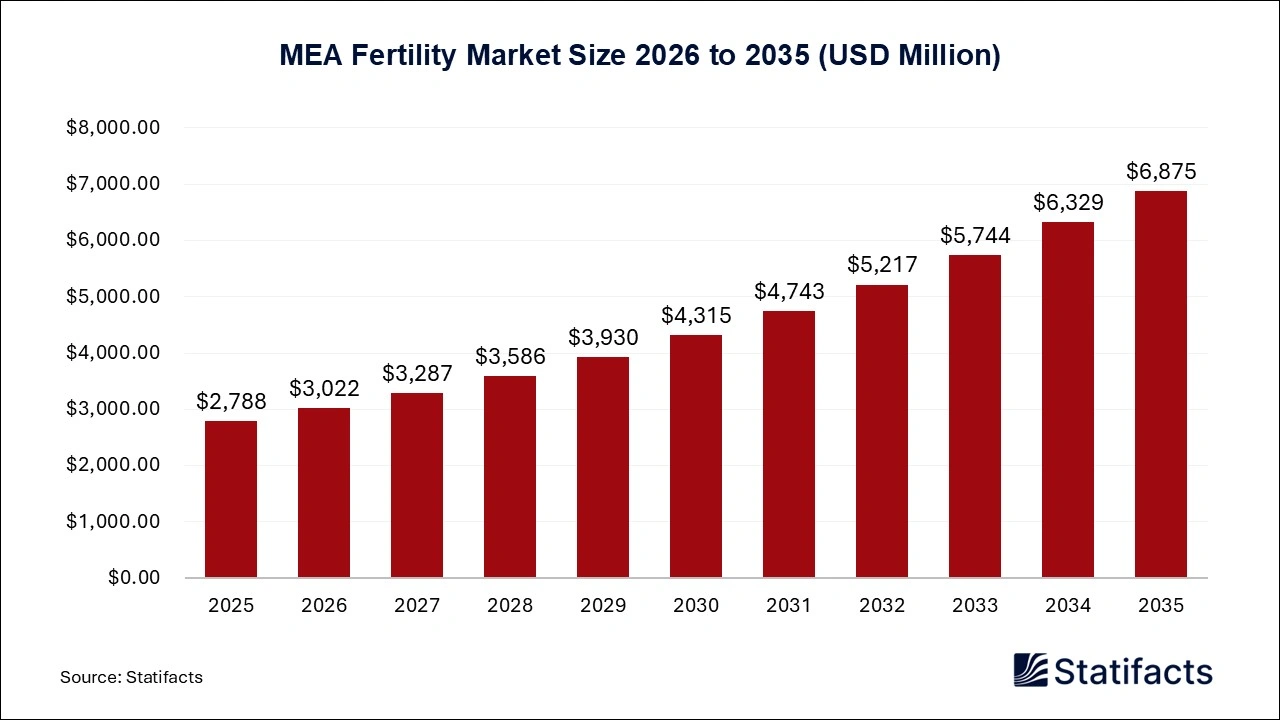
The Middle East and Africa fertility market, valued at USD 2,788 million in 2025, is projected to reach about USD 6,875 million by 2035. Growing demand for assisted reproductive technologies and expanding fertility clinic infrastructure are driving its 9.45% CAGR. Driven by rising infertility prevalence, demographic transitions, and growing investment in reproductive medicine across key regional healthcare systems. Greater awareness of fertility preservation, coupled with strengthened diagnostic capacity in major countries, is also contributing to market expansion.
| Reports Attributes | Statistics |
| Market Size in 2025 | USD 2,788 Million |
| Market Size in 2026 | USD 3,022 Million |
| Market Size in 2032 | USD 5,217 Million |
| Market Size by 2035 | USD 6,875 Million |
| CAGR 2026 to 2035 | 9.45% |
| Base Year | 2025 |
| Forecast Period | 2026 to 2035 |
Demand in the region is growing due to changing demographic and health patterns. According to the World Health Organization’s 2023 global infertility assessment, infertility affects one in six individuals worldwide, and the burden in the Middle East and Africa is shaped by both age-related infertility and secondary infertility related to infection, reproductive health complications, and limited access to early treatment. The United Nations Population Division’s 2023 demographic data notes that several countries in the region have experienced shifts in marriage age, with urban populations delaying family formation, which increases reliance on assisted reproductive technologies. National statistics offices in countries such as Saudi Arabia and the United Arab Emirates report rising maternal age at first birth, a key indicator associated with increased infertility risk.
Greater public awareness and improved availability of fertility services also support demand. Ministries of health across the region, including those in Saudi Arabia, the UAE, South Africa, and Egypt, have introduced reproductive health awareness programs that emphasize the importance of early evaluation and evidence-based infertility management. Academic research published in the Eastern Mediterranean Health Journal in 2022 highlights growing public interest in fertility preservation and reproductive endocrinology, particularly among younger working populations in urban areas. Telemedicine-based consultations have become more widespread, improving access to counselling and initial assessments.
Despite increasing demand, access remains uneven across the region. According to the WHO’s 2023 Eastern Mediterranean Region health systems report, many low and middle-income countries continue to face structural barriers that limit the availability of advanced reproductive treatments. High out-of-pocket costs for IVF cycles, medications, and laboratory diagnostics create access challenges for large segments of the population. Geographic disparities are also significant. Advanced fertility centers are concentrated in major cities such as Riyadh, Dubai, Johannesburg, and Nairobi, while rural and remote areas lack specialized reproductive health services.
Regulatory variation and cultural considerations also influence market growth. Countries differ in their policies regarding gamete donation, embryo storage, and the scope of assisted reproductive services permitted under national guidelines. These differences shape patient decision-making and clinic operations. For example, some countries restrict aspects of donor-assisted conception, which affects treatment options. Workforce shortages are another obstacle. National health workforce assessments from 2022 and 2023 highlight the limited number of trained embryologists and reproductive endocrinologists in many African nations. While AI-assisted tools for embryo imaging and laboratory workflow optimization show promise, adoption remains inconsistent across clinics due to resource and infrastructure constraints.
The Middle East has a more established fertility services infrastructure than many parts of Africa. Countries such as Saudi Arabia, the UAE, Qatar, and Israel have advanced reproductive medicine centers supported by strong private healthcare investment and national regulations. The United Nations 2023 demographic indicators report indicates that several Gulf countries have experienced declining fertility rates, encouraging an expanded focus on reproductive health services and the adoption of technology. Clinics in these markets are adopting AI-supported embryo evaluation, electronic monitoring systems, and digital patient management platforms to enhance efficiency and improve patient outcomes.
Africa presents a mixed landscape, with pockets of advanced services in South Africa, Kenya, Nigeria, and Egypt, alongside significant access limitations in lower-resource settings. The African Union’s 2022 health sector review identifies reproductive health access as a central challenge, even as private-sector investment in fertility centers has been increasing. International collaborations and training programs supported by academic institutions are expanding capacity in embryology and reproductive medicine. Mobile health platforms have become valuable tools for fertility awareness, especially in East Africa, where digital health adoption is strong.
Saudi Arabia has seen a rising demand for fertility treatment due to demographic shifts and increased recognition of infertility as a clinical condition requiring specialized care. According to the Saudi Ministry of Health’s 2023 reproductive health report, the average maternal age at first birth has increased over recent years, contributing to greater reliance on assisted reproductive technologies. The country hosts advanced fertility centers that use high-resolution imaging, AI-enhanced embryo evaluation, and digital laboratory systems. Regulatory guidelines ensure high clinical quality, although access varies between large metropolitan regions and smaller cities. Financial barriers remain for some patients despite growing private insurance participation.
The United Arab Emirates has one of the most advanced fertility service ecosystems in the Middle East. According to the UAE Ministry of Health and Prevention’s 2023 data, the country has experienced increased demand for IVF, ICSI, and fertility preservation due to rising maternal age and greater clinical awareness. The UAE supports a strong private clinic network that incorporates AI-supported embryo assessment, digital cycle tracking platforms, and sophisticated cryopreservation technologies. Regulatory improvements have strengthened patient protections and expanded access, although treatment costs can be significant for individuals without comprehensive insurance coverage. Urban centers such as Dubai and Abu Dhabi remain regional hubs for advanced reproductive care.
| Segments | Shares (%) |
| Assisted Reproductive Technology | 58% |
| Fertility Drugs | 42% |
| Segments | Shares (%) |
| Fertility Clinics | 54% |
| Hospitals | 31% |
| Clinical Research Institutes | 15% |
Published by Ajit Bansod





