



Middle East and Africa Corporate Wellness Market (By Service: Fitness, Health Risk Assessment, Health Screening, Smoking Cessation, Stress Management, Nutrition & Weight Management, Others; By Category: Psychological Therapists, Fitness & Nutrition Consultants, Organizations/Employers; By Delivery Model: Offsite, Onsite; By End-use: Large Scale Organizations, Medium Scale Organizations, Small Scale Organizations) Industry Size, Share, Growth, Trends 2026 to 2035

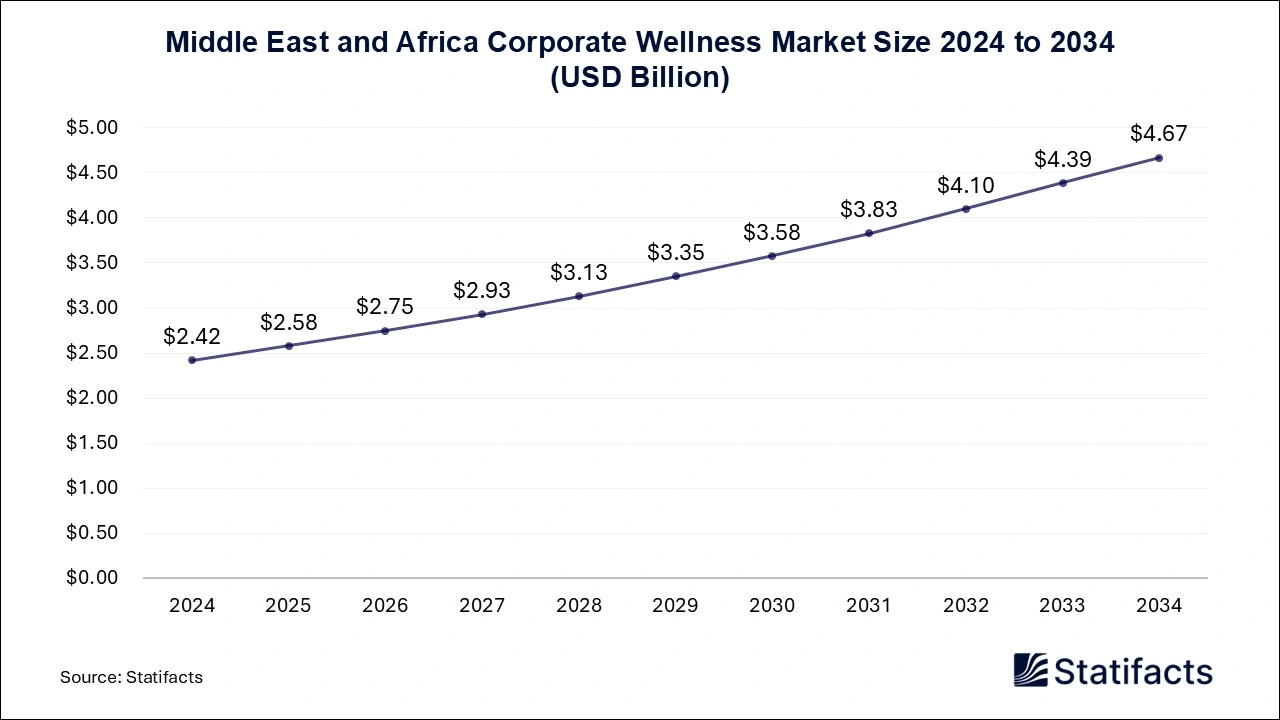
The Middle East & Africa corporate wellness market reached USD 2.58 billion in 2025 and is forecast to grow to about USD 4.96 billion by 2035 at a 6.75% CAGR, driven by increasing workplace health awareness and employer focus on productivity.
| Reports Attributes | Statistics |
| Market Size in 2025 | USD 2.58 Billion |
| Market Size in 2026 | USD 2.75 Billion |
| Market Size in 2032 | USD 4.1 Billion |
| Market Size by 2035 | USD 4.96 Billion |
| CAGR 2026 to 2035 | 6.75% |
| Base Year | 2025 |
| Forecast Period | 2026 to 2035 |
Demand is rising because organisations across the region are placing greater emphasis on employee health and operational performance. In the Gulf countries, rapid economic diversification and competitive labour markets encourage employers to offer mental health support, chronic disease prevention programmes and digital wellbeing platforms. National health authorities in Saudi Arabia and the UAE have introduced stronger preventive health guidelines in recent years, increasing employer engagement in mental health education, fitness partnerships and nutritional counselling.
Urbanisation is another driver. Across major cities in the Middle East and Africa, sedentary lifestyles, metabolic risk factors and long working hours have increased the prevalence of lifestyle-related diseases. The WHO Africa Regional Office reported in 2023 that noncommunicable diseases such as diabetes and hypertension are rising sharply across Sub-Saharan Africa, intensifying employer interest in early screening, telehealth access, wellness coaching and community-based fitness programmes. Hybrid and remote work growth is also contributing to rising adoption of digital wellbeing tools and mental health applications.
Despite strong long-term potential, the region faces several structural barriers. Cost remains a key limitation in small and medium enterprises, especially in lower-income African markets where healthcare budgets are already strained. Many companies struggle to justify spending on comprehensive wellness programmes when more immediate operational needs take priority.
Cultural stigma around mental health also restricts uptake of counselling and behavioural wellbeing programmes in several countries. Employees may hesitate to participate in mental health initiatives because of concerns about confidentiality or social perceptions. Regulatory variation adds complexity, as data privacy and occupational health laws differ significantly across the region. Digital inequality remains another challenge in parts of Sub-Saharan Africa where limited access to smartphones or broadband affects the reach of app-based wellness platforms.
The market divides into two main segments: high-income Gulf economies with advanced corporate wellness adoption, and emerging African markets with developing wellness infrastructures. Gulf Cooperation Council countries show strong uptake of structured wellness solutions, including mental health services, digital fitness platforms, biometric screenings and preventive health campaigns. National health goals in these countries often align closely with organisational wellness strategies.
In Africa, growth is strongest in countries with expanding corporate sectors such as South Africa, Kenya and Nigeria. Employers in these markets are increasing their focus on chronic disease prevention, ergonomic interventions and mental health awareness. Many African companies partner with local healthcare providers or non-governmental organisations to deliver preventive care education, vaccination programmes and stress management workshops. Awareness campaigns led by public health agencies continue to support adoption, though resource gaps slow programme expansion.
Saudi Arabia’s market is growing rapidly due to strong government support for preventive health under national transformation initiatives. The Ministry of Health has prioritised chronic disease prevention, workplace mental health awareness and physical activity promotion. Employers increasingly integrate digital health platforms, virtual counselling services and structured wellness campaigns. Large companies in finance, energy and technology sectors lead adoption, offering personalised health assessments, fitness incentives and nutrition programmes to improve employee wellbeing and productivity.
The UAE holds one of the most advanced corporate wellness ecosystems in the region. The country’s focus on employee wellbeing, mental health and preventive care has strengthened employer adoption of hybrid wellness programmes, telehealth access and digital behavioural health tools. Dubai Health Authority and other emirate-level agencies have launched workplace health guidelines encouraging fitness engagement, stress reduction and lifestyle screening. Multinational companies and local enterprises increasingly incorporate mindfulness sessions, ergonomic assessments and wearable-based wellness challenges into annual programmes.
| Segments | Shares (%) |
| Fitness | 14.12% |
| Health Risk Assessment | 11.38% |
| Health Screening | 15.87% |
| Smoking Cessation | 12.45% |
| Stress Management | 13.29% |
| Nutrition & Weight Management | 18.11% |
| Others | 14.78% |
| Segments | Shares (%) |
| Psychological Therapists | 35.14% |
| Fitness & Nutrition Consultants | 30.08% |
| Organizations/Employers | 34.78% |
| Segments | Shares (%) |
| Offsite | 48.72% |
| Onsite | 51.28% |
| Segments | Shares (%) |
| Large Scale Organizations | 40.23% |
| Medium Scale Organizations | 33.64% |
| Small Scale Organizations | 26.13% |
Published by Ajit Bansod





