

The global medical packaging HDPE cards market, valued at USD 244 million in 2024, is projected to reach USD 475.52 million by 2034, growing at a CAGR of 6.9% driven by increasing demand for durable, sterile, and sustainable healthcare packaging solutions.
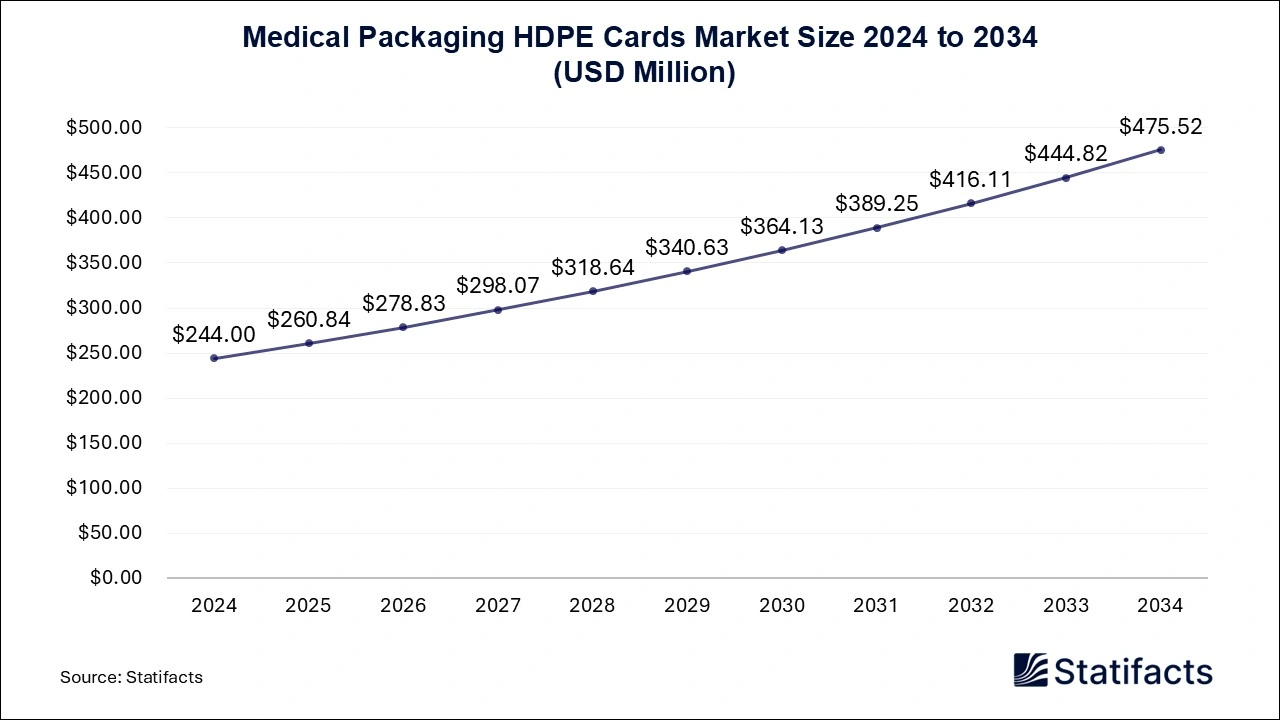
Medical Packaging HDPE Cards Market Statical Scope
| Reports Attributes |
Statistics |
| Market Size in 2024 |
USD 244 Million |
| Market Size in 2025 |
USD 260.84 Million |
| Market Size in 2031 |
USD 389.25 Million |
| Market Size by 2034 |
USD 475.52 Million |
| CAGR 2025 to 2034 |
6.9% |
| Base Year |
2024 |
| Forecast Period |
2025 to 2034 |
The market for medical packaging HDPE cards is growing due to the rising demand for secure device retention with reduced volume and weight, providing a cost-effective and recyclable substitute for thermoformed trays. An increased need for sterile, tamper-resistant, and eco-friendly packaging solutions in the healthcare sector additionally drives the market. Important prospects encompass the growth of medical device production in Asia and the ASEAN region, an increasing emphasis on eco-friendly packaging materials such as recycled HDPE, and the incorporation of intelligent technologies like RFID and AI, alongside progress in medical technology and more rigorous regulatory requirements, particularly in the Asia-Pacific and developing markets. Nonetheless, the market faces limitations, including fluctuations in raw material costs (such as HDPE resin), the need for certified cleanroom manufacturing, strict regulatory adherence, and competition from substitute materials.
- In May 2025, Oliver Healthcare Packaging revealed the inauguration of a 120,000-square-foot manufacturing site in Johor, Malaysia, boosting its medical packaging production capabilities in the expanding healthcare market of Asia-Pacific. It is the ninth of the organization's medical-grade packaging production facilities, situated throughout Asia-Pacific, Europe, and North America. They collectively manufacture pouches, die-cut lids, HDPE cards, and specialized materials for medical devices.
Artificial intelligence (AI) is becoming increasingly vital in the medical packaging industry by enhancing quality assurance through immediate fault identification, increasing productivity through anticipatory maintenance, and supporting sustainable initiatives by maximizing material efficiency. AI helps to guarantee traceability and adherence to regulations by identifying inconsistencies in the supply chain. In the future, AI is anticipated to continue transforming packaging design, optimizing supply chains, and creating personalized medicine packaging.
Medical Packaging HDPE Cards Market Share, By Region, 2024 (%)
| Regions |
Shares (%) |
| North America |
28% |
| Asia Pacific |
42% |
| Europe |
26% |
| Latin America |
2% |
| Middle East & Africa |
2% |
- Asia-Pacific – Accounts for 42% of the market, with the largest share due to rapid industrialization and high demand for medical packaging in the region. Dominates due to significant growth in healthcare infrastructure and production.
- Europe – Represents 26% of the market, driven by strong regulations and high demand for quality medical packaging. Does not dominate as Asia-Pacific outpaces it in growth, but remains a key player due to regulatory standards.
- North America – Holds 28% of the market, with a strong presence in the medical and pharmaceutical industries. Gaining momentum as healthcare regulations and standards for packaging remain strict in the region.
- Latin America – Accounts for 2% of the market, with limited share due to lower production and demand for medical packaging. Does not dominate as regional healthcare infrastructure is still developing.
- Middle East & Africa – Also represents 2% of the market, with a small share due to emerging healthcare markets and lower production capacity. Does not dominate but is witnessing gradual growth in demand for medical packaging solutions.
Medical Packaging HDPE Cards Market Share, By Type, 2024 (%)
| Segments |
Shares (%) |
| Standard Type |
65% |
| Customized Type |
35% |
- Standard Type – Accounts for 65% of the market, representing the most common and widely used type of medical packaging HDPE cards. Dominates due to its cost-effectiveness and high adoption across multiple sectors.
- Customized Type – Holds 35% of the market, representing tailored packaging solutions. Does not dominate as it requires additional investment and is more specialized, but is gaining momentum for premium and specialized applications.
Medical Packaging HDPE Cards Market Share, By Application, 2024 (%)
| Segments |
Shares (%) |
| Medical Devices |
40% |
| Pharmaceuticals |
35% |
| Electronics and Semiconductors |
15% |
| Others |
10% |
- Medical Devices – Represents 40% of the market, the largest application segment, where medical HDPE cards are widely used for packaging medical devices. Dominates due to the high demand for secure and sterile packaging in the medical device industry.
- Pharmaceuticals – Accounts for 35% of the market, with medical packaging HDPE cards used in pharmaceutical packaging. Does not dominate as medical devices lead the sector, but remains a significant player due to stringent packaging requirements.
- Electronics and Semiconductors – Holds 15% of the market, where HDPE cards are used for packaging sensitive electronic components. Not dominating as the sector is niche and requires specific packaging standards.
- Others – Represents 10% of the market, covering miscellaneous applications. Does not dominate due to its smaller scope compared to medical devices and pharmaceuticals.
Published by
Vidyesh Swar



