




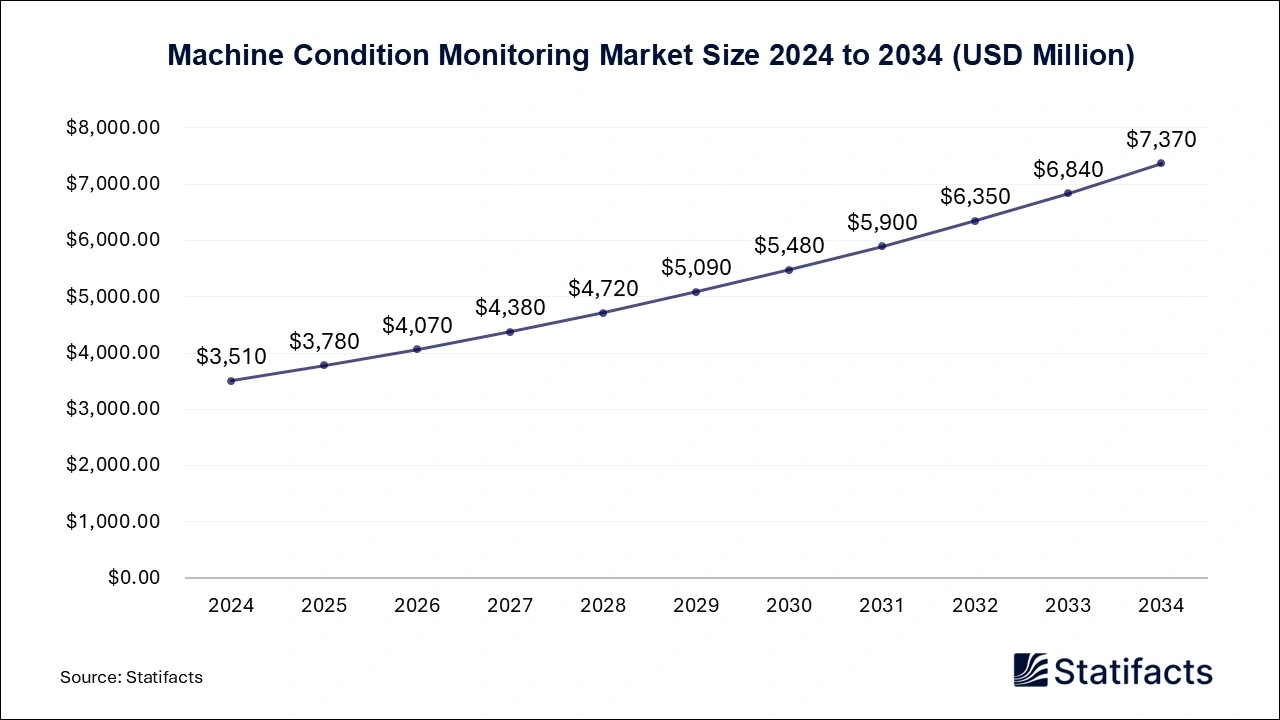
The global machine condition monitoring market size was evaluated at USD 3,510 million in 2024 and is expected to grow around USD 7,370 million by 2034, registering a CAGR of 7.7% from 2025 to 2034.
| Industry Worth | Details |
| Market Size in 2025 | USD 3,780 Million |
| Market Size by 2034 | USD 7,370 Million |
| Market Growth Rate from 2025 to 2034 | CAGR of 7.7% |
Machine condition monitoring is an essential practice that assesses the health of industrial equipment and its performance. Therefore, it should sustain edifice productivity and avoid abrupt breakdowns. Such conditions are monitored with parameters such as temperature, humidity, pressure, vibration, and noise to find any disturbances before significant breaks. Techniques are then used to find out what the machine feels internally, including thermography, vibration analysis, oil analysis, corrosion monitoring, and ultrasound detection. The machine condition monitoring market has recorded a major boost in its growth globally by the digitalization trend that's embraced today, and thus, the evolution of various technologies such as cloud computing, internet of things (IoT), and wireless connectivity. These technologies have brought a significant change in the data collection and analysis methods. This transformation not only improves machine performance but also gears operations towards industrial automation and operational efficiency.
Machine condition monitoring can be an effective remedy to virtually every industry, ranging from manufacturing and healthcare to aerospace, defense, energy, and mining. This could truly swathe the aforementioned industries, increasing and ever augmenting penetration for machine monitoring applications to ensure seamless, uninterrupted operations. The increasing awareness of preventive maintenance further comes to bolsters that movement. Therefore, the power generation, oil and gas, and metals and mining industries have become markets with growing demand for machine monitoring. This is being driven by a need to reduce operational risks to maximize productivity. The furtherance of monitoring technologies and automation trends is envisaged to strengthen the market.
“Real-time monitoring of the actual belt performance prompts the necessary corrective actions ahead of failure or further and more costly damage.”
“The new remote monitoring center in Campinas enables remote delivery of Bently Nevada machinery monitoring and diagnostics expertise in near real-time to support the critical operations of our customers in Brazil and throughout South and Central America.”
Regional factors dictate the development of the machine condition monitoring market in Asia Pacific, North America, and Europe, and hence the rapid growth of this particular market in these regions.
Asia-Pacific
The global machine condition monitoring market is seeing tremendous growth, with Asia-Pacific being a major contributor to the high growth. The Asia-Pacific region is enjoying rapid industrialization along with the advanced technological development and the growth of the manufacturing and energy sectors. The countries in this region have automated and digitized their operations using these tools while improving their operational efficiency. As a result, demand for machine monitoring systems has increased. Increased machine monitoring systems in an industry multiply productivity, equipment life, and performance, for example, in industries such as automotive, oil and gas, power generation, and manufacturing.
North America
North America is expected to grow at the fastest rate during the forecast period. The expenditure in North America is also growing steadily, with technological innovation and industrial automation driving the overall expenditure. Companies utilize real-time data analytics and cloud monitoring to make the processes as efficient as possible while minimizing the overall downtime and providing a safer standard.
Europe
Europe, focusing more on sustainability, energy efficiency, and regulatory compliance, tends to follow the same path in digital transformation through machine monitoring. On this note, adoption of smart monitoring technologies for real-time diagnostics and maintenance planning goes hand in hand with the value of Industry 4.0 practices. Overall, the machine monitoring systems market is likely to see very healthy and strong growth in the immediate future.
The machine condition monitoring market is very fragmented, with leading companies such as SKF (Sweden), Honeywell International (US), National Instruments (US), Emerson Electric (US), General Electric (US), Parker Hannifin Corporation, Rockwell Automation, Inc., Schaeffler AG, Fortive Corporation (Fluke Corporation), ALS Limited. The global machine condition monitoring market is facing intense competition due to innovation, evolving consumer preferences, and product development, with brand managers focusing on global market share and differentiation.
The market is dominated by several companies renowned for their significant contributions. Based on recent data, the top three companies are:
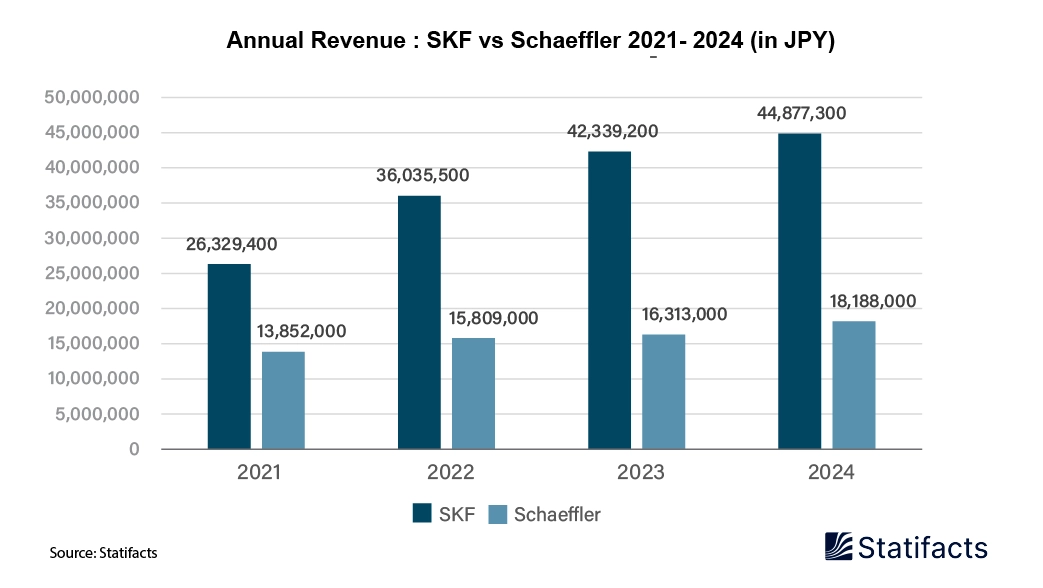
In the fourth quarter of 2024, SKF's net sales in Sweden were SEK 24,725 million. While sales declined in Europe and China, the Americas and India & Southeast Asia saw positive sales growth. The adjusted operating profit for the quarter was SEK 2,735 million, with an adjusted operating margin of 11.1%.
In 2024, Schaeffler's revenue was 18.2 billion euros, a 12.9% increase at constant currency. This growth was partly attributed to the Vitesco Technologies acquisition. The company anticipates a revenue range of 23 to 25 billion euros for 2025.
General Electric's 2023 revenue was $68.0 billion, a 17% increase from the previous year. This growth was driven by strong performance in key segments like aviation and power, with adjusted revenues at $64.6 billion, also up 17% organically. The company's total orders for the year reached $79.2 billion, a 25% increase.
Published by Yogesh Kulkarni





