

Share


Latin America Vehicle-to-Grid Technology Market (By Component Type: Smart Meters, Electric Vehicle Supply Equipment (EVSE), Software, Home Energy Management (HEM); By Application Type: Battery Electric Vehicles (BEVs), Fuel Cell Vehicles (FCVs), Plug-in Hybrid Electric Vehicles (PHEVs)) Industry Size, Share, Growth, Trends 2026 to 2035.

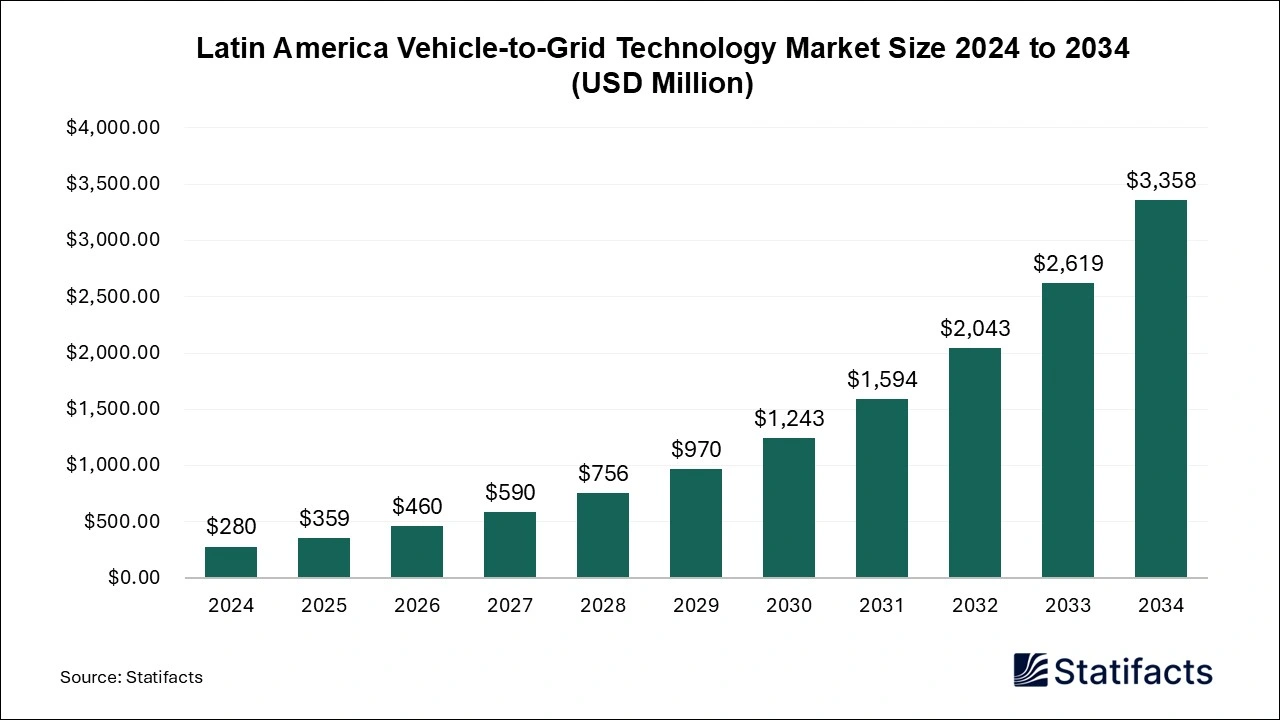
The latin america vehicle-to-grid technology market surpassed USD 359 million in 2025 and is expected to reach USD 3,988 million by 2035, accelerating at a 27.22% CAGR driven by EV adoption and smart energy infrastructure advancements.
| Reports Attributes | Statistics |
| Market Size in 2025 | USD 359 Million |
| Market Size in 2026 | USD 460 Million |
| Market Size in 2032 | USD 2,043 Million |
| Market Size by 2035 | USD 3,988 Million |
| CAGR 2026 to 2035 | 27.22% |
| Base Year | 2025 |
| Forecast Period | 2026 to 2035 |
The Latin America vehicle-to-grid technology market is expanding at a decent pace, driven by growing EV adoption and government incentives to adopt sustainable transport practices. Commercial fleets, such as buses, taxis, and delivery vehicles, are a major driver of V2G expansion in these areas, with greater government support. Renewable energy integration also plays a crucial role, with V2G serving as a low-cost distributed option for companies. Additionally, the many motives for adopting V2G include addressing grid stress and outages, as well as managing power requirements across diverse settings. The increasing commitment to clean energy is expected to drive greater business for V2G technology as infrastructure development expands.
EV penetration is primarily driven by countries such as the Asia Pacific and North America, due to well-established infrastructure and consumer awareness. Compared to these regions and Latin America, EV adoption rates in some countries remain low, limiting the expansion of V2G technology. Lower EV adoption also limits advancements, such as bidirectional chargers and others that require higher capital.
The future landscape of the vehicle-to-grid technology market is highly driven by the increasing number of municipal fleets rolling out several V2G opportunities in their areas. The Latin American vehicle-to-grid technology market is expanding significantly, with these technologies being integrated into rural microgrid applications to stabilize energy supply and reduce reliance on traditional options. Additionally, the growing investments in directional charging stations, smart meters, and other infrastructure are expected to create several opportunities for V2G use in a reliable manner. The long-term use of this technology is expected to help the EV owners earn income by supplying energy. Companies like Nissan have already entered the Chilean market by introducing a bidirectional charging station.
artificial intelligence and machine learning are being adopted in the Latin America vehicle-to-grid technology market, helping predict grid demand and EV availability to schedule charging in a way that optimizes energy use while maintaining battery health. As a result, the influence of AI is rising in delivery fleets due to higher operational requirements. The battery observation patterns are also expected to improve, with these systems providing suggestions for stabilizing the grid and managing grid loads. AI predictive analysis will also help monitor irregularities in activity, cyberattacks, and other faults in chargers, thereby managing the workload.
Brazil is a crucial country for V2G growth due to its rapid EV adoption, which creates opportunities for energy storage. The Electric Vehicle Association ABVE reported that EV sales in Brazil increased by 90%, reaching 177,360 units in 2024. The previous year’s EV sales record in the country was 93,930. This data represents the growth of the Latin America vehicle-to-grid technology market, which will help drive renewable energy storage.
Argentina is expected to emerge as a crucial player in V2G growth due to its higher renewable energy capacity, which supports the adoption of sustainable energy storage solutions. Moreover, the government is also supporting the rise of EVs by providing incentives to buyers, which can help stabilize the grid during peak demand. Additionally, academic research from the National University of Rafaela in Argentina proposed integrating V2G systems with solar systems on its campus to optimize energy use and reduce the carbon footprint, identifying major opportunities for other companies in this business.
| Segments | Shares (%) |
| Smart Meters | 19.58% |
| Electric Vehicle Supply Equipment (EVSE) | 30.61% |
| Software | 29.38% |
| Home Energy Management (HEM) | 20.43% |
| Segments | Shares (%) |
| Battery Electric Vehicles (BEVs) | 38.14% |
| Fuel Cell Vehicles (FCVs) | 32.49% |
| Plug-in Hybrid Electric Vehicles (PHEVs) | 29.37% |
Published by Yogesh Kulkarni





