



Latin America Fertility Market (By Offering: Assisted Reproductive Technology (IVF, Artificial Insemination, Surrogacy, Others) and Fertility Drugs (Gonadotropin, Anti-estrogen, Others); By End User: Fertility Clinics, Hospitals, and Clinical Research Institutes) Industry Size, Share, Growth, Trends 2026 to 2035

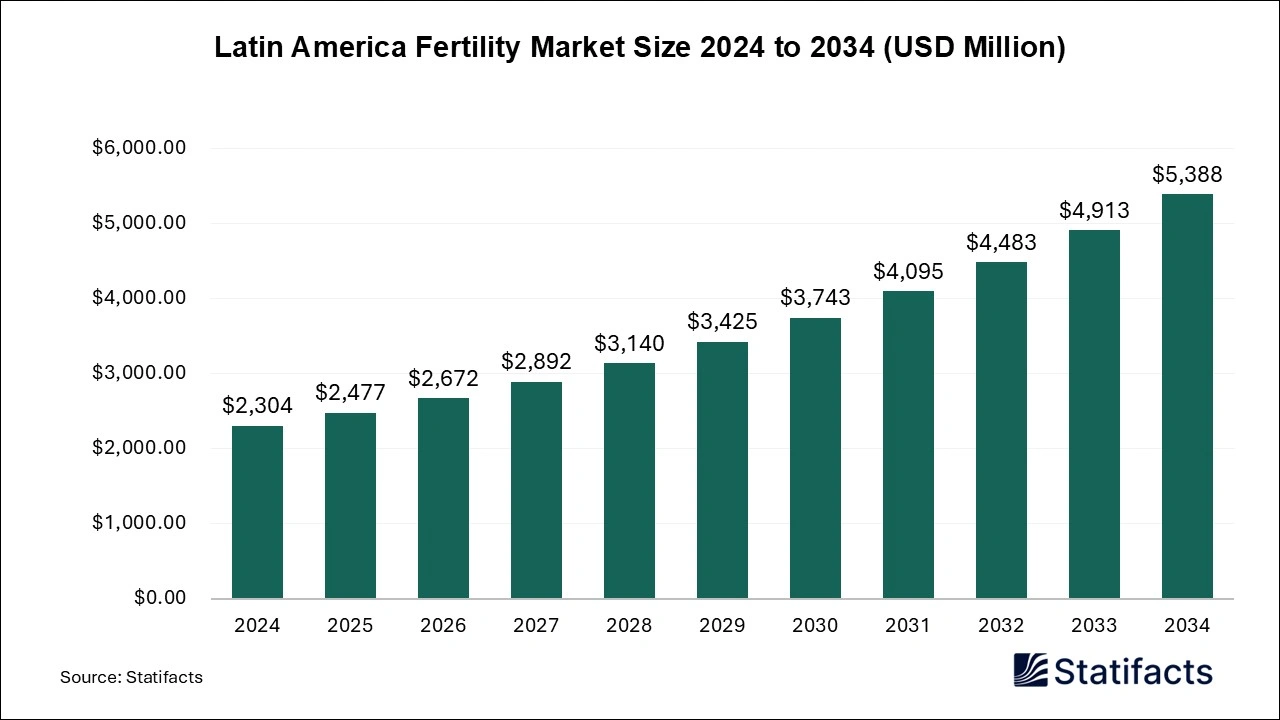
The Latin America fertility market size was valued at USD 2,477 billion in 2025, is projected to reach USD 5,833 billion by 2035. Rising infertility rates, improved access to treatments, and expanding IVF technologies are driving its strong 8.94% CAGR.Driven by rising infertility prevalence, demographic transitions, and growing public and private investment in reproductive health services. Expanding access to assisted reproductive technologies and increasing awareness of fertility preservation across major economies in the region further strengthen market growth.
| Reports Attributes | Statistics |
| Market Size in 2025 | USD 2,477 Million |
| Market Size in 2026 | USD 2,672 Million |
| Market Size in 2032 | USD 4,483 Million |
| Market Size by 2035 | USD 5,833 Million |
| CAGR 2026 to 2035 | 8.94% |
| Base Year | 2025 |
| Forecast Period | 2026 to 2035 |
Demand is rising due to demographic shifts and growing recognition of infertility as a public health concern. According to the World Health Organization’s 2023 analysis, infertility affects one in six individuals globally, and this burden is reflected across Latin America, where delayed childbearing and lifestyle-related risk factors are increasingly common. Pan American Health Organization reports from 2023 highlight that several countries in the region have experienced rising maternal ages at first birth, a trend strongly associated with higher rates of age-related infertility. In urban centers such as São Paulo, Buenos Aires, and Santiago, national statistics offices document clear shifts toward later family formation, creating increased demand for diagnostics and assisted reproduction.
Awareness of fertility options has also expanded significantly. Ministries of health in Brazil and Argentina have launched reproductive health initiatives that encourage early assessment of fertility markers, expand access to gynecological screenings, and promote public campaigns on reproductive aging. Fertility preservation is gaining traction as more individuals pursue career development and delay parenthood. Academic literature published in 2022 in journals such as the Revista Panamericana de Salud Pública notes an increasing demand for egg and sperm freezing among urban populations. Telemedicine-based fertility consultations, strengthened during the pandemic years, continue to support increased engagement with reproductive health services.
Access and affordability are major barriers in the region. PAHO’s 2023 health systems report identifies significant differences in healthcare funding structures across Latin America, which influence access to specialized reproductive treatments. In many countries, fertility services are not fully covered by national insurance systems, leaving patients to bear high out-of-pocket costs for IVF cycles, medications, and diagnostic procedures. Economic disparities between urban and rural populations further widen access gaps, with rural communities often lacking specialized reproductive medicine facilities.
Regulatory variation across Latin America presents additional challenges. Countries differ in their policies regarding gamete donation, embryo use, and eligibility criteria for fertility treatment. Academic assessments published in 2021 and 2022 show that inconsistent regulations lead to cross-border reproductive care, particularly among patients seeking treatments not offered in their home countries. Laboratory capacity also varies. Workforce shortages in embryology and reproductive endocrinology remain a concern in several countries, even as AI-supported imaging and digital laboratory systems begin to help clinics improve efficiency. These technologies show promise, but adoption remains uneven due to resource constraints.
Latin America presents a growing yet uneven landscape of fertility services. Large economies such as Brazil, Argentina, Chile, and Mexico have established fertility clinics with expanding laboratory capabilities, supported by increasing numbers of private providers. According to PAHO’s 2023 health analytics, reproductive health indicators vary widely, but urban areas across the region have seen improvements in access to specialized services. Professional medical associations, including the Latin American Network of Assisted Reproduction, collect regional ART data and report steady increases in IVF, ICSI, and fertility preservation cycles.
Public health initiatives are shaping the regional environment. Brazil’s Unified Health System and Argentina’s national reproductive health legislation offer partial or full coverage for specific fertility treatments, thereby increasing patient access and encouraging earlier interventions. In countries where public funding is still limited, private clinics play a primary role in delivering ART services. Advances in AI-assisted embryo evaluation, electronic witnessing systems, and digital patient management platforms are gradually entering leading clinics in Brazil, Chile, and Argentina, improving laboratory consistency and workflow.
Brazil is one of the largest fertility markets in Latin America, driven by its large population and growing investment in reproductive health. According to Brazil’s Ministry of Health 2023 reproductive health statistics, rising maternal age and increasing infertility diagnoses have contributed to growing demand for assisted reproductive technologies. Brazil provides some publicly funded fertility services through its national health system, although availability varies by region. Major cities host advanced ART centers using high-resolution imaging systems, AI-assisted embryo selection tools, and digital cycle management platforms. Despite these strengths, geographic disparities and long waiting times in public facilities continue to limit equitable access.
Argentina has a strong regulatory and policy foundation for fertility services. According to the Ministry of Health’s 2023 report, national legislation supports access to assisted reproductive technologies through public and private pathways. This framework has contributed to steady demand across major metropolitan areas, including Buenos Aires, Córdoba, and Rosario. Fertility preservation for medical reasons has gained wider acceptance, and clinics increasingly incorporate AI-enhanced embryo imaging to improve laboratory assessment accuracy. While Argentina’s public funding structure improves access compared with many countries in the region, rural populations still encounter barriers due to limited clinic availability and specialist shortages.
| Segments | Shares (%) |
| Assisted Reproductive Technology | 62% |
| Fertility Drugs | 38% |
| Segments | Shares (%) |
| Fertility Clinics | 56% |
| Hospitals | 29% |
| Clinical Research Institutes | 15% |
Published by Ajit Bansod





