

Share


Europe Biofuels Market (By Fuel Type: Biodiesel, Ethanol; By Feedstock: Coarse Grains, Non-agri Feedstock, Biomass, Vegetable Oil, Sugar Crop, Jatropha, Others) Industry Size, Share, Growth, Trends 2026 to 2035

The Latin America biofuels market reached USD 32.05 billion in 2025 and is expected to grow to USD 59.08 billion by 2035 at a 6.31% CAGR, fueled by expanding ethanol production, agricultural feedstock availability, and renewable energy policies.
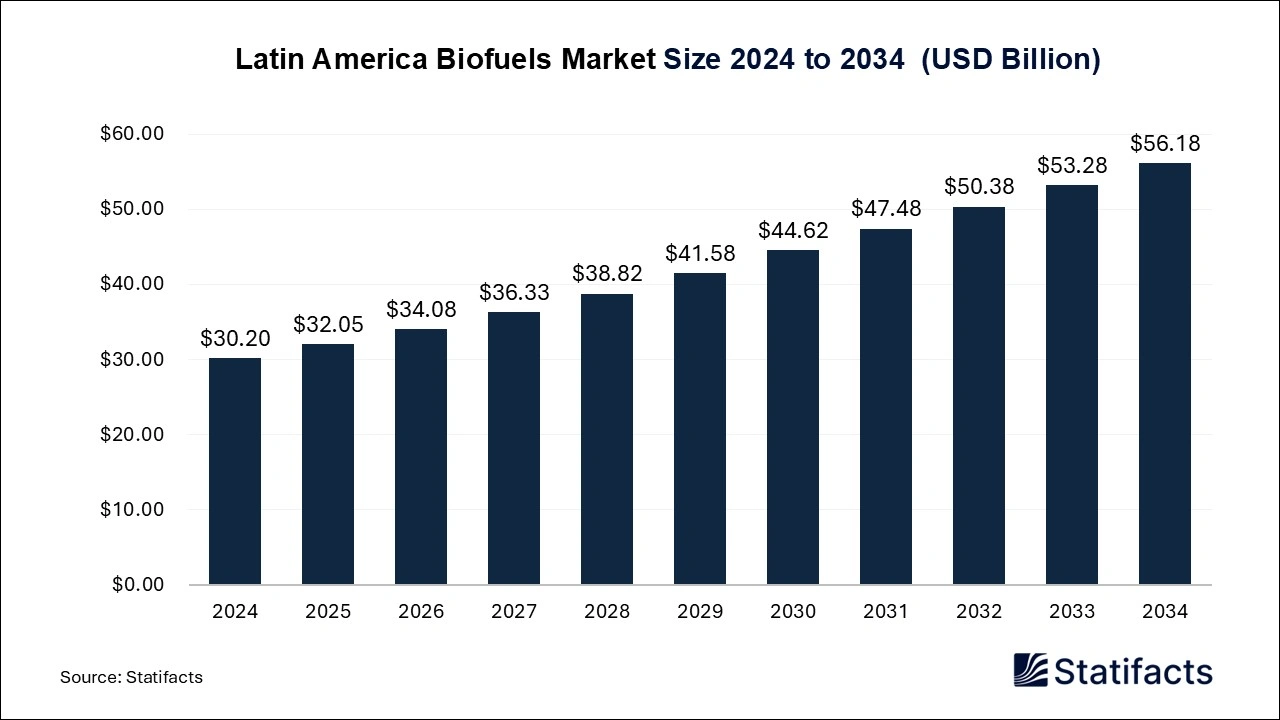
| Reports Attributes | Statistics |
| Market Size in 2025 | USD 32.05 Billion |
| Market Size in 2026 | USD 34.08 Billion |
| Market Size in 2032 | USD 50.38 Billion |
| Market Size by 2035 | USD 59.08 Billion |
| CAGR 2026 to 2035 | 6.31% |
| Base Year | 2025 |
| Forecast Period | 2026 to 2035 |
Demand is rising because several Latin American countries have some of the most ambitious and long-standing biofuel programs globally. Brazil continues to be a global leader in ethanol due to its efficient sugarcane supply chain, high-yield crops and distribution networks that support wide availability of E25 blends and growing adoption of E100 in flex-fuel vehicles. The National Agency of Petroleum, Natural Gas and Biofuels in Brazil reported in 2023 that ethanol remains a core component of the country’s transport-energy strategy and contributes significantly to greenhouse-gas reduction efforts.
Biodiesel demand is also rising across the region. Argentina remains one of the largest biodiesel exporters, supported by its strong soybean industry and well-developed processing capacity. Domestic use is also increasing due to national blending mandates. Mexico, Colombia, Paraguay and other countries are expanding their ethanol and biodiesel programs to reduce fossil-fuel imports and support rural agricultural economies. Growing interest in sustainable aviation fuel is emerging as airlines in Brazil, Colombia and Chile explore pathways to meet global aviation-emission requirements.
Despite strong production potential, the region faces challenges related to regulatory inconsistency, feedstock competition and infrastructure gaps. Some countries have experienced policy fluctuations that create uncertainty for investors and producers. The Food and Agriculture Organization has noted that fluctuations in climate conditions, especially drought cycles, affect sugarcane, maize and soybean yields, influencing biofuel supply stability. Competition between food and fuel uses also remains a policy concern in parts of the region.
Another obstacle is limited refining and logistical capacity for next-generation biofuels. Advanced biofuel technologies such as cellulosic ethanol and renewable diesel require significant capital investments, and smaller economies struggle to secure financing for large-scale projects. Export-oriented biodiesel producers also face trade challenges, including periodic tariff disputes that affect international competitiveness. Regional fuel-distribution infrastructure is uneven, and some countries lack widespread availability of higher blends despite robust production capabilities.
Latin America is characterised by strong diversity in policy maturity and feedstock strengths. Brazil and Argentina dominate the regional market due to their large agricultural sectors, well-established biofuel industries and supportive regulatory environments. Brazil leads global sugarcane ethanol production, while Argentina is a global force in biodiesel exports. Both countries are exploring advanced biofuel technologies and sustainable aviation fuel pathways.
Other regional markets such as Colombia, Paraguay and Uruguay maintain strong or growing ethanol and biodiesel mandates. Colombia’s ethanol program is supported by its sugarcane sector, while Paraguay has become a rising biodiesel exporter due to its soybean output. Chile and Peru are exploring biofuel adoption as part of broader decarbonisation strategies, though scale remains smaller. The region’s ability to produce high-yield feedstocks places it in a favourable position to meet future global demand for sustainable fuels.
Brazil is the largest and most influential market in the region. The Ministry of Mines and Energy emphasises ethanol and biodiesel as pillars of national energy policy, supported by RenovaBio, a federal decarbonisation program that issues carbon-intensity credits to biofuel producers. Brazil’s sugarcane ethanol is recognised globally for its low lifecycle emissions, and the rapidly growing production of corn ethanol adds supply diversity. Biodiesel blending mandates continue to increase, and Brazil is also investing in sustainable aviation fuel production, with pilot projects supported by academic institutions and private companies.
Argentina’s market is shaped by its strong soybean industry and well-developed biodiesel export sector. The Ministry of Economy and national biofuel regulations support both domestic blending and international trade. Argentina maintains advanced processing capacity and focuses on improving biodiesel quality for international markets. Ethanol production is growing steadily, driven by sugarcane and corn-based facilities. Research and industry partnerships are exploring technologies such as biogas, renewable diesel and second-generation biofuels to diversify future energy pathways.
| Segments | Shares (%) |
| Biodiesel | 57.04% |
| Ethanol | 42.96% |
| Segments | Shares (%) |
| Coarse Grains | 14.07% |
| Non-agri Feedstock | 7.29% |
| Biomass | 12.93% |
| Vegetable oil | 11.99% |
| Sugar crop | 16.12% |
| Jatropha | 18.71% |
| Others | 19.89% |
Published by Vidyesh Swar





