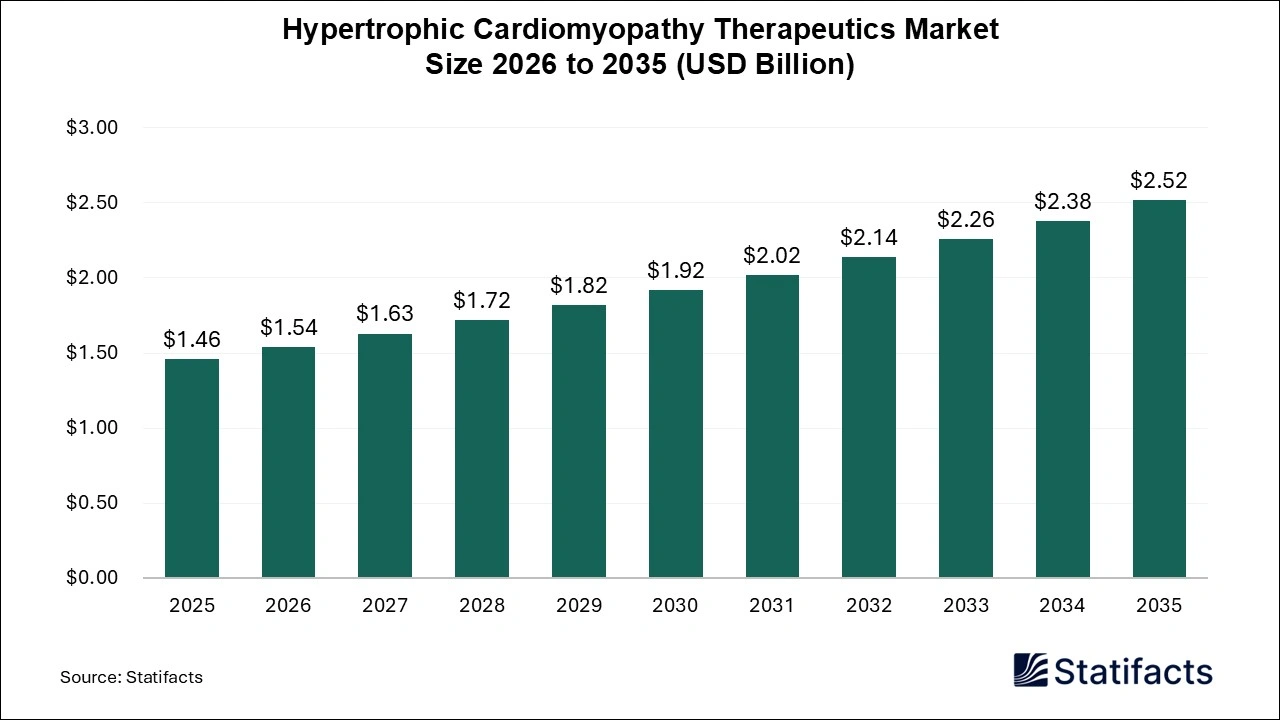
The global hypertrophic cardiomyopathy therapeutics market, valued at USD 1.46 billion in 2025, is projected to reach USD 2.52 billion by 2035, growing at a CAGR of 5.60%, driven by rising disease prevalence, innovation in targeted therapies, and improved diagnostic capabilities.
Hypertrophic Cardiomyopathy Therapeutics Market Statical Scope
| Reports Attributes |
Statistics |
| Market Size in 2025 |
USD 1.46 Billion |
| Market Size in 2026 |
USD 1.54 Billion |
| Market Size in 2032 |
USD 2.14 Billion |
| Market Size by 2035 |
USD 2.52 Billion |
| CAGR 2026 to 2035 |
5.60% |
| Base Year |
2025 |
| Forecast Period |
2026 to 2035 |
The growth and business of the market is cooperative with the factors like mechanism, gene replacement, and in a modified research setting as well. The market allows the groundbreaking solutions to take center stage, mainly for the sarcomere.
The hypertrophic cardiomyopathy therapeutics are a bunch of medications, balancers, and procedures. This range of health services is engineered to focus on symptoms to avoid life-threatening incidents like cardiac death or heart failure. The market has evolved into first-line disease-specific therapies. The treatments are positioned according to the diversified role of the market in each medical field, and procedures follow the same pattern. The revolutionary research therapies are practising more innovation with the rise in genetic and disease modification spectrum involving metabolic modulators, novel procedures, and gene therapy.
The businesses are expanding with the targeted portfolios and modern diagnostics. The transition in precision medicine is sharpening its concentration with personalized treatments mainly for particular genetic mutations and non-obstructive HCM. The popular approved mavacamten of the BMS company encouraged the market and set the benchmark for treating obstructive HCM.
Hypertrophic Cardiomyopathy Therapeutics Market Share, By Region, 2025 (%)
| Regions |
Shares (%) |
| North America |
46% |
| Europe |
24% |
| Asia-Pacific |
18% |
| Latin America |
7% |
| Middle East & Africa |
5% |
- North America – The North America regional segment dominated the market with 46% profit with its strong innovative therapies portfolio. The growing diagnostics has enhanced the genetic testing and cardiac MRI, which brings a clear picture to the win of the regional market.
- Europe – The Europe regional segment is expected to grow at a share of 24% with the boost to targeted therapies and robust drug classes' potential participation. The accelerating prevalence of the condition drives advancement in diagnosis.
- Asia-Pacific – The Asia-Pacific segment is pumped with 18% of the market, with the success in drug segments and smart alliances between regional pharmaceutical giants being the strength of the regional market. It helps fuel market share and extend their respective product portfolios.
- Latin America – Latin America acquires 7% of the market share, with the increasing awareness of cardiovascular conditions and massive adoption of modern therapeutics and diagnostic tools. This covers the vast population, and so the expansion of the regional market peaks.
- Middle East & Africa – MEA is leading with 5% of market share, with the clear dominance over the treatments popularly involving Beta-blockers. Due to the growing threat of cardiovascular vulnerability, the specialized cardiac centers are expanding their reach to the larger population.
Hypertrophic Cardiomyopathy Therapeutics Market Share, By Drug Class, 2025 (%)
| Segments |
Shares (%) |
| Beta Blockers |
37% |
| Cardiac Myosin Inhibitors |
18% |
| Calcium Channel Blockers |
15% |
| Antiarrhythmic Drugs |
12% |
| Anticoagulants |
10% |
| Others |
8% |
- Beta Blockers – The beta blockers segment dominated the market with the highest of 37% of share as it is essential for first-line therapy for HCM. The highlights of the segment are its well-developed efficacy rate in controlling heart rates and LVOT gradients.
- Cardiac Myosin Inhibitors – The cardiac myosin inhibitors segment is expected to grow at a share of 18% as the transition in HCM treatment harnesses the mechanism-oriented, disease-specific therapy. The evolving next-gen inhibitors are paving the way for more segment market share earnings and run.
- Calcium Channel Blockers – The segment is heading with 15% of market share as it's another fundamental drug class, but for second-line therapy for better usage stabilization and works as an alternative to beta-blockers, respectively, depending on the demand and situation.
- Antiarrhythmic Drugs – The segment is fuelling with 12% of market share with its ongoing smart changes, and its coordination with the potential of traditional techniques is accelerating the segmental strength.
- Anticoagulants – The segment is classified with its noteworthy transition to direct oral anticoagulants (DOACs), and so the adoption of the same is acquiring around 10% of the market to position the segment.
- Others – The other novel drug classes and disopyramide are in the lead position with 8% of market share to confirm their involvement in the market as agents and solutions to the future therapeutic targets and development.
Hypertrophic Cardiomyopathy Therapeutics Market Share, By Disease Type, 2025 (%)
| Segments |
Shares (%) |
| Obstructive Hypertrophic Cardiomyopathy (oHCM) |
64% |
| Non-Obstructive Hypertrophic Cardiomyopathy (nHCM) |
36% |
- Obstructive Hypertrophic Cardiomyopathy (oHCM) – The oHCM segment dominated the market with 64% of market share, with the transition break to the traditional agents and invasive alternatives being a strength of the segmental growth.
- Non-Obstructive Hypertrophic Cardiomyopathy (nHCM) – The nHCM segment is expected to grow at a share of 36% due to the rising HCM conditions, with the highest volume of nHCM cases. The potential of the HCM therapeutics is boosted with this growth.
Hypertrophic Cardiomyopathy Therapeutics Market Share, By Route of Administration, 2025 (%)
| Segments |
Shares (%) |
| Oral |
76% |
| Injectable/Parenteral |
18% |
| Others |
6% |
- Oral – The oral segment stands with the highest of the dominance market dominance of 76%, as it's more convenient mainly for LVOT destruction and boosts the functionality. The massive portfolio rise brings more demand for this segment.
- Injectable/Parenteral – The injectable/parenteral segment is expected to grow at a share of 18% with its emerging innovation pipeline, which helps discover the injectable delivery. The rise of gene and RNA therapies is paving the way for more profit in the segment.
- Others – The other route of administration, like the gene-based therapeutics route, acquires 6% of the market. Alongside, the invasive/alternative routes are different yet effective, undefined pathways to specific conditions and healing.
Hypertrophic Cardiomyopathy Therapeutics Market Share, By Distribution Channel, 2025 (%)
| Segments |
Shares (%) |
| Hospital Pharmacies |
53% |
| Online Pharmacies |
22% |
| Retail Pharmacies |
15% |
| Specialty Pharmacies |
10% |
- Hospital Pharmacies – The hospital pharmacies segment dominated the market with 53% of shares, supporting specialty drug management. The need for REMS mandates is featuring the major potential and role of hospital pharmacies in this market.
- Online Pharmacies – The online pharmacies segment is expected to grow at a share of 22% with the growing digitization involvement in services, treatment, drug delivery, and distribution. The online pharmacies are capable of maintaining the medications and long-standing refills.
- Retail Pharmacies – The retail pharmacies acquires 15% of the market with its retail chain strength doubling with specialty certifications. The digital integration and targeted therapies are listed as a source of growth for the segment.
- Specialty Pharmacies – The segment lifts with 10% of the market due to the need for expensive, specialized cardiac myosin inhibitors. This drives the compliance improvement and patient education.
Published by
Deepa Pandey