



Hoist Monorail Trolley Market (By Type: Motorized Type, Non-Motorized Type; By Application: Logistics Industry, Manufacturing Industry, Construction Industry, Others; By Region: North America, Europe, Asia-Pacific, Latin America, Middle East and Africa) Industry Size, Share, Growth, Trends 2025 to 2035.

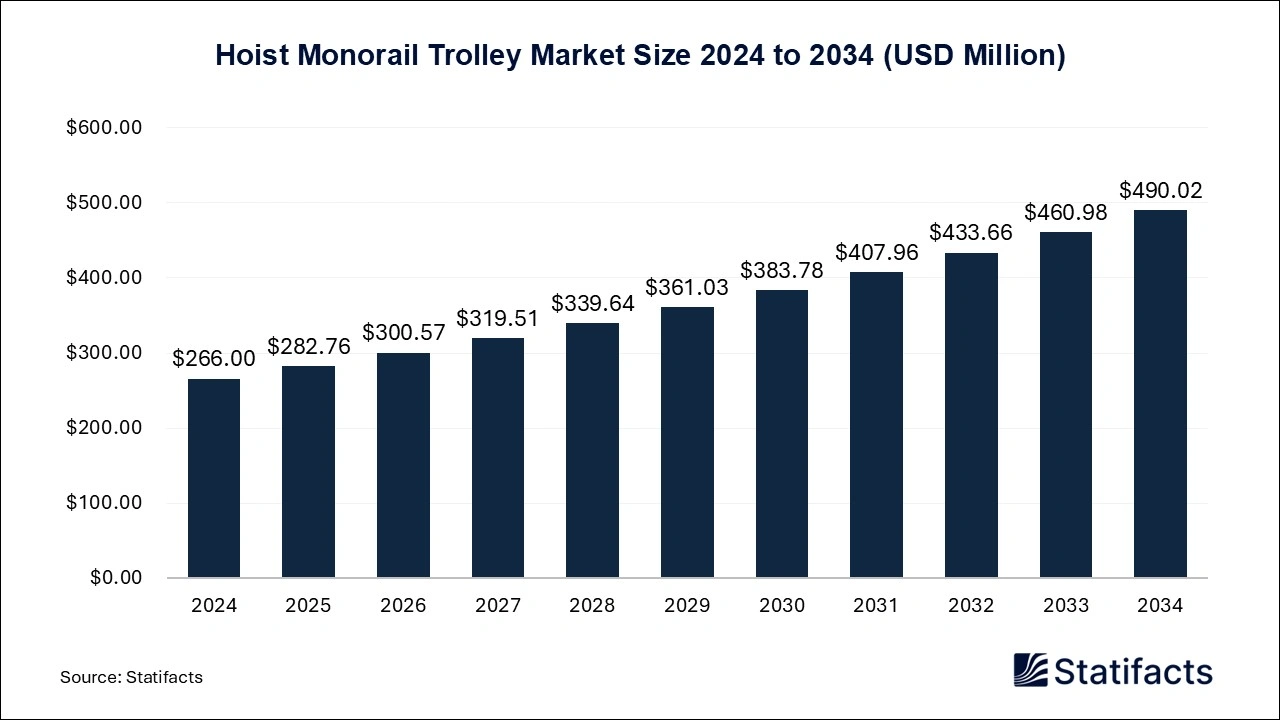
The global hoist monorail trolley market, valued at USD 282.76 million in 2025, is projected to reach USD 517.91 million by 2035, expanding at a CAGR of 6.24% fueled by rising demand in material handling, warehousing, and industrial automation.
| Reports Attributes | Statistics |
| Market Size in 2025 | USD 282.76 Million |
| Market Size in 2026 | USD 300.57 Million |
| Market Size in 2032 | USD 433.66 Million |
| Market Size by 2035 | USD 517.91 Million |
| CAGR 2026 to 2035 | 6.24% |
| Base Year | 2025 |
| Forecast Period | 2026 to 2035 |
The hoist monorail trolleys market is witnessing steady growth, driven by the rising need for safe and efficient material handling across factories, warehouses, and construction sites. These systems reduce manual labor, enhance workplace safety, and facilitate the smoother transport of heavy loads, making them indispensable in modern industrial operations. Rapid industrialization, along with the surge in global e-commerce and logistics activities, has further fueled demand, as companies seek reliable solutions for handling high-volume tasks.
However, the market faces certain restraints. High installation and maintenance costs continue to be a challenge for small and mid-sized enterprises, often delaying the adoption of large-scale solutions. Despite these barriers, opportunities are expanding. The growing preference for customized solutions tailored to logistics, warehousing, and e-commerce operations is expected to boost market positioning for manufacturers. Additionally, the integration of advanced features such as remote monitoring and predictive maintenance systems is creating a more compelling value proposition for buyers seeking long-term efficiency.
Artificial intelligence (AI) is set to play a transformative role in the sector. By integrating AI-driven smart sensors and predictive analytics, manufacturers can enhance safety, optimize performance, and reduce downtime through preventive maintenance. AI-enabled monitoring systems can also analyze real-time data to identify potential failures before they occur, minimizing operational risks. As adoption grows, AI is expected not only to improve equipment reliability but also to redefine the competitive landscape of the hoist monorail trolleys market.
| Regions | Shares (%) |
| North America | 30% |
| Asia Pacific | 35% |
| Europe | 25% |
| LAMEA | 10% |
| Segments | Shares (%) |
| Motorized Type | 55% |
| Non-Motorized Type | 45% |
| Segments | Shares (%) |
| Logistics Industry | 40% |
| Manufacturing Industry | 35% |
| Construction Industry | 20% |
| Others | 5% |





