


By clicking “Accept All Cookies” you agree to the storing of cookies on your device
to enhance site navigation, analyze site usage, and assist in our marketing efforts.
Germany’s herbal extract market grows steadily with demand from pharma and wellness sectors, driven by organic trends, Ayurveda, and innovative delivery formats.
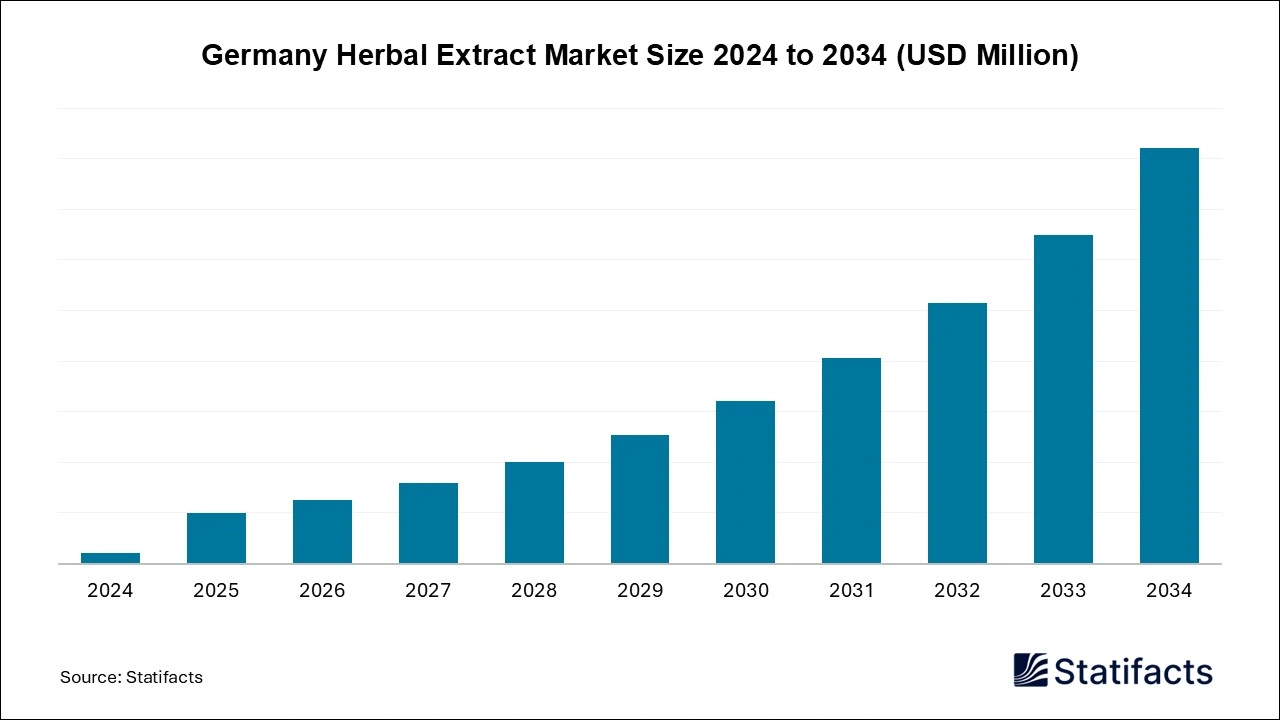
Highlights of the Germany Herbal Extract Market
By source, the fruits, flowers and bulbs segment underwent notable growth in the market during 2024.
By source, the leaves segment is anticipated to expand rapidly.
By type, the phytomedicines segment experienced significant expansion in the Germany herbal extract market.
By type, the essential oils segment is expected to see notable performance in growth between 2025–2034.
By application, the pharmaceutical & dietary supplements segment showed noteworthy growth in the market.
By application, the food & beverage segment is expected to see relatively strong growth during the forecast period of 2025 to 2034.
The herbal extract market in Germany represents an important sub-market within the broader European plant-extracts market, ensuring steady development over the period as consumer preference for natural, healthful, and holistic therapies continues to rise. Moderate growth can be foreseen for the market on the back of increasing demand from the pharmaceutical, food and beverage, and cosmetics sectors. Martin Bauer GmbH & Co. KG and Starwest Botanicals are known to tremendously contribute to the market development. The trends also speak of huge acceptance for organic and natural extracts, particularly in liquid and tincture forms. Germany seems to play an active role in the import and export of medicinal and aromatic plants across the world. The expansion of the influence of Ayurvedic herbal products is evident from the varied interests of consumers.
Market Trends
Ayurveda and Traditional Medicine Gaining Popularity: The ancient herbal systems have started influencing the new product development in the modern markets.
Preventive Health Care Takes Precedence: Herbal extracts are fast becoming a component in consumers' wellness and immune-boosting regimes.
Dietary Supplements Drastic Rise: The growth of the nutraceuticals market and demand for herbal ingredients go hand in hand.
E-Commerce Growth: The emergence of online platforms has given herbal products wider visibility, thereby expanding their global reach.
Delivery Format Innovations: Firms are now converting herbal extracts into newer and user-friendly forms such as capsules, gummies, tinctures, and powders.
Restraints
Sustainability Restraints in the Herbal Extract Market
Biodiversity Loss and Over-Harvesting: Huge market demand leads to claims of unsustainable harvest of medicinal plants and hence local extinction of taxa. With limited attempts at sustainable cultivation, pressures on natural resources continue to rise.
Lack of Quality Control and Standardization: Due to poor quality control and suitability of standard methods, product safety and efficacy are compromised. Wrongly accused of adulteration, contaminants, or even misidentification of the species of plants.
Industrialization and Biopiracy: Rapid industrial development causes further deforestation and ecosystem degradation. Biopiracy denies the rights of indigenous communities.
Sharing of Infrastructure and Regulation: Sharing of infrastructure must be enhanced in terms of research and testing facilities and means of documentation to secure quality control. Lack of regulations poses a lot of threat to enforcing sustainable sourcing practices.
Opportunity
Organic Trade Boom & Specialty Routes: Opportunities through health retail, pharmacies, and e-commerce.
Innovations in Herbal Formulations: Growing R&D investments in new uses and delivery systems (gummies, tinctures, capsules).
Increased Import Volumes: Europe continues to be a major importer of medicinal and aromatic plants, thus diversification of products.
Growth of Local Manufacturing and Centres of Innovation: German companies are undertaking research and development for local processing and extraction.
Export Opportunity: Germany retains herbal exports, which opens up the option of global market expansion.
Joint Ventures with Pharma & Biotech: Collaborations with Germany's strong pharmaceutical
Recent Developments in the German Herbal Extract Market:
In January 2024, Sandoz launched Tyruko®, a biosimilar of natalizumab, in Germany for adults with RRMS, marking the first European launch of a biosimilar to Biogen's Tysabri®.


