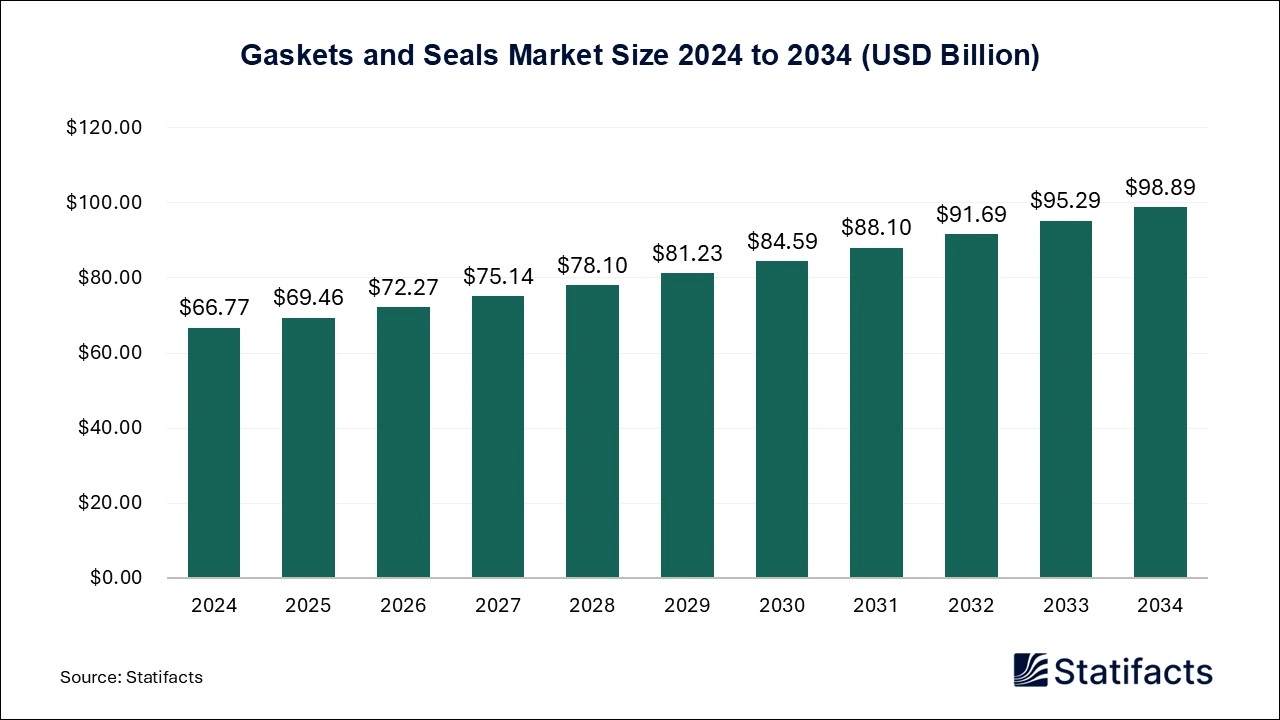
The global gaskets and seals market size was evaluated at USD 66.77 billion in 2024 and is expected to grow around USD 98.89 billion by 2034, registering a CAGR of 4% from 2025 to 2034.
Highlights of the Gaskets and Seals Market
- Asia Pacific dominated the global market in 2024.
- By product, the seals segment underwent notable growth in the market during 2024.
- By product, the gasket segment will gain a significant share of the market over the studied period of 2025 to 2034.
- By application, the heat exchangers segment enjoyed a prominent position in the U.S. gaskets and seals market in 2024.
- By application, the pressure vessels segment is predicted to witness significant growth in the market over the forecast period.
- By distribution channel, the original equipment manufacturer (OEM) segment captured a significant portion of the U.S. gaskets and seals market in 2024.
- By distribution channel, the aftermarket segment is projected to expand rapidly in the market in the coming years.
- By end-use industry, the automotive segment maintained a leading position in the market in 2024.
- By end-use industry, the industrial machinery segment is anticipated to grow with the highest CAGR in the market during the studied years.
Industry Valuation and Growth Rate Projection
| Industry Worth |
Details |
| Market Size in 2025 |
USD 69.46 Billion |
| Market Size by 2034 |
USD 98.89 Billion |
| Market Growth Rate from 2025 to 2034 |
CAGR of 4% |
The gaskets and seals market consists of seals, which are used between components like rotating shafts, pumps, and engines, and gaskets, which can seal two flat surfaces, such as joints. The common purpose of both is to prevent leakage in fields like food processing machinery, in pipelines and offshore platforms, aerospace, and pharmaceutical industries.
Types of gaskets include spiral wound gaskets, ring joint gaskets, rubber gaskets, and elastomeric gaskets. Additionally, some of the several kinds of seals are pusher seals, non-pusher (bellows) seals, balanced seals, and unbalanced seals.
Methane emissions can be reduced by companies through the application of technologies like double mechanical seals on pumps, dry gas seals on compressors, and carbon packing ring sets on valve stems.
Gaskets and Seals Market: Stats and Figures
- The demand for natural rubber is expected to stretch to $33.87 billion by 2027.
- Heating, Ventilation, and Air Conditioning or HVAC systems account for approximately 15% of the global energy consumption.
- As stated by an expert, for protection in general, a seal that is stretched more than 50% should never be used.
- As per the report by IEA International Energy Agency, more than 4.45 million electric SUVs, which have crucial automotive components such as seals and gaskets, were sold in 2023.
What Does an Industry Leader Have to Say About the Market?
- Ryan Bealmear, President of Teague Electric:
Highlighting the importance of business expansion, Bealmear said, “Our team has always been focused on building on Teague’s heritage, and this partnership will strengthen our ability to grow our customer relationships and build a team that can take Teague into its next chapter of growth. Extending our business by acquiring other like-minded companies has been an interest for some time, and we’re excited for IX Partners to help us realize that outcome.”
How Has AI Benefited the Market?
- The gaskets and seals market with AI can provide several benefits, considering the characteristics like accuracy and efficacy compared to the traditional methods used. Here is how AI is beneficial for the market:
- Machine learning: AI combines computer and machine vision software with machine learning to detect issues, often missed by humans, such as uneven seals and improper closures in the seal area.
- Deep learning method: Using deep learning AI can lessen the false positive detection in the seal and gaskets sector.
- Data escalation: AI-driven systems collect data and technologies like data augmentation, which help AI achieve greater accuracy in analyzing small or imbalanced datasets.
- Real-time data: Smart gaskets make use of AI so that they can offer real-time data on the seals and allow users to keep track of their maintenance.
Which Recent Developments Took Place in the Gaskets and Seals Market?
- In 2025, IX Capital Partners made a growth investment in Teague Electric to support the company’s strategic growth. In 2025, Marco Rubber & Plastics acquired Colonial Seal Company, as this is going to support the reach of the products while connecting with more customers than usual.
Geographical Insights
The global gaskets and seals market is experiencing significant growth, with North America maintaining its position as the dominant region while Europe emerges as the fastest-growing market. The APAC region is expected to grow in the coming years.
North America
- The market in North America triumphed as a consequence of the firms uniting with each other to deliver gaskets and seals.
- Chart Industries and Flowserve Corporation have come to an agreement to unite in an all-stock deal, taking the value of the merged company to approximately $19 billion.
Europe
The European market is seen growing rapidly, thanks to more than a couple of companies getting together to boost their trade in the region.
Hultec has associated with S&B Technical Products and three other brands, and this collaboration set its sights on fortifying its business in the pipe sealing solutions and put them in a place of growth in the machinery and manufacturing sector.
APAC
The gaskets and seals market is expected to grow in the APAC region as a result of the companies supplying their products to the government for the progress of countries on a national level.
Gayatri Rubbers and Chemicals Ltd. has obtained a Work Order or Letter of Award priced at Rs 18,51,641.35 for delivering "Neoprene Sponge Gaskets" to be utilized in smart meters and Vande Bharat trains for Indian Railways.
What Does the Competitive Landscape Look Like?
The gaskets and seals market is highly competitive, with leading Machinery and Equipment companies such as Freudenberg Sealing Technologies, Trelleborg Sealing Solutions, SKF, Flowserve Corporation, ElringKlinger AG, Dana Limited, Saint-Gobain Seals, and Smiths Group holding the highest market share. Emerging biotech firms also play a crucial role by fostering a dynamic and evolving competitive landscape.
The market is dominated by several Machinery and Equipment companies renowned for their significant contributions to cancer research and treatment. Based on recent data, the top three leading companies are:
- Company Name: SKF
- Year of Incorporation: 1907
- Headquarters: Gothenburg, Sweden
The yearly revenue of SKF was accounted to be $98,722,000 in 2024.
- Company Name: Flowserve Corporation
- Year of Incorporation: 1997
- Headquarters: Texas, United States
The gross profit of Flowserve Corporation took a step forward from $1,276,828 in 2023 to $1,434,246 in 2024.
- Company Name: ElringKlinger AG
- Year of Incorporation: 2000
- Headquarters: Dettingen/Erms, Germany
The year-on-year revenue of ElringKlinger AG was positioned at $1,803,136 in 2024.
Gaskets and Seals Market Share, By Region, 2024 (%)
| Regions |
Shares (%) |
| North America |
25% |
| Asia Pacific |
40% |
| Europe |
22% |
| LAMEA |
13% |
- North America – Holds 25%, supported by large-scale industrial and energy sectors, gaining strong presence through advanced manufacturing adoption.
- Europe – Accounts for 22%, driven by engineering-focused industries, steady but not dominant due to slower industrial expansion.
- Asia Pacific – Leads with 40%, powered by rapid industrialization and huge manufacturing output, dominating due to being the global production hub.
- LAMEA – Represents 13%, supported by emerging industrial activities, not dominating due to limited industrial base.
Gaskets and Seals Market Share, By Product, 2024 (%)
| Segments |
Shares (%) |
| Gaskets |
45% |
| Seals |
55% |
- Gaskets – Holds 45% of the market as essential sealing components used across industrial machinery, gaining strong dominance due to wide applicability and frequent replacement cycles.
- Seals – Accounts for 55%, covering dynamic and static sealing needs, dominating the segment because of higher usage in rotating equipment and critical containment systems.
Gaskets and Seals Market Share,By Application, 2024 (%)
| Segments |
Shares (%) |
| Pressure vessels |
20% |
| Heat exchangers |
18% |
| Manhole covers |
12% |
| Valve bonnets |
15% |
| Pipe flanges |
35% |
- Pressure Vessels – Holds 20%, used for high-pressure industrial containment, gaining steady adoption due to rising safety regulations.
- Heat Exchangers – Represents 18%, ensuring leakage-free thermal transfer systems, not dominating as usage is more specialized.
- Manhole Covers – Captures 12%, providing access sealing in tanks and pipelines, not dominating due to limited application frequency.
- Valve Bonnets – Holds 15%, ensuring sealed valve operation, gaining momentum as process industries expand.
- Pipe Flanges – Leads with 35%, sealing connections in pipelines, dominating because flanges are widely used across oil, gas, chemical, and manufacturing systems.
Gaskets and Seals Market Share, By Distribution Channel, 2024 (%)
| Segments |
Shares (%) |
| Original equipment manufacturer (OEM) |
60% |
| Aftermarket |
40% |
- OEM – Holds 60%, supplying components directly to equipment manufacturers, dominating due to long-term contracts and integration into new machinery.
- Aftermarket – Accounts for 40%, driven by maintenance and replacements, not dominating as OEM consumption remains primary.
Gaskets and Seals Market Share, By End-Use Industry, 2024 (%)
| Segments |
Shares (%) |
| Oil and gas |
25% |
| Electricals |
10% |
| Automotive |
30% |
| Aerospace |
10% |
| Marine and rail |
8% |
| Paper and pulp industry |
7% |
| Industrial manufacturing |
10% |
- Oil & Gas – Holds 25%, using seals and gaskets in high-pressure operations, dominating due to safety-critical sealing requirements.
- Electricals – Represents 10%, used in insulating and protective sealing, not dominating because applications are limited to specific components.
- Automotive – Accounts for 30%, driven by engines, transmissions, and EV systems, gaining strong dominance with high production volumes.
- Aerospace – Holds 10%, used in high-performance sealing, not dominating due to smaller production scales.
- Marine & Rail – Captures 8%, used in heavy-duty sealing systems, not dominating because demand is niche and replacement cycles are long.
- Paper & Pulp Industry – Represents 7%, applied in chemical and steam systems, does not dominate due to limited global capacity.
- Industrial Manufacturing – Holds 10%, providing general-purpose sealing, steady but not dominant due to diverse but low-volume usage.