

Share


Fixed Commercial Gas Detection Market (By Product: Electrochemical Detectors, Infrared Detectors (IR), Catalytic Bead Detectors, and Others; By Gas Type: Toxic/Combustible Gases, Volatile Organic Compounds (VOCs), Oxygen (O?), and Others; By Application: Vehicle Exhaust Systems, Grow Facilities, Boiler Rooms, Battery Storage & Charging Rooms, Data Centers, Cold Storage Facilities, and Others; By Region: North America, Europe, Asia Pacific, and LAMEA) Industry Size, Share, Growth, Trends 2026 to 2035

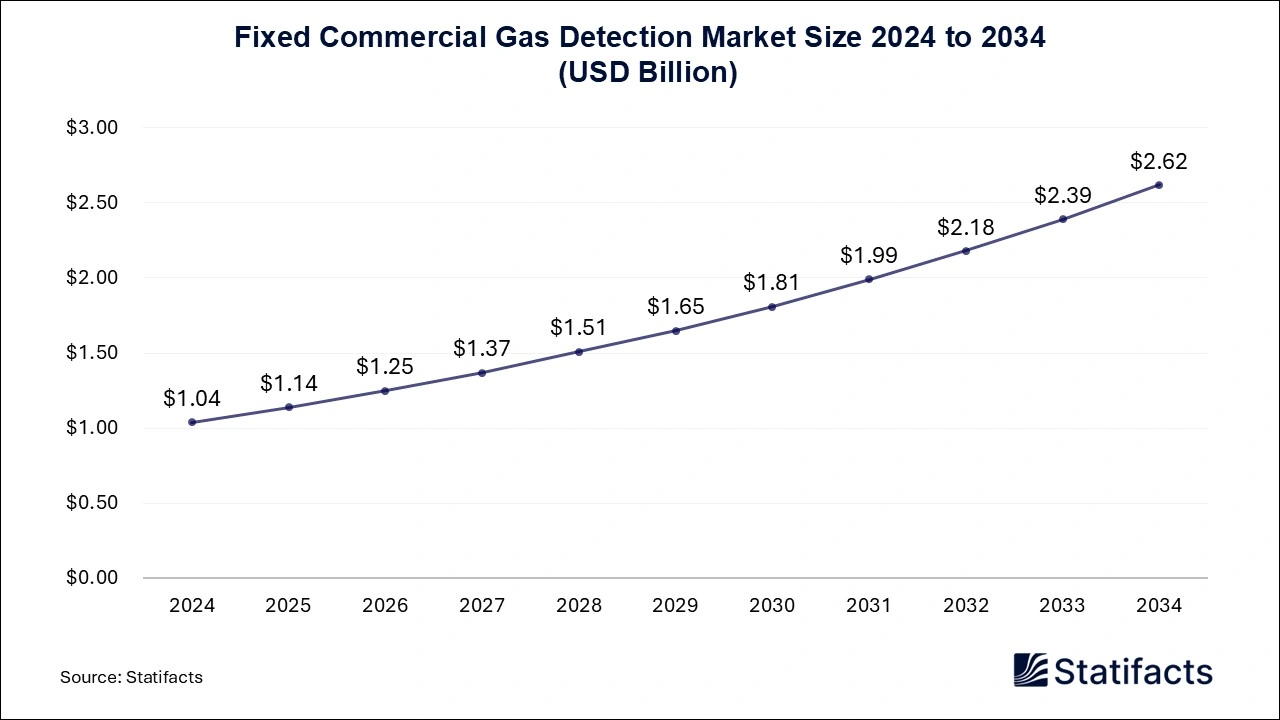
The global fixed commercial gas detection market, valued at USD 1.14 billion in 2025, is projected to reach nearly USD 2.84 billion by 2035. Growing safety regulations, rising industrial automation, and demand for real-time monitoring systems are driving its strong 9.56% CAGR.
| Reports Attributes | Statistics |
| Market Size in 2025 | USD 1.14 Billion |
| Market Size in 2026 | USD 1.25 Billion |
| Market Size in 2032 | USD 2.18 Billion |
| Market Size by 2035 | USD 2.84 Billion |
| CAGR 2026 to 2035 | 9.56% |
| Base Year | 2025 |
| Forecast Period | 2026 to 2035 |
The fixed commercial gas detection market is gaining momentum due to increased regulatory focus from OSHA, EPA, and NFPA, which mandate measures prioritizing employee safety. It is a permanently installed safety system that monitors and detects hazardous gas leaks in manufacturing facilities, refineries, laboratories, data centers, and public settings. The government's increased focus on commercial and industrial setups is benefiting system manufacturers as they expand their business base in these industries.
Some industries, such as oil and gas and chemicals, are major investors in these systems due to higher safety requirements that rely on them for alerts. One of the major benefits is preventing gas leaks, which can disrupt air quality and environmental safety, leading to mandates for green building certifications in such commercial settings.
Small-scale industries, mainly in underdeveloped and some developing regions, face challenges in adopting such systems due to higher installation and maintenance costs. The limited financial resources of these small companies have been affecting the growth pace in the fixed commercial gas detection market due to low awareness in rural areas, where authorities have a lower presence and impact in these industrial settings.
Advancements are expected to drive a massive user base for these safety systems, as the popularity of smart buildings increases and automated systems are deployed to detect safety threats and enhance human safety. More technological advancements, like multi-gas detection systems, are expected to gain popularity as they are being designed with modular configurations that can be installed in commercial settings. The companies are highly focused on implementing these advancements, which can also help reduce energy consumption and improve durability.
Asia Pacific is a dominant region in the fixed commercial gas detection market, driven by the rapid expansion of data centers and industrial infrastructure in countries such as India, China, South Korea, and Japan. The governments of these nations are mandating stringent safety regulations, which further create several opportunities for the manufacturing companies. North America also holds a significant share of the market due to advanced safety protocols and the integration of technology in its industrial settings.
The artificial intelligence integrated systems are expected to play an opportunistic role by analyzing data patterns, helping focus on real-time alerts, and minimizing unnecessary alerts in commercial and industrial settings. The technology is expected to gain popularity as urban areas witness smart buildings with automated systems for greater safety. The fixed commercial gas detection market will drive further growth, with AI a crucial factor in predictive maintenance across the monitoring and manufacturing processes.
| Regions | Shares (%) |
| North America | 34% |
| Asia Pacific | 31% |
| Europe | 24% |
| LAMEA | 11% |
| Segments | Shares (%) |
| Electrochemical Detectors | 38% |
| Infrared Detectors (IR) | 27% |
| Catalytic Bead Detectors | 22% |
| Others | 13% |
| Segments | Shares (%) |
| Toxic/Combustible Gases | 44% |
| Volatile Organic Compounds (VOCs) | 24% |
| Oxygen (O?) | 20% |
| Others | 12% |
| Segments | Shares (%) |
| Vehicle Exhaust Systems | 18% |
| Grow Facilities | 10% |
| Boiler Rooms | 16% |
| Battery Storage & Charging Rooms | 14% |
| Data Centers | 17% |
| Cold Storage Facilities | 13% |
| Others | 12% |
Published by Saurabh Bidwai
Related Reports





