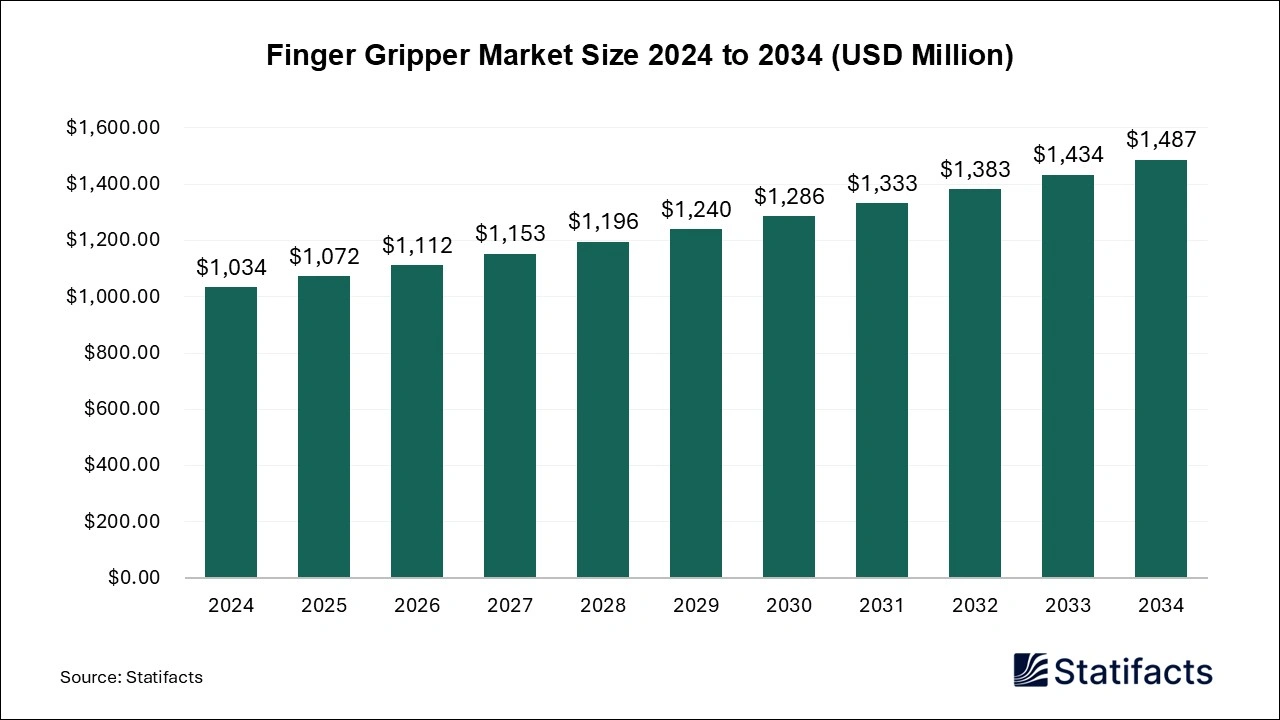
The global finger gripper market size was valued at USD 1,034 million in 2024, is projected to reach approximately USD 1,487 million by 2034. This growth, driven by advancements in robotics and automation across industries, is expected at a CAGR of 3.7%.
Finger Gripper Market Statical Scope
| Reports Attributes |
Statistics |
| Market Size in 2024 |
USD 1,034 Million |
| Market Size in 2025 |
USD 1,072 Million |
| Market Size in 2031 |
USD 1,333 Million |
| Market Size by 2034 |
USD 1,487 Million |
| CAGR 2025 to 2034 |
3.7% |
| Base Year |
2024 |
| Forecast Period |
2025 to 2034 |
Finger gripper is an emerging market due to the ever-growing rate of robotic automation and collaborative robots, which are currently being implemented in automotive, electronics, food and beverage, and logistics. As manufacturers are trying to enhance the efficiency of operations, to save on labor expenses, and to lower the number of injuries in the workplace, there is an increased demand for accurate and dependable gripping solutions. There are also opportunities in the case of modular, lightweight, and flexible grippers that can be used in delicate, irregular, or high-speed handling applications. The high prices of the advanced grippers, complexity in integration with current robotic systems, and technical expertise are among the factors that could set back the adoption, especially for small and medium-sized companies.
The finger gripper market will increase more rapidly because artificial intelligence AI- and sensor-based gripping technologies have been innovated. AI-based force control grippers with real-time object recognition, adaptive gripping, and predictive maintenance can be used to increase accuracy, minimize product damage, and make robots more efficient. As the smart factories, Industry 4.0 efforts, and the use of collaborative robots continue to grow, the finger gripper market will see massive growth in the next decade.
Finger Gripper Market Share, By Region, 2024 (%)
| Regions |
Shares (%) |
| North America |
30% |
| Asia Pacific |
35% |
| Europe |
25% |
| LAMEA |
10% |
- North America – Holds 30% of the market, driven by the strong presence of automotive and electronics industries in the U.S. Dominates due to high industrial automation and adoption of advanced robotics.
- Europe – Accounts for 25% of the market, with significant adoption in automotive, aerospace, and industrial machinery sectors. Gaining momentum due to manufacturing innovations and a strong push for Industry 4.0.
- Asia Pacific – Represents 35% of the market, led by China, Japan, and South Korea in robotics and automation industries. Dominates due to large-scale manufacturing operations and the rapid adoption of robotics in various sectors.
- Latin America & Middle East & Africa – Combined, these regions hold 10% of the market, with Latin America contributing to automotive and machinery sectors and the Middle East & Africa showing slow adoption due to limited automation in comparison. Not dominating due to lower industrialization and robotics penetration compared to other regions.
Finger Gripper Market Share, By Type, 2024 (%)
| Segments |
Shares (%) |
| Two Fingers |
45% |
| Three Fingers |
35% |
| Four Fingers |
20% |
- Two Fingers – Holds 45% of the market, representing the most commonly used type of finger gripper in robotic systems. Dominates due to its versatility and efficiency in handling a wide range of tasks in various industries.
- Three Fingers – Accounts for 35% of the market, offering greater precision and stability than two-fingered grippers. Gaining momentum as more complex applications in automation and robotics increase demand for better grip control.
- Four Fingers – Represents 20% of the market, providing enhanced gripping power for larger or more delicate objects. Not dominating due to its more specialized use in applications that require higher precision and load-bearing capacity.
Finger Gripper Market Share, By Application, 2024 (%)
| Segments |
Shares (%) |
| Automotive |
30% |
| Electronics and Semiconductors |
15% |
| Aviation |
10% |
| Marine |
5% |
| Machinery |
10% |
| Oil and Gas |
10% |
| Medical |
8% |
| Others |
12% |
- Automotive – Represents 30% of the market, widely used in manufacturing processes such as assembly and part handling. Dominates due to the strong demand for automation and robotics in vehicle production lines.
- Electronics and Semiconductors – Accounts for 15% of the market, used for delicate handling of small parts and components. Gaining momentum due to the increasing automation in electronics manufacturing and semiconductor production.
- Aviation – Holds 10% of the market, used for precise handling of aircraft components. Not dominating due to limited applications compared to the broader automotive and electronics sectors.
- Marine – Captures 5% of the market, applied in shipbuilding and maintenance for material handling and assembly. Not dominating due to lower adoption in comparison to other industries.
- Machinery – Represents 10% of the market, used in the assembly and maintenance of industrial machines. Gaining momentum as automation in manufacturing equipment handling continues to rise.
- Oil and Gas – Accounts for 10% of the market, widely used in material handling and operations in harsh environments. Gaining momentum with increasing automation in offshore and onshore operations.
- Medical – Represents 8% of the market, used in precise and clean environments for handling medical components. Gaining momentum with the rise in medical device manufacturing and automation in healthcare.
- Others – Holds 12% of the market, encompassing various specialized applications beyond the major sectors. Gaining momentum as robotics expands into new industries and applications.