

Share


Europe Digital Health Market (By Component: Software, Hardware, Services; By Technology: Telehealthcare, mHealth, Digital Health Systems, Health Analytics) Industry Size, Share, Growth, Trends 2026 to 2035.

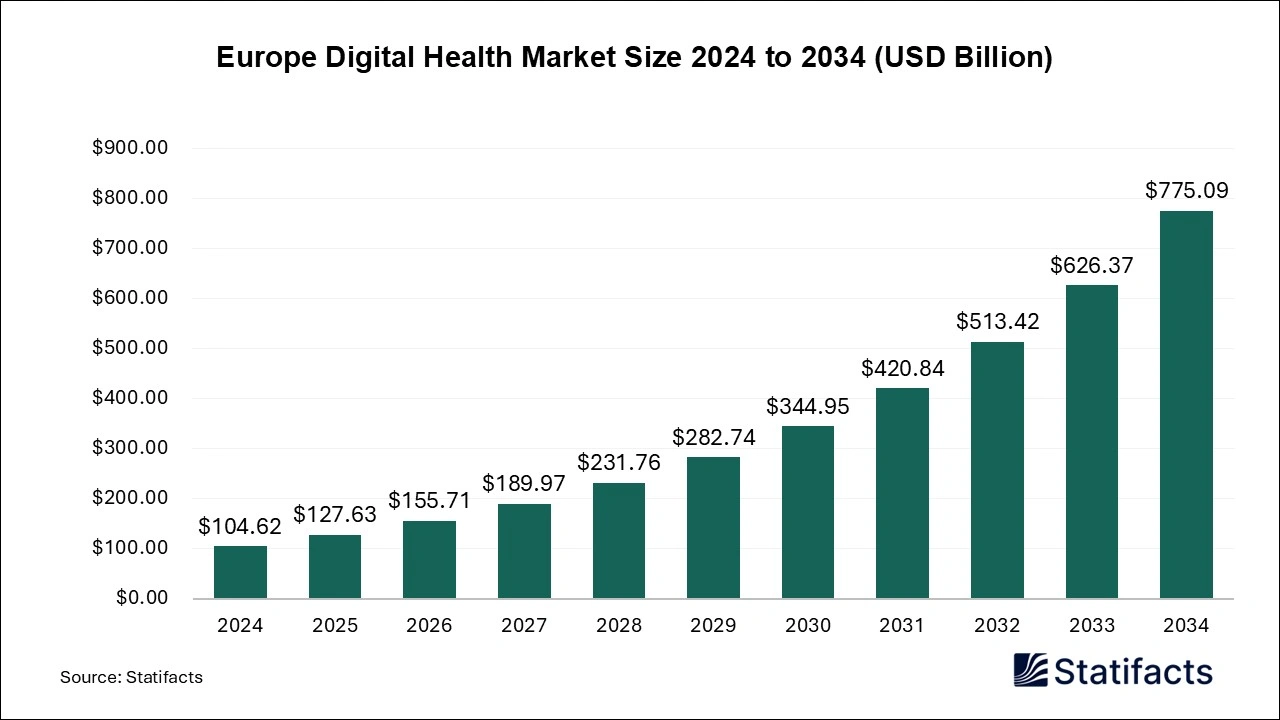
The Europe digital health market exceeded USD 127.63 billion in 2025 and is forecast to reach nearly USD 899.96 billion by 2035, advancing at a 21.57% CAGR, supported by growing telehealth adoption, AI-driven care solutions, and rising healthcare digitization.
| Reports Attributes | Statistics |
| Market Size in 2025 | USD 127.63 Billion |
| Market Size in 2026 | USD 155.71 Billion |
| Market Size in 2032 | USD 513.42 Billion |
| Market Size by 2035 | USD 899.96 Billion |
| CAGR 2026 to 2035 | 21.57% |
| Base Year | 2025 |
| Forecast Period | 2026 to 2035 |
The Europe digital health market is expanding at a decent pace due to the increasing demographic shifts towards the elderly cohorts, which increases a massive demand in managing healthcare for various conditions like diabetes, COPD, neurodegenerative disease, and many more. According to the World Health Organization, chronic diseases like heart disease, stroke, cancer, chronic respiratory diseases, and diabetes are the leading causes of mortality in the European region, where they account for 77% disease rate, with 86% of overall deaths. The rise of digital tools in the region is driven primarily by a focus on adjusting bed pressure and containing costs in the healthcare sector. The region's mature population also has an upper hand in digital health solutions, given higher levels of understanding and wearable use.
The rural healthcare infrastructure in the European region may act as a barrier to some extent due to a lack of long-term vision and consistent funding towards digital health. Moreover, small villages in the region have lower populations and lower awareness of digital health, which may limit the use of advanced healthcare devices and wearables. The regulatory pressure remains in some areas, particularly on reimbursement, which can limit the adoption of digital solutions.
The emerging developments in the European healthcare sector are highly backed by the European Health Data Space (EHDS), which aims to enable cross-border access to health data for researchers, innovators, and citizens. The growing citizen empowerment, especially among women, is boosting the use of digital tools to manage their own health, thanks to better access to platforms and data. The authorities are also looking into addressing fragmentation, prioritizing the expansion of digital health systems across the EU. The growing investment in remote monitoring is also expected to improve healthcare access for rural populations. The EU's Digital Decade policy program, with support from private companies, is expected to establish reliable digital health solutions.
The European healthcare system is effectively adopting artificial intelligence AI and machine learning ML to enhance its digital health solutions. These algorithms are helping to analyze images, which can be impactful in stroke detection and breast cancer screening. The rising patient volume will also drive the use of AI to detect the elderly population and the patient rate in the region to manage healthcare needs. The effective use of AI in PRM streams helps send alerts and reminders to patients, which can improve early intervention rates.
Germany stands as the dominant country in the European digital health market due to government initiatives such as the Digital Healthcare Act, which enables digitalization, authorizes doctors to prescribe digital health apps, and increases coverage by public health insurance funds. They are also investing heavily to enable the adoption of digital tools within their infrastructure at a cost-effective rate. The IT companies are also partnering with the hospital groups to invest in the digital transformation of German healthcare.
France is one of the fastest-growing countries in healthcare digitalization, with the French Health Data Hub and Ma Sante 2022 helping modernize the overall healthcare system. The government is also backing huge growth through funding and incentives for hospitals that adopt interoperable electronic health records and e-prescriptions. The growth is also driven by the increasing shift towards virtual hospital models due to higher healthcare costs in the country.
| Segments | Shares (%) |
| Software | 35.24% |
| Hardware | 29.67% |
| Services | 35.09% |
| Segments | Shares (%) |
| Telehealthcare | 27.81% |
| mHealth | 22.43% |
| Digital Health Systems | 25.91% |
| Health Analytics | 23.85% |
Published by Rohan Patil





