

Share


Europe Biofuels Market (By Fuel Type: Biodiesel, Ethanol; By Feedstock: Coarse Grains, Non-agri Feedstock, Biomass, Vegetable Oil, Sugar Crop, Jatropha, Others) Industry Size, Share, Growth, Trends 2026 to 2035

The Europe biofuels market exceeded USD 21.94 billion in 2025 and is anticipated to reach nearly USD 41.84 billion by 2035 at a 6.67% CAGR, fueled by decarbonization policies, renewable energy expansion, and growing demand for low-emission fuels.
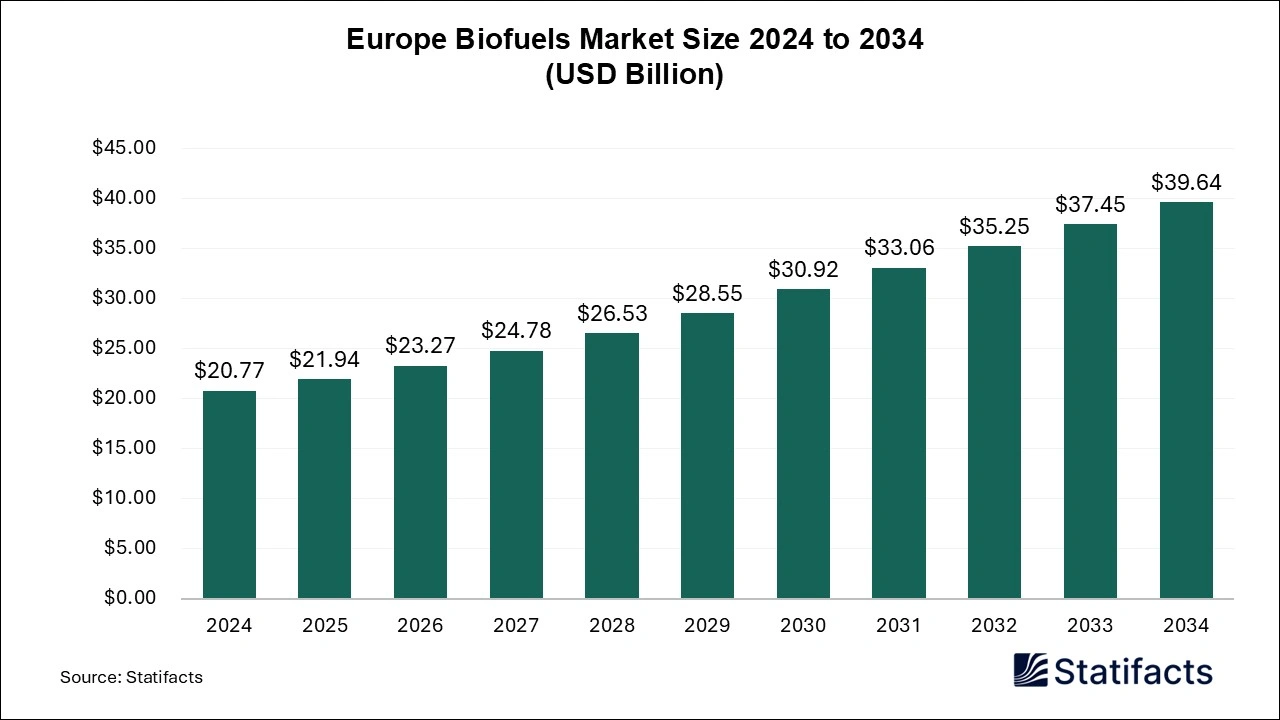
| Reports Attributes | Statistics |
| Market Size in 2025 | USD 21.94 Billion |
| Market Size in 2026 | USD 23.27 Billion |
| Market Size in 2032 | USD 35.25 Billion |
| Market Size by 2035 | USD 41.84 Billion |
| CAGR 2026 to 2035 | 6.67% |
| Base Year | 2025 |
| Forecast Period | 2026 to 2035 |
Demand is increasing because Europe maintains one of the world’s most advanced regulatory frameworks promoting renewable fuels. The EU Renewable Energy Directive II requires member states to reduce the carbon intensity of transport fuels and mandates the use of advanced biofuels. This has strengthened demand for biodiesel, hydrotreated vegetable oil, ethanol and emerging sustainable aviation fuel. The European Environment Agency noted in 2022 that biofuels remain one of the most widely deployed decarbonisation tools in road transport.
A second major driver is the region’s aggressive climate strategy. The European Climate Law and national programmes in countries such as Germany, France, Spain and the Netherlands require rapid progress toward net zero emissions. Heavy-duty transport operators, municipal fleets and aviation players are increasingly turning to biofuels as a bridge solution while electrification infrastructure continues to expand. Advanced biofuels made from agricultural residues, forestry waste and used cooking oil are gaining momentum due to their lower lifecycle emissions and compliance with EU sustainability criteria.
Despite strong policy support, the market faces structural challenges. Feedstock limitations remain a primary concern. The European Commission highlighted in 2023 that availability of sustainable feedstocks such as waste oils and residues is insufficient to meet long-term demand growth, and strict EU rules limit the use of food-based biofuels, tightening supply further. Competition for waste-based feedstocks across biodiesel, renewable diesel and sustainable aviation fuel producers contributes to price volatility.
Infrastructure and production constraints also present obstacles. Several European countries lack sufficient refining and blending capacity for advanced biofuels, slowing adoption. Regulatory complexity across member states creates uncertainty for investors, especially around implementation timelines and sustainability verification rules. Smaller producers face high capital requirements and lengthy permitting processes, affecting the speed of new biorefinery development. Public debate on land use, deforestation and sustainability certification continues to influence policy and market sentiment.
The Europe market is shaped by its diverse policy landscape. Northern and Western Europe, particularly Germany, France, the Netherlands and the Nordic countries, lead in advanced biofuel adoption due to strong climate commitments and well-established sustainability standards. These countries emphasise waste-based biofuels and advanced feedstocks due to strict environmental policies. Southern Europe shows increasing investment in biodiesel and renewable diesel, supported by agricultural output and ports equipped for international biofuel trade.
The aviation sector plays an increasingly important role. The EU’s ReFuelEU Aviation regulation, introduced in 2023, mandates the gradual uptake of sustainable aviation fuel across all EU airports, positioning Europe as a global leader in aviation decarbonisation. Demand is also growing in maritime fuel markets as the region adopts emissions reduction measures aligned with the Fit for 55 package.
Germany is a major contributor to the region due to its strong climate policies, advanced biorefinery infrastructure and high fuel consumption levels. The Federal Ministry for Economic Affairs and Climate Action has reinforced advanced biofuel quotas and supports the growth of renewable diesel and ethanol blending. Germany’s transport decarbonisation plan places significant emphasis on sustainable feedstocks, waste-based inputs and the rapid deployment of sustainable aviation fuel. Investments in second-generation biofuel technologies and research programmes support long-term innovation in the sector.
France’s biofuels market is expanding due to its national energy transition law, blending mandates and strong agricultural sector. The French Ministry for the Energy Transition noted in 2023 that biofuels remain central to national decarbonisation efforts, particularly in road transport. France continues to scale up advanced biodiesel and ethanol production, including used cooking oil-based biodiesel and cellulosic ethanol. The country also plays an active role in sustainable aviation fuel development, supported by public programmes and partnerships between refineries, airlines and research institutions.
| Segments | Shares (%) |
| Biodiesel | 44.39% |
| Ethanol | 55.61% |
| Segments | Shares (%) |
| Coarse Grains | 15.94% |
| Non-agri Feedstock | 11.80% |
| Biomass | 16.67% |
| Vegetable oil | 13.43% |
| Sugar crop | 13.13% |
| Jatropha | 14.81% |
| Others | 14.22% |
Published by Vidyesh Swar





