



Enterprise High Availability Server Market (By Type: On-Premises Deployment, Cloud Deployment, and Hybrid Deployment; By Application: IT & Telecom, BFSI, Healthcare, Government, and Others; By Region: North America, Europe, Asia Pacific, and LAMEA) Industry Size, Share, Growth, Trends 2026 to 2036

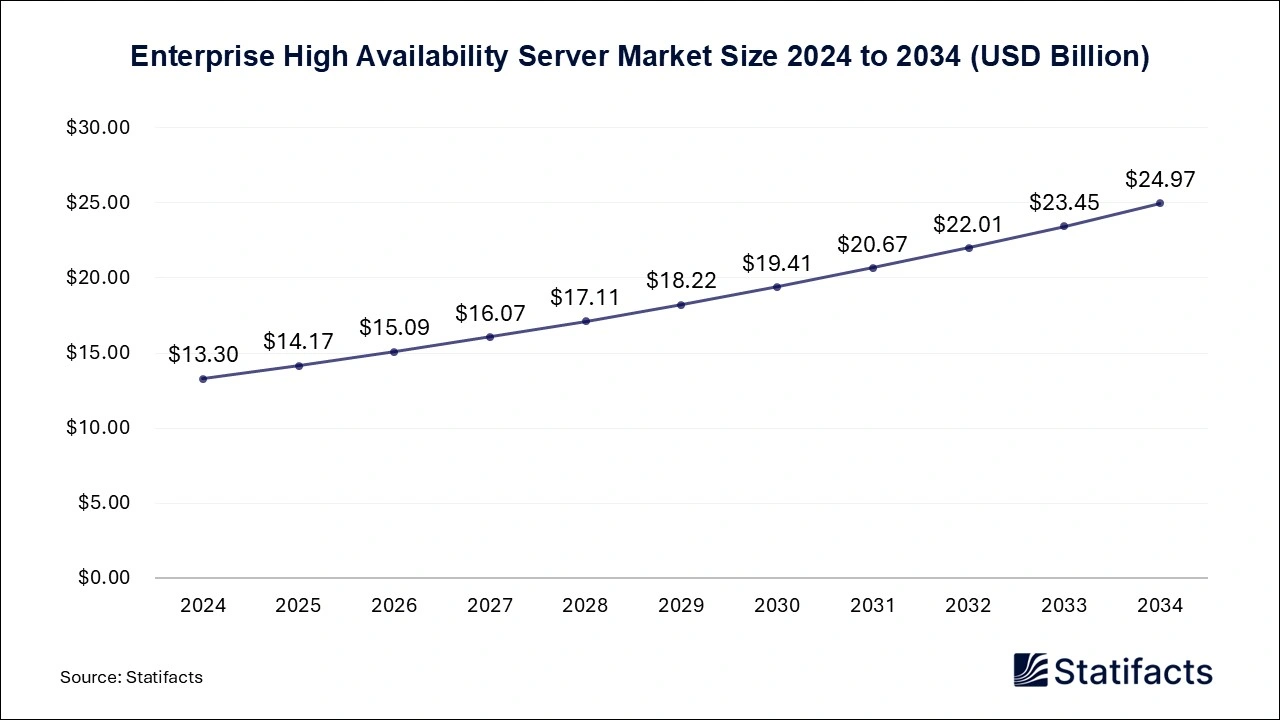
The global enterprise high availability server market size was valued at USD 14.17 billion in 2025, is projected to reach approximately USD 26.44 billion by 2035. This growth, driven by increasing data center expansion and demand for uninterrupted business operations, is expected at a CAGR of 6.44%.
| Reports Attributes | Statistics |
| Market Size in 2025 | USD 14.17 Billion |
| Market Size in 2026 | USD 15.09 Billion |
| Market Size in 2032 | USD 22.01 Billion |
| Market Size by 2035 | USD 26.44 Billion |
| CAGR 2026 to 2035 | 6.44% |
| Base Year | 2025 |
| Forecast Period | 2026 to 2035 |
The enterprise high-availability server market is expanding rapidly as organizations rely on continuous uptime for mission-critical operations, cloud computing, and digital transformation initiatives. High-availability (HA) servers are designed to minimize downtime by using redundant components, failover systems, and advanced clustering technologies that ensure consistent performance and data integrity. The growing adoption of cloud-based applications, edge computing, and AI-driven analytics has increased the pressure on enterprises to maintain 24/7 system reliability. Moreover, the proliferation of e-commerce platforms, financial services, and healthcare systems that require real-time data processing is fueling demand for robust HA server infrastructure.
However, high implementation costs, complex system integration, and power management challenges are key restraints to widespread adoption, particularly among small and medium-sized enterprises (SMEs). Additionally, maintaining cybersecurity across redundant systems and managing hardware lifecycle costs present ongoing challenges. Despite these factors, advancements in virtualization, load balancing, and software-defined infrastructure are creating new growth opportunities for scalable, energy-efficient HA solutions.
The enterprise high-availability server market is expected to grow more rapidly a artificial intelligence AI and automation become central to infrastructure management and failure prevention. Artificial intelligence enables predictive analytics to detect hardware faults and optimize workload distribution in real time, preventing unplanned downtime. Machine learning algorithms enhance capacity planning and performance optimization, ensuring efficient use of server resources. Furthermore, AI-powered orchestration platforms can automate failover processes and security responses, reducing human intervention and boosting reliability.
| Regions | Shares (%) |
| North America | 6.42% |
| Asia Pacific | 40.98% |
| Europe | 28.42% |
| LAMEA | 24.18% |
| Segments | Shares (%) |
| On-Premises Deployment | 29.85% |
| Cloud Deployment | 58.14% |
| Hybrid Deployment | 12.01% |
| Segments | Shares (%) |
| IT & Telecom | 39.10% |
| BFSI | 26.78% |
| Healthcare | 10.75% |
| Government | 8.69% |
| Others | 14.68% |





