

Share


Data Management Platform Market (By Data Type: First-party Data, Second-party Data, and Third-party Data; By Functionality: Data Collection, Data Integration, Data Analysis, Audience Segmentation, and Reporting & Analytics; By Deployment: Cloud and On-Premise; By Enterprise Size: Large Enterprises and Small & Medium Enterprises (SMEs); By End-use Outlook: Media & Entertainment, BFSI, Telecommunications, Travel & Hospitality, Government & Public Sector, Healthcare & Pharmaceuticals, Retail & E-commerce, and Others; By Region: North America, Europe, Asia Pacific, and LAMEA) Industry Size, Share, Growth, Trends 2025 to 2034

The global data management platform market, valued at USD 2.53 billion in 2024, is projected to reach approximately USD 8.07 billion by 2034. This strong growth, driven by rising demand for unified data insights and targeted digital marketing, is expected at a CAGR of 12.3%.
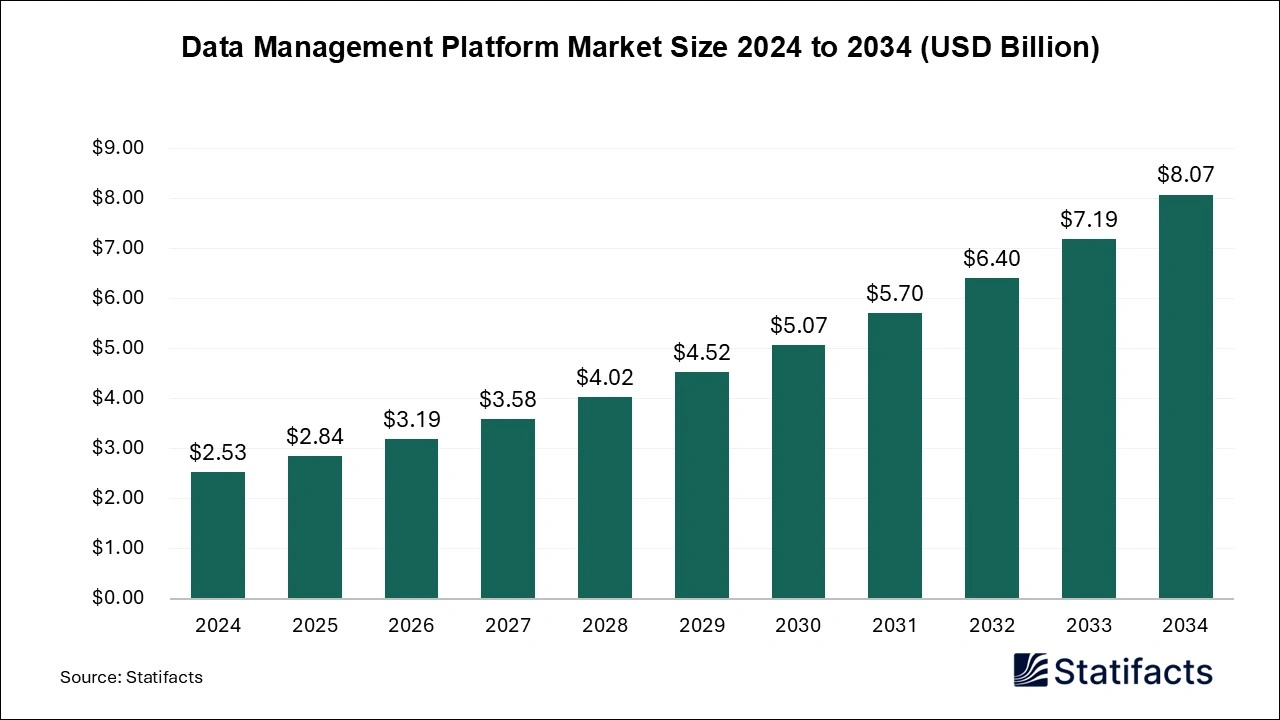
| Reports Attributes | Statistics |
| Market Size in 2024 | USD 2.53 Million |
| Market Size in 2025 | USD 2.84 Million |
| Market Size in 2031 | USD 5.7 Million |
| Market Size by 2034 | USD 8.07 Million |
| CAGR 2025 to 2034 | 12.3% |
| Base Year | 2024 |
| Forecast Period | 2025 to 2034 |
The data management platform market is gaining momentum as businesses increasingly prioritize collecting, organizing, and activating large volumes of data from multiple online and offline sources. Companies use data management platforms to centralize first, second, and third-party data and extract valuable insights for marketing and advertising. The growing digital transformation across industries has expanded data footprints from social media, e-commerce, and mobile applications, intensifying the need for effective platforms that can process and structure this information.
Digital advertising spending continues to grow as enterprises adopt programmatic and personalized advertising models. DMPs help marketers segment audiences and create targeted campaigns across channels such as web, mobile, and connected TV. The demand for real-time analytics and customer journey mapping is also propelling market adoption. Furthermore, integrating data management platforms with Customer Data Platforms (CDPs) and Demand-Side Platforms (DSPs) is creating a seamless ecosystem for end-to-end marketing management.
The introduction of cloud-based data management platforms has revolutionized the market by offering flexibility, scalability, and ease of integration with analytics and ad-tech tools. Cloud deployment has made it more feasible for mid-sized enterprises to access enterprise-grade data solutions without heavy infrastructure investments. Advancements in data encryption, API-based integration, and real-time processing are improving the efficiency and security of these systems.
Artificial intelligence and machine learning are being increasingly integrated into data management platforms to automate data classification, user segmentation, and predictive analytics. These technologies allow marketers to better understand customer intent, optimize ad spending, and deliver dynamic content based on behavior patterns. The evolution of AI-driven automation has also reduced the time required for audience analysis, thereby improving campaign speed and accuracy.
Despite strong growth drivers, the data management platform market faces challenges, including rising data privacy regulations such as GDPR in Europe and CCPA in California, which restrict data collection and use practices. The deprecation of third-party data and the move toward a cookieless digital environment are forcing data management platform vendors to rethink their approaches. Small enterprises often face high implementation costs and limited expertise in managing these complex platforms. In addition, data integration challenges between legacy systems and modern DMPs continue to slow full-scale adoption in certain industries.
Opportunities lie in developing privacy-compliant, first-party data-based data management platform solutions that emphasize transparency and user consent. Vendors focusing on hybrid DMP-CDP models are expected to gain a competitive advantage, as these platforms combine audience analytics with direct engagement capabilities. The adoption of contextual advertising, where ads are served based on content relevance rather than user data, is another emerging area for DMP innovation.
Cross-industry demand from retail, BFSI, healthcare, and media sectors also provides new growth avenues. Retailers use data management platforms for omnichannel personalization, banks for risk analysis, and healthcare providers for patient outreach analytics. As enterprises increasingly seek unified data views to improve the customer experience, data management platform vendors that offer vertical-specific customization are likely to stand out.
AI is redefining how data management platforms function. Through machine learning algorithms, data management platforms can now identify micro-segments of users and predict their preferences based on interaction patterns. Natural language processing helps extract meaning from unstructured data such as reviews, comments, and social posts. Predictive analytics tools are enabling real-time decision-making, improving conversion rates, and optimizing digital ad performance.
The combination of AI and automation is also helping data management platforms comply with evolving privacy standards. By using AI-powered consent management and anonymization tools, vendors can balance personalization with user privacy. This dual advantage positions AI as a foundational technology in the next phase of DMP evolution.
| Regions | Shares (%) |
| North America | 36% |
| Asia Pacific | 26% |
| Europe | 30% |
| LAMEA | 8% |
| Segments | Shares (%) |
| First-party Data | 55% |
| Second-party Data | 15% |
| Third-party Data | 30% |
| Segments | Shares (%) |
| Data Collection | 18% |
| Data Integration | 17% |
| Data Analysis | 22% |
| Audience Segmentation | 23% |
| Reporting and Analytics | 20% |
| Segments | Shares (%) |
| Cloud |
70% |
| On-Premise | 30% |
| Segments | Shares (%) |
| Large Enterprises |
60% |
| Small and Medium Enterprises | 40% |
| Segments | Shares (%) |
| Media & Entertainment |
22% |
| BFSI | 14% |
| Telecommunications | 13% |
| Travel & Hospitality | 8% |
| Government & Public Sector | 9% |
| Healthcare & Pharmaceuticals | 10% |
| Retail & E-commerce | 18% |
| Others | 6% |
Published by Yogesh Kulkarni





