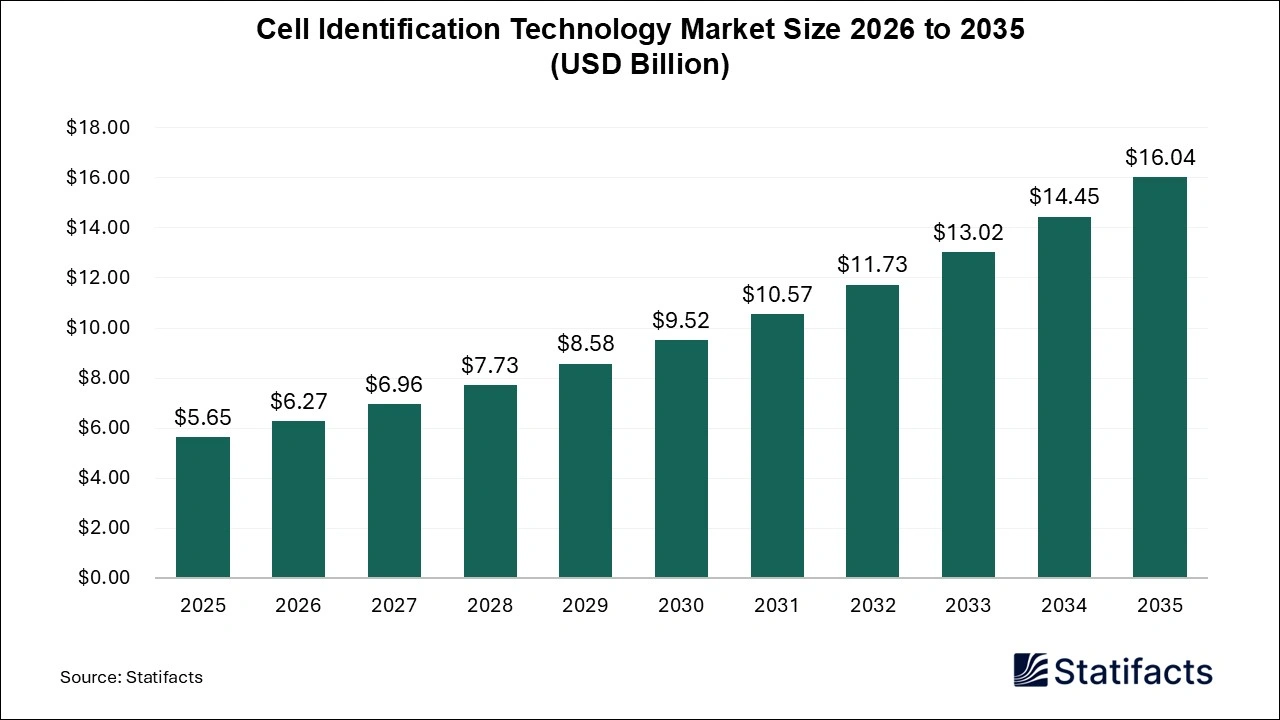
The global cell identification technology market is projected to grow from USD 5.65 billion in 2025 to USD 16.04 billion by 2035, reflecting a strong CAGR of 11%. This growth is driven by advancements in biomedical research, diagnostics, and personalized medicine.
Cell Identification Technology Market Statical Scope
| Reports Attributes |
Statistics |
| Market Size in 2025 |
USD 5.65 Billion |
| Market Size in 2026 |
USD 6.27 Billion |
| Market Size in 2032 |
USD 11.73 Billion |
| Market Size by 2035 |
USD 16.04 Billion |
| CAGR 2026 to 2035 |
11% |
| Base Year |
2025 |
| Forecast Period |
2026 to 2035 |
The cell identification technology market is expected to grow from USD 5.61 billion in 2025, with a satisfying CAGR of 11%. This growing rise and encouragement come from the heavy demand for NGS and modernized flow cytometry. The tech innovations are accelerating the market growth and signalling the right direction to practice precision.
Cell identification is a technology introducing a robust technique to address a single base station near the wireless communication network. The use of various cellular systems is essential for network management, service rendering (on location), and connectivity.
The convincing components aligned best with the functionality, giving remarkable results in cell identification. The healthcare sector is experiencing advancements, and so this market is a result of the existing advancements, like precision medicine, and support for the new tech integration. The rapid drug discovery and development volume attracts massive investments and business in this market.
Cell Identification Technology Market Share, By Region, 2025 (%)
| Regions |
Shares (%) |
| North America |
41% |
| Europe |
24% |
| Asia-Pacific |
22% |
| Latin America |
7% |
| Middle East & Africa |
6% |
- North America – North America retains its position in this market with the highest of 41% of market share due to its consistent value to modernized methods such as flow cytometry and single-cell analysis. The regional market earns heavy profit with the internal collaborations, expanding smart approaches to the vast market.
- Europe – Europe grows with 24% of market share, with its commendable transition in the modern therapies and personalized medicine. The regulatory encouragement for adopting the advanced biotechnology spectrum is fuelling more growth in the regional market.
- Asia-Pacific – Asia-Pacific covers 22% of the market share with its proficiency in CGT trial activities and government support. The rising chronic conditions mark honest government funding and support for the healthcare infrastructure.
- Latin America – Latin America held 7% of market share with its emerging efforts for practicing transitions in cell identification technology, alongside government initiatives backing the possible launches in the regional market.
- Middle East & Africa – MEA has reserved 6% of its market share with the rising expectation from the UAE for expansion and adoption of the cell identification technology. While the healthcare infrastructure stands as a plus point for the regional market to rise.
Cell Identification Technology Market Share, By Product & Service, 2025 (%)
| Segments |
Shares (%) |
| Reagents & Consumables |
42% |
| Instruments |
30% |
| Software |
13% |
| Services |
15% |
- Reagents & Consumables - Holding a dominating position with 42% market share due to its high demand and repeated use for cell identification.
- Instruments – The instruments segment acquires 30% of the market share with its higher potency and efficiency, supporting the existing automation and robust technologies like modern imagers and spectral flow cytometers.
- Software – The software as a product cooperates best with the new technologies like ML and AI, confirming 13% of market share as the increase in single-cell analysis has increased, and so the software operation has doubled.
- Services – The growing demand for data analysis and specialized testing, mainly in clinical research and pharmaceutical settings, has marked 15% of market share for this segment. The rising investments in market trends drive more business to services.
Cell Identification Technology Market Share, By Technology, 2025 (%)
| Segments |
Shares (%) |
| Flow Cytometry |
37% |
| PCR |
16% |
| Microscopy |
14% |
- Flow Cytometry – The flow cytometry technology held 37% of the market share due to its decades of potential in general single-cell counting operations. The evolution into a multi-parametric technology has commendable potential and is a reason for this segment to rise.
- PCR – The PCR technology has strengthened research and molecular diagnostics with its particular and careful detection of genetic variations, abnormal cells and microorganisms. The segment acquires 16% of the market share with the same specification and capability.
- Microscopy – This segment covers 14% of the market share with its smart analyzation including AI-powered analysis, 3D advancement and quick service for cell identification. This is a huge support to the researchers seeking internal components of cells.
Cell Identification Technology Market Share, By Application, 2025 (%)
| Segments |
Shares (%) |
| Disease Diagnosis |
36% |
| Drug Discovery & Development |
18% |
| Cancer Research |
15% |
- Disease Diagnosis – The growing number of diagnoses is promoting remarkable unification of AI, single-cell genomics and DHM, which helps the segment acquire 36% of market share. This is bringing more automation to the existing system.
- Drug Discovery & Development – The rapid drug discovery and development bridge the need for cell identification technology in the research and clinical setting. The growing prevalence of severe health conditions welcomes tech-driven solutions embarking with 18% of market share journey in this market.
- Cancer Research – This segment has come into focus with rising cancer cases and a spectacular advancement in the oncology sector, with 15% of the market share. The single-cell identification technologies are a major boost to the segmental growth.
Cell Identification Technology Market Share, By End-use, 2025 (%)
| Segments |
Shares (%) |
| Pharmaceutical & Biotechnology Companies |
41% |
| Hospitals & Clinical Testing Laboratories |
27% |
| Academic & Research Institutes |
22% |
- Pharmaceutical & Biotechnology Companies – The growing automated methods, technologies integration and smart collaborations drive the segmental growth with the highest of 41% of market share.
- Hospitals & Clinical Testing Laboratories – The second largest rise of 27% of market share to this segment is due to consistent molecular demand for precision medicine. AI and automation involvement are a boost to the segmental growth.
- Academic & Research Institutes – The heavy adoption of technologies and NGS solutions, mainly in universities are attracting more demand for precision treatment of genomic-based conditions. The segment held 22% of the market share.
Published by
Deepa Pandey