

Share


Capsule Endoscopy Market (By Type: CMOS Photosensitive Chip, CCD Photosensitive Chip, and Others; By Application: For Small Intestine, For Visualization of the Colon, For Stomach, and Other (For Esophagus, etc.); By Region: North America, Europe, Asia Pacific, and LAMEA) Industry Size, Share, Growth, Trends 2026 to 2035

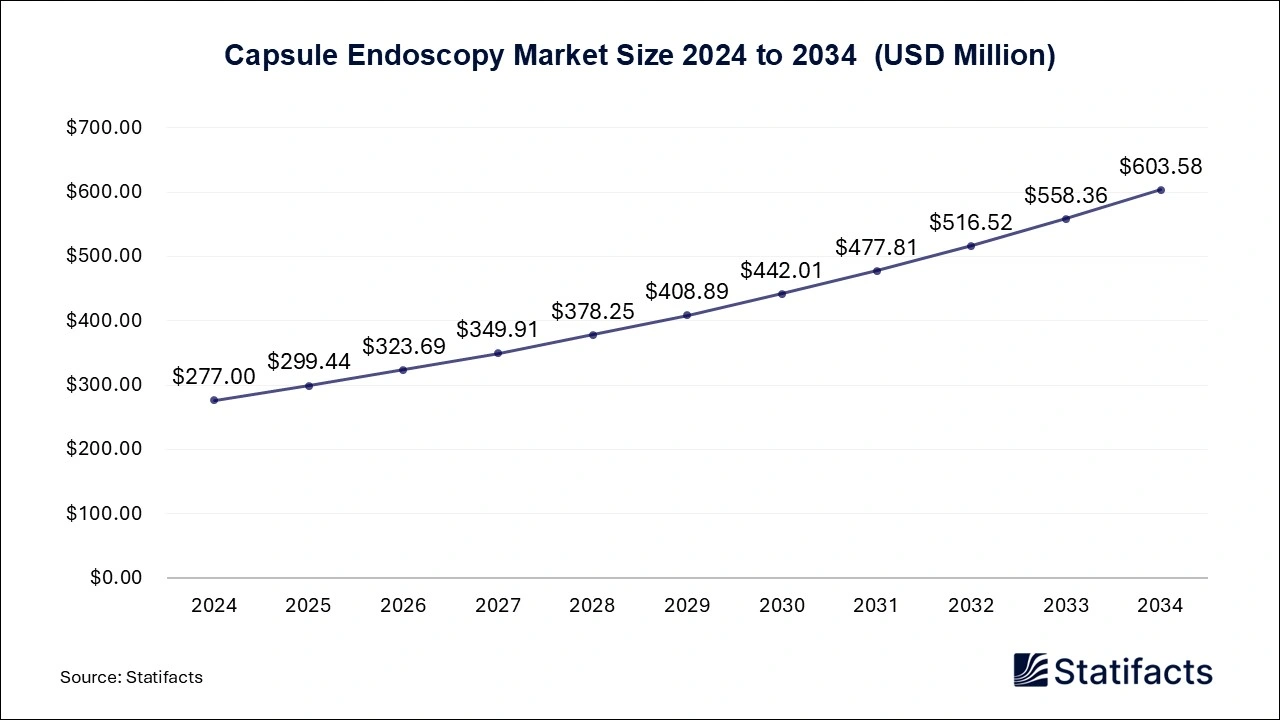
The global capsule endoscopy market, valued at USD 299.44 million in 2025, is projected to reach approximately USD 646.55 million by 2035. This growth, driven by advancements in non-invasive diagnostics and increasing prevalence of gastrointestinal diseases, is expected at a CAGR of 8%.
| Reports Attributes | Statistics |
| Market Size in 2025 | USD 299.44 Million |
| Market Size in 2026 | USD 323.69 Million |
| Market Size in 2032 | USD 516.52 Million |
| Market Size by 2035 | USD 646.55 Million |
| CAGR 2026 to 2035 | 8% |
| Base Year | 2025 |
| Forecast Period | 2026 to 2035 |
The capsule endoscopy market is emerging at a significant pace due to the growing focus on improving visualization for gastrointestinal disorders, including bleeding, small bowel disorders, colorectal cancer, and other related conditions. Capsule endoscopy refers to a non-invasive diagnostic procedure in which the patient swallows a capsule containing a built-in camera that captures thousands of images of the small intestine. The key objective behind the innovation of this technology is to reach areas of the gastrointestinal tract where traditional endoscopy is less effective. The rising incidence of Crohn’s disease has been one of the major factors attracting investment in the endoscopy equipment market. For instance, data from the National Institutes of Health revealed that around one million people in the United States suffer from Crohn’s disease, creating a strong need for advanced diagnostic procedures.
Capsule technology has become one of the most discussed topics in the healthcare sector, although it presents some challenges such as limited control compared to traditional procedures, which can restrict its ability to achieve desired diagnostic outcomes. Additionally, budget-constrained regions continue to lag in adoption due to limited funding from authorities and a lack of awareness among healthcare providers and patients. These financial and knowledge barriers remain key challenges to large-scale implementation, particularly in developing countries.
The rising R&D focus from healthcare authorities and private organizations is expected to help the capsule endoscopy market improve regulatory approval and accelerate adoption in emerging economies. The ongoing development of multi-camera capsules with 3D imaging capabilities aims to address the limitations of current technologies, enhancing accuracy and diagnostic range. This innovation is expected to create multiple opportunities for new manufacturers entering the market. One of the most promising developments in capsule endoscopy is the introduction of remote diagnostic capabilities, which allow at-home and distance-based testing. These capsules can transmit data directly to professionals without requiring physical presence, improving access to quality diagnostics in regions with limited healthcare infrastructure.
The increasing integration of Artificial Intelligence (AI) and Machine Learning (ML) in healthcare systems is also expected to enhance diagnostic accuracy through advanced image analysis. These technologies enable faster and more precise identification of abnormalities compared to traditional manual methods. The application of AI-driven algorithms helps in filtering and classifying images efficiently, reducing review time and supporting better clinical decision-making. In capsule endoscopy, this leads to improved detection of gastrointestinal bleeding, polyps, and other abnormalities while saving time for both clinicians and patients.
Emerging countries in the Asia Pacific region are expected to witness substantial growth in the coming years, driven by strong government support for healthcare modernization and technological innovation. Increasing healthcare expenditure, expanding digital infrastructure, and ongoing medical device advancements are further contributing to the market’s growth in the region. As awareness of non-invasive diagnostic methods rises and technology becomes more affordable, capsule endoscopy is expected to become a standard diagnostic tool for gastrointestinal evaluation worldwide.
| Regions | Shares (%) |
| North America | 23.10% |
| Asia Pacific | 16.64% |
| Europe | 30.86% |
| LAMEA | 29.40% |
| Segments | Shares (%) |
| CMOS Photosensitive Chip | 29.85% |
| CCD Photosensitive Chip | 58.14% |
| Others | 12.01% |
| Segments | Shares (%) |
| For Small Intestine | 16.20% |
| For Visualization of the Colon | 37.84% |
| For Stomach | 27.88% |
| Other(For Esophagus, etc.) | 18.08% |
Published by Ajit Bansod





